

This guide explains how to increase fiber after 50 using ordinary foods, practical substitutions, simple meals, and realistic daily habits. It does not prescribe a personalized fiber target or treat a medical condition.
What Is the Easiest Way to Add More Fiber After 50?
Use these five changes first:
- Choose whole fruit more often instead of juice.
- Add beans or lentils to soups, salads, bowls, and main dishes.
- Replace refined grains with whole-grain bread, brown rice, oatmeal, barley, or whole-grain pasta.
- Add vegetables to meals you already eat.
- Include nuts or seeds with appropriate meals or snacks.
The key is gradual change. A sudden large increase in fiber can cause gas, bloating, or abdominal discomfort. MedlinePlus recommends increasing fiber slowly rather than adding a large amount all at once.
How Much Fiber Should You Get After 50?
There is not one universal number that applies to every adult. Fiber guidance is commonly expressed relative to energy intake: 14 grams of fiber per 1,000 calories.
| Daily calorie intake | Fiber at 14 g per 1,000 calories |
|---|---|
| 1,500 calories | About 21 g |
| 1,800 calories | About 25 g |
| 2,000 calories | About 28 g |
| 2,200 calories | About 31 g |
| 2,500 calories | About 35 g |
These are mathematical examples, not personalized calorie or fiber prescriptions. Individual nutritional needs vary with factors such as age, sex, activity, and overall dietary requirements. NIA emphasizes that calorie and food-group needs vary between individuals.
Which Foods Have the Most Fiber?
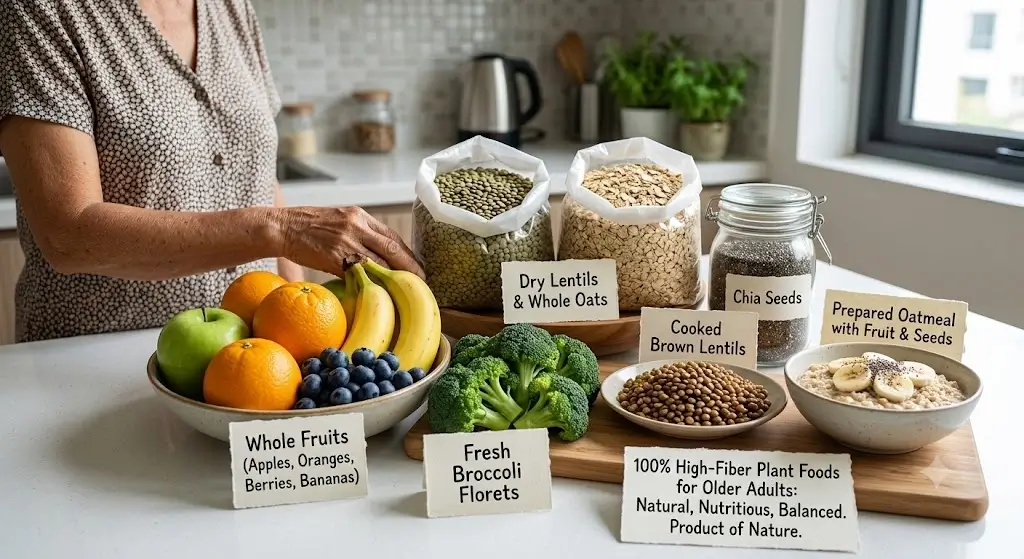
The easiest way to increase fiber is to eat a greater variety of naturally fiber-rich plant foods.
| Food group | Examples | Easy ways to use them |
|---|---|---|
| Beans and legumes | Black beans, kidney beans, chickpeas, lentils, peas | Soups, salads, tacos, bowls |
| Fruit | Apples, pears, berries, oranges, bananas | Breakfast, snacks, yogurt |
| Vegetables | Broccoli, carrots, peas, squash, potatoes with skin | Soups, sides, bowls, stir-fries |
| Whole grains | Oats, brown rice, barley, whole-wheat bread, whole-grain pasta | Breakfast, sandwiches, dinner |
| Nuts and seeds | Almonds, walnuts, peanuts, chia, flax | Yogurt, oatmeal, salads, snacks |
NIA identifies vegetables, beans, peas, fruits, and whole grains as important sources of fiber. For ideas on combining fiber-rich plant options with protein, see our guide to high-protein foods for adults over 50.
Should You Increase Fiber Gradually?
Yes. Gradual increases are generally easier to tolerate than suddenly doubling fiber intake.
If your current diet contains relatively little fiber, adding large amounts of beans, bran, vegetables, and whole grains at once may lead to gas, bloating, cramps, or changes in bowel habits. MedlinePlus recommends increasing fiber slowly and notes that digestive symptoms often improve as the body adapts.
A practical progression is:
| Stage | What to do |
|---|---|
| Start | Add one fiber-rich food to one meal each day |
| Next | Add fruit or vegetables to another meal |
| Then | Replace one refined grain with a whole grain |
| Build | Include beans, lentils, nuts, or seeds regularly |
| Maintain | Vary your fiber sources throughout the week |
How Can You Add Fiber at Breakfast?

Breakfast is one of the easiest meals at which to make a high-fiber substitution.
- Choose oatmeal instead of a low-fiber refined breakfast.
- Add berries or another whole fruit to yogurt.
- Add nuts or seeds to oatmeal.
- Choose whole-grain toast instead of refined white bread.
- Add fruit to a breakfast smoothie.
- Combine whole-grain cereal with fruit and nuts.
You do not need to make breakfast dramatically larger. Often, simply changing the type of grain or adding fruit is enough to increase fiber.
How Can You Add Fiber at Lunch?
Lunch can gain fiber through vegetables, beans, whole grains, and whole fruit.
| Common lunch | Higher-fiber adjustment |
|---|---|
| White-bread sandwich | Whole-grain bread + vegetables |
| Chicken sandwich | Chicken + whole-grain bread + avocado + vegetables |
| Plain soup | Bean or lentil vegetable soup |
| Crackers | Whole-grain crackers + hummus |
| Fruit juice | Whole fruit |
Whole fruit is particularly useful because it contributes fiber that is reduced or absent when fruit is consumed primarily as juice. Dietary guidance recommends that most fruit intake come from whole fruit rather than juice. For actionable daytime recipes, explore our collection of healthy lunch ideas for older adults.
How Can You Add Fiber at Dinner?
Dinner provides many opportunities to increase fiber without creating a completely different meal.
- Add beans to tacos, chili, soups, or grain bowls.
- Serve a vegetable with the main meal.
- Use brown rice or another whole grain.
- Choose whole-grain pasta when practical.
- Leave edible skins on potatoes and other suitable produce after washing.
- Add vegetables to pasta sauces, soups, and stews.
A simple dinner formula is:
Protein + vegetables + whole grain or legumes + healthy fat when appropriate.
Are Beans and Lentils Good Ways to Increase Fiber?
Yes. Beans and lentils are among the most practical foods for increasing fiber because they can contribute both fiber and plant protein.
Useful choices include:
- Black beans
- Kidney beans
- Chickpeas
- Navy beans
- Lentils
- Split peas
- Soybeans
Use them in:
- Bean soups
- Lentil soups
- Chili
- Tacos
- Grain bowls
- Salads
- Bean spreads
If canned beans are more convenient, rinse them before use when appropriate. This can help remove some of the liquid and may reduce sodium depending on the product.
Are Fruits a Good Way to Add More Fiber?
Yes. Whole fruit is one of the easiest fiber additions because it usually requires little preparation.
Good everyday choices include:
- Apples
- Pears
- Berries
- Oranges
- Bananas
- Peaches
- Plums
When edible skins are normally eaten, keeping the skin on can provide additional fiber. Wash produce thoroughly before eating. NIA specifically notes that eating fruits with their skins can provide more fiber.
Are Vegetables an Easy Way to Increase Fiber?
Yes. Vegetables can be added to foods you already eat rather than treated as a separate side dish.
- Add spinach to eggs.
- Add broccoli to stir-fries.
- Add carrots and celery to soup.
- Add peppers and onions to tacos.
- Add mushrooms to pasta.
- Add frozen vegetables to rice bowls.
- Add leafy greens to sandwiches.
Fresh, frozen, and canned vegetables can all contribute to a fiber-rich eating pattern. The best option is often the one that is affordable, available, and easy enough to use consistently.
Should You Switch From White Bread to Whole-Grain Bread?
For many people, this is one of the easiest fiber upgrades.
Instead of changing the entire meal, keep the same sandwich filling and switch the bread.
| Lower-fiber choice | Possible higher-fiber alternative |
|---|---|
| White bread | Whole-grain bread |
| Refined crackers | Whole-grain crackers |
| White rice | Brown rice or another whole grain |
| Refined pasta | Whole-grain pasta |
| Sugary low-fiber cereal | Oatmeal or higher-fiber whole-grain cereal |
MedlinePlus specifically recommends choosing whole-grain products over refined grains when increasing fiber.
How Can You Add Fiber Without Eating More Food?
Use substitutions rather than simply adding extra food to every meal.
- Replace juice with whole fruit.
- Replace white bread with whole-grain bread.
- Replace white rice with brown rice.
- Replace refined crackers with whole-grain crackers.
- Add beans to part of a meat-based dish.
- Add vegetables to soups and sauces.
- Add berries to yogurt instead of a sweetened topping.
This approach can increase fiber while keeping the overall meal structure familiar.
How Can You Add Fiber to Snacks?
Snacks are another simple opportunity.
- Apple + peanut butter
- Pear + unsalted nuts
- Berries + plain yogurt
- Carrots + hummus
- Whole-grain crackers + cheese
- Banana + nuts
- Whole-grain toast + avocado
- Oatmeal + berries
Combining a fiber-rich food with protein or healthy fat can make a snack more substantial without requiring complicated preparation.
How Much Water Should You Drink When Increasing Fiber?

Clinical Fluid Caution: While adequate hydration helps dietary fiber move smoothly through the digestive tract, individuals managing congestive heart failure, chronic kidney disease (CKD), or severe edema must strictly adhere to their nephrologist’s or cardiologist’s daily fluid prescription.
Do not increase fiber while ignoring fluids. Fiber interacts with water in the digestive system, and insufficient fluid intake can make constipation worse for some people.
MedlinePlus recommends drinking plenty of fluids when increasing dietary fiber and specifically warns that insufficient fluid can worsen constipation.
There is no single fluid amount appropriate for everyone. People with conditions requiring fluid restriction should follow their healthcare professional’s guidance rather than increasing fluid intake on their own.
What If More Fiber Causes Gas or Bloating?
The first step is usually to slow the rate of increase rather than abandoning fiber altogether.
Common reasons for discomfort include:
- Increasing fiber too quickly
- Adding very large portions of beans or legumes suddenly
- Not drinking enough fluids
- Changing several dietary habits at once
Reduce the pace, allow your digestive system time to adapt, and increase gradually. MedlinePlus notes that gas and bloating can occur when fiber intake rises too quickly.
Should You Use Fiber Supplements?
Food is generally the preferred starting point for increasing dietary fiber. Whole foods provide fiber along with other nutrients and components of a varied eating pattern.
MedlinePlus notes that people with a balanced diet generally do not need a fiber supplement and that some fiber-fortified products or supplements may cause additional gas or bloating.
Fiber supplements can have specific uses, but whether one is appropriate depends on the person and the reason for using it. They should not automatically replace fiber-rich foods.
What Is the Difference Between Soluble and Insoluble Fiber?
Fiber is commonly described as soluble or insoluble based on how it behaves in water and during digestion.
| Type | Examples | General characteristics |
|---|---|---|
| Soluble fiber | Oats, barley, beans, lentils, some fruits | Absorbs water and forms a gel-like material during digestion |
| Insoluble fiber | Whole grains, wheat bran, many vegetables | Adds bulk and tends to speed movement through the digestive tract |
Many foods contain a mixture of fiber types. You do not need to calculate the soluble-to-insoluble ratio to eat a fiber-rich diet.
How Can You Add Fiber If You Have Limited Cooking Energy?
Fiber-rich eating does not require elaborate cooking.
| Preparation barrier | Lower-effort fiber solution |
|---|---|
| Chopping | Pre-cut vegetables or ready-to-eat fruit |
| Cooking beans | Canned beans or lentils |
| Cooking grains | Pre-cooked brown rice or other whole grains |
| Washing produce | Prepared produce when appropriate |
| Long meal preparation | Simple grain bowls, oatmeal, hummus plates, or bean soups |
NIA specifically recommends pre-cut fruits and vegetables when slicing and chopping are difficult and encourages planning around realistic preparation time.
How Can You Add Fiber When Cooking for One?
Cooking for one can make fiber-rich eating easier if you rely on ingredients that work across several meals.
For example:
- Cook or open beans for tacos, salads, and grain bowls.
- Keep several types of fruit available.
- Use frozen vegetables to avoid produce waste.
- Prepare a small batch of whole grains.
- Keep oatmeal available for quick breakfasts.
- Use nuts and seeds in small portions.
For a broader approach to building meals around one-person portions and reducing food waste, see Healthy Meal Planning for One Person.
How Can You Add More Fiber to an Already Healthy Diet?
You do not necessarily need to redesign your entire diet. Look for the lowest-fiber parts of your existing meals and make one substitution at a time.
Example:
White toast at breakfast → whole-grain toast.
Juice at lunch → whole fruit.
White rice at dinner → brown rice.
Chips as a snack → nuts or vegetables with hummus.
These small changes can gradually shift the overall dietary pattern toward more fiber.
What Is a Simple One-Day High-Fiber Eating Pattern?
| Meal | Example | Fiber sources |
|---|---|---|
| Breakfast | Oatmeal + berries + nuts | Oats, berries, nuts |
| Lunch | Chicken and bean whole-grain wrap + vegetables | Beans, whole grains, vegetables |
| Snack | Apple + peanut butter | Apple, peanut |
| Dinner | Salmon + brown rice + broccoli | Brown rice, broccoli |
This is an example of food combinations, not a prescribed meal plan. Portions should be appropriate for the individual’s overall nutritional needs.
What Are the Biggest Mistakes When Increasing Fiber After 50?
- Increasing fiber too quickly: this can cause unnecessary digestive discomfort.
- Focusing on one food: variety is better than relying on bran, one fruit, or one vegetable.
- Forgetting fluids: adequate fluid intake is important when increasing fiber.
- Assuming every packaged “high-fiber” product is ideal: check the complete Nutrition Facts label.
- Replacing meals with fiber supplements: whole foods provide additional nutrients.
- Ignoring individual dietary restrictions: some medical conditions require a different approach.
- Making too many changes at once: gradual substitutions are easier to maintain.
How Can You Check Whether a Packaged Food Is High in Fiber?
Use the Nutrition Facts label.
NIA notes that the Daily Value information on food labels is not calculated specifically for older adults, so the label should be considered as part of the entire eating pattern. It also notes that many older adults do not consume recommended amounts of dietary fiber.
When comparing similar foods, look at:
- Fiber per serving
- Serving size
- Added sugars
- Sodium
- Saturated fat
- Ingredient list
A food does not become a healthy choice simply because the package prominently advertises its fiber content.
When Should You Talk With a Healthcare Professional About Increasing Fiber?
Increasing fiber through ordinary foods is appropriate for many healthy adults, but it is not suitable to assume that more fiber is always better in every medical situation.
Talk with a healthcare professional before making major dietary changes if you have been prescribed a low-fiber diet, have significant or persistent digestive symptoms, have difficulty swallowing, have unexplained changes in bowel habits, or have a medical condition requiring specific dietary restrictions.
For example, some gastrointestinal conditions may require temporary adjustments in fiber intake. A personalized plan should follow the advice of the healthcare professional managing that condition.
7 Simple Fiber Habits to Start This Week
- Eat one piece of whole fruit instead of juice.
- Choose whole-grain bread for one meal.
- Add vegetables to lunch.
- Include beans or lentils in one dinner.
- Add berries or fruit to breakfast.
- Keep nuts or seeds available for a simple snack.
- Increase fiber gradually while maintaining adequate fluid intake.
Once these habits become routine, add another change rather than attempting a complete dietary overhaul.
How Does More Fiber Fit Into Healthy Eating After 50?
Fiber is one part of a broader healthy eating pattern. A nutritious diet after 50 also needs adequate protein, a variety of vegetables and fruits, whole grains, appropriate fats, and sufficient fluids.
The objective is therefore not to maximize fiber at the expense of everything else. Instead, choose more fiber-rich foods while maintaining variety and meeting overall nutritional needs. For a structured look at building a complete plate, review our foundational guide to healthy eating after 50.
Fiber Increase Checklist
- ☐ Add one fiber-rich food at a time.
- ☐ Eat whole fruit regularly.
- ☐ Include vegetables at meals.
- ☐ Eat beans or lentils regularly.
- ☐ Choose whole grains more often.
- ☐ Include nuts or seeds when appropriate.
- ☐ Increase fiber gradually.
- ☐ Drink adequate fluids.
- ☐ Read Nutrition Facts labels.
- ☐ Choose a variety of fiber sources.
- ☐ Slow down if increased fiber causes significant digestive discomfort.
Frequently Asked Questions
What is the easiest way to get more fiber after 50?
Start with whole fruit, vegetables, beans or lentils, whole grains, and nuts or seeds. Making one substitution at a time is usually easier than changing the entire diet.
How much fiber should adults over 50 eat?
A commonly used guideline is 14 grams of fiber per 1,000 calories. The appropriate amount depends on total energy intake and individual nutritional needs.
What foods are highest in fiber?
Beans, lentils, peas, vegetables, fruits, whole grains, nuts, and seeds are important natural sources of dietary fiber.
Should fiber be increased slowly?
Yes. Increasing fiber gradually can reduce gas, bloating, and abdominal discomfort. MedlinePlus recommends a slow increase rather than adding a large amount at once.
Should you drink more water when increasing fiber?
Adequate fluid intake is important when increasing fiber. Insufficient fluids can make constipation worse for some people. People with fluid restrictions should follow their healthcare professional’s instructions.
Are beans good for increasing fiber?
Yes. Beans and lentils are practical sources of both fiber and plant protein and can be added to soups, salads, tacos, chili, and grain bowls.
Is fruit better than fruit juice for fiber?
Whole fruit generally provides more fiber than juice. Dietary guidance recommends that most fruit intake come from whole fruit rather than juice.
Are whole grains better for fiber?
Generally, yes. Whole-grain foods retain more of the grain components that contribute fiber than refined grains. Examples include oatmeal, brown rice, barley, and whole-grain bread.
What if eating more fiber causes gas?
Slow down the increase. Large, sudden increases in fiber can cause gas and bloating. Allow your digestive system time to adapt and make changes gradually.
Do older adults need fiber supplements?
Not necessarily. Whole foods are generally the preferred starting point because they provide fiber along with other nutrients. A healthcare professional can determine whether a supplement is appropriate for a specific situation.
Can you get too much fiber?
Very large increases can cause gas, bloating, cramps, and other digestive symptoms. The practical goal is an appropriate amount from a varied diet, not simply the highest possible intake.
What is one easy high-fiber breakfast?
Oatmeal topped with berries and nuts is a simple example. Other options include whole-grain toast with fruit or whole-grain cereal with berries.
What is one easy high-fiber dinner?
A bean-and-vegetable bowl with brown rice is an easy example. Lentil soup, bean chili, and whole-grain pasta with vegetables are other practical choices.
The Bottom Line
Adding more fiber after 50 is best approached as a series of small food substitutions, not a sudden diet overhaul.
Start with whole fruit, vegetables, beans, lentils, whole grains, nuts, and seeds. Increase the amount gradually, maintain adequate fluid intake, and vary your sources instead of relying on a single “high-fiber” food.
The most sustainable fiber strategy is simple: make the higher-fiber choice the easier choice you can repeat every day.
Editorial Methodology
This guide uses an evidence-first approach based primarily on guidance from the National Institute on Aging, MedlinePlus, and U.S. dietary guidance. Fiber recommendations are presented as general nutrition information rather than individualized medical advice. Where medical conditions can change dietary requirements, the article recommends individualized guidance from a qualified healthcare professional.
Sources
- National Institute on Aging (NIA) — Healthy Eating, Nutrition, and Diet for Older Adults
- National Institute on Aging (NIA) — Know Your Food Groups: Fruits, Vegetables, and Grains
- National Library of Medicine / MedlinePlus — Dietary Fiber and Digestive Health
- U.S. Department of Agriculture (USDA) / HHS — Dietary Guidelines for Americans
- Food and Drug Administration (FDA) — Interactive Nutrition Facts Label: Dietary Fiber
Editorial standard: AgingWellGuide distinguishes general consumer nutrition advice from clinical medical nutrition therapy. Fiber recommendations emphasize realistic pacing, minimally processed whole foods, and clear safety cautions for individuals with digestive or fluid-restricted health conditions.
