
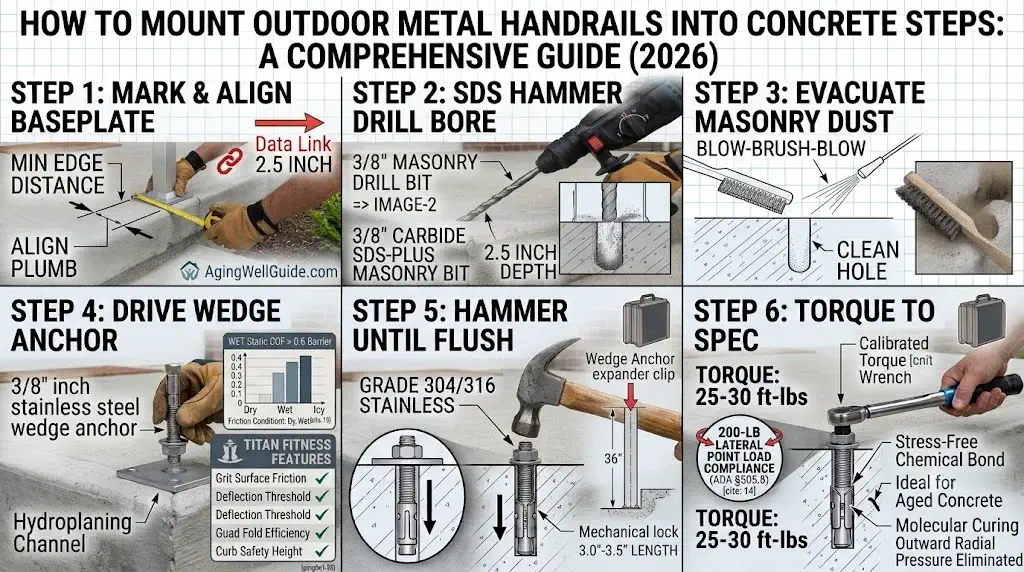
How to Mount Outdoor Metal Handrails into Concrete Steps
Engineering Ground Truth: Concrete Anchoring & Handrail Stability
Learning how to mount outdoor metal handrails into concrete steps requires mechanical fastening that resists a continuous 200-pound concentrated load applied in any direction per ADA Section 505.8 and IBC Section 1607.8. The reliable installation standard demands drilling clean, perpendicular holes with an SDS-plus rotary hammer drill and seating 3/8-inch 304/316 stainless steel wedge anchors with a minimum embedment depth of 2.0 inches. To prevent concrete spalling and blowout failure, all fastener holes must maintain an edge clearance distance of at least 2.5 inches from step nosings. For aged or crumbling aggregate concrete, two-part structural epoxy anchoring replaces expansion anchors to eliminate lateral outward hoop stresses.
- Critical Edge Safety: Drilling closer than 2.5 inches to stair corners causes radial concrete cracking during mechanical anchor expansion.
- Corrosion Resistance: Carbon steel fasteners oxidize rapidly outdoors; use Grade 304 or 316 stainless steel wedge anchors exclusively.
- Code Grip Ergonomics: Rail diameter must measure between 1.25 and 2.0 inches OD, installed between 34 and 38 inches above step tread nosing.
Quick Reference Specification: Concrete Handrail Fastener Matrix and Tooling
The technical specification matrix below outlines the verified fastener dimensions, drill bit diameters, hole depths, and mechanical torque ratings for mounting outdoor metal handrails to concrete steps:
| Fastener Parameter | Solid Cured Concrete (Wedge Anchor) | Aged / Fractured Concrete (Chemical Epoxy) |
|---|---|---|
| Anchor Bolt Diameter | 3/8-inch (9.5 mm) Wedge Anchor | 3/8-inch to 1/2-inch Threaded Rod |
| Minimum Embedment | 2.0 inches (50.8 mm) Depth | 3.0 inches (76.2 mm) Depth |
| Masonry Drill Bit Size | 3/8-inch SDS-Plus Carbide Bit | 7/16-inch or 9/16-inch SDS-Plus Bit |
| Minimum Edge Distance | 2.5 inches (63.5 mm) from tread lip | 1.75 inches (Epoxy exerts zero hoop stress) |
| Required Installation Torque | 25 to 30 ft-lbs (34 to 41 Nm) | Snug hand-tight + 1/4 turn after full cure |
| Material Grade | 304 / 316 Marine Stainless Steel | Zinc-Plated B7 Rod or Stainless Steel |
| Load Compliance | ADA §505 (200 lbs lateral shear) | Exceeds 500 lbs tension / shear pull-out |
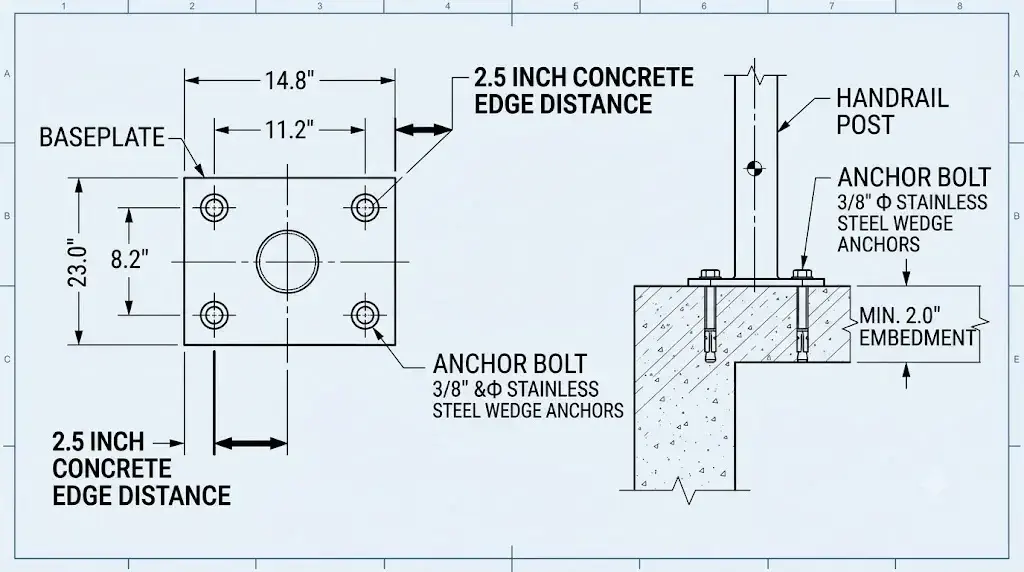
Handrail Fasteners: Resisting a 200-Pound Lateral Point Load Demands Mechanical Anchoring
Building codes mandate that exterior handrails must withstand extreme mechanical leverage without plastic deformation. When an elderly person stumbles on an icy exterior porch step, their body weight translates into a sudden, dynamic lateral thrust. If the handrail baseplate is secured using cheap plastic wall plugs or undersized screws, the fastener immediately pulls out of the masonry, leading to catastrophic falls.
The structural physics governing outdoor handrail anchoring include:
- ADA 200-lb Point Load Mandate (§505.8): Grab rails and handrails must support a concentrated downward or outward lateral force of at least 200 lbs (890 N) applied at any point along the grab bar without twisting or structural bending.
- Cantilever Leverage Factor: Because standard handrails stand 36 inches above the stair tread, a 200-lb lateral push at the top rail acts as a 3-foot lever arm, amplifying tensile pull-out forces on the rear baseplate anchor to over 450 lbs.
- Cohesive Barrier-Free Entryways: Handrails stabilize seniors walking up exterior stairs, but wheelchair access demands rolling transitions. Pair stair handrails with verified safe slope ratio for wheelchair ramps to ensure full exterior accessibility.
Installation Methodology: Rotary Hammer Drilling and Clean Anchoring Secure Baseplates Permanently
Proper masonry installation requires specialized tools to prevent cracking concrete steps while ensuring deep mechanical bite. Using a standard household drill with a smooth shank masonry bit will glaze the concrete and create sloppy, out-of-round holes. An SDS-plus rotary hammer drill delivers rapid percussive impacts that shatter aggregate cleanly without fracturing adjacent slab edges.
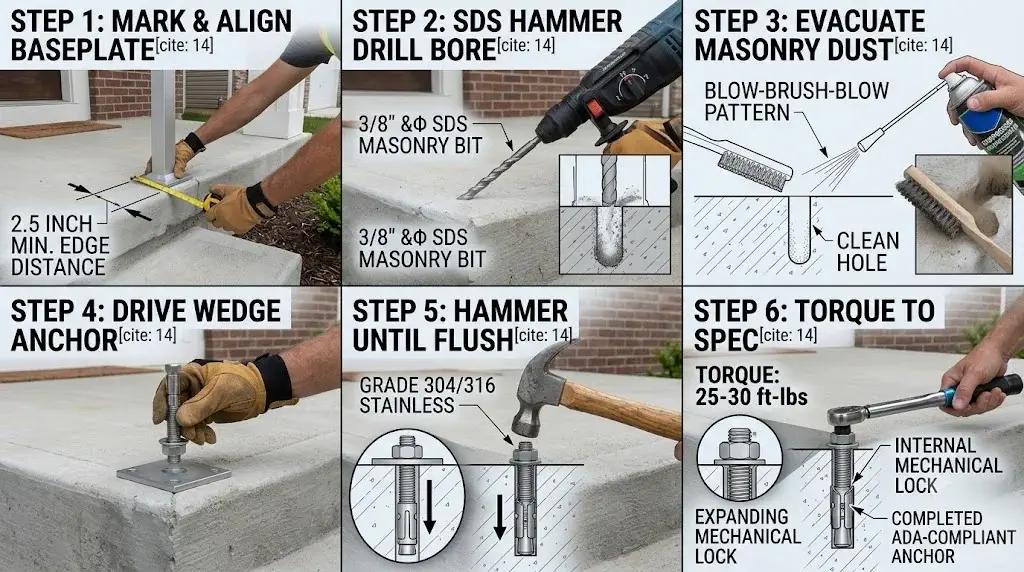
The 5-Step Professional Handrail Mounting Protocol
- Establish Plumb Alignment and Mark Hole Centerlines: Assemble the handrail loosely. Place the baseplates onto the concrete treads, verifying that posts stand vertically plumb with a 24-inch torpedo level. Confirm that each baseplate hole sits at least 2.5 inches inward from the step edge. Mark the hole centers with a permanent black marker.
- Bore Perpendicular Holes with SDS-Plus Drill: Chuck a 3/8-inch carbide SDS-plus masonry bit into your rotary hammer. Set your drill depth stop to 2.5 inches (the 2.0-inch anchor embedment plus 0.5 inches of bottom clearance for dust accumulation). Drill downward strictly at a 90-degree angle without rocking the drill bit.
- Evacuate Concrete Masonry Dust (Blow-Brush-Blow): Compressed air and a nylon wire wire-bristle brush are essential. A hole filled with concrete dust reduces wedge anchor pull-out resistance by over 60%. Blow air into the hole, scrub with the wire brush, and blow out the remaining dust three consecutive times.
- Drive Stainless Wedge Anchors into Position: Place the metal handrail baseplate directly over the drilled holes. Thread the hex nut flush onto the top of each 3/8-inch stainless steel wedge anchor to protect the bolt threads. Hammer the anchor straight through the baseplate hole until the washer seats firmly against the plate surface.
- Torque to Factory Specification: Tighten the hex nuts using a calibrated torque wrench to 25-30 ft-lbs (34-41 Nm). As the nut turns, the expander clip wedges firmly into the concrete wall, creating an unbreakable mechanical lock. For temporary accessibility solutions where drilling concrete is not permitted, compare non-permanent hardware in our review of portable folding wheelchair ramps.
Fastener Dynamics: Structural Epoxy Eliminates Outward Hoop Stresses on Fragile Steps
Mechanical wedge anchors function by exerting severe radial outward pressure against the concrete hole walls as they expand. On fresh, dense concrete (3,000+ PSI), this outward friction provides incredible holding power. However, on older residential steps, outdoor concrete often suffers from freeze-thaw spalling, hairline fractures, or low compressive strength. In these environments, mechanical anchors crack the step completely.
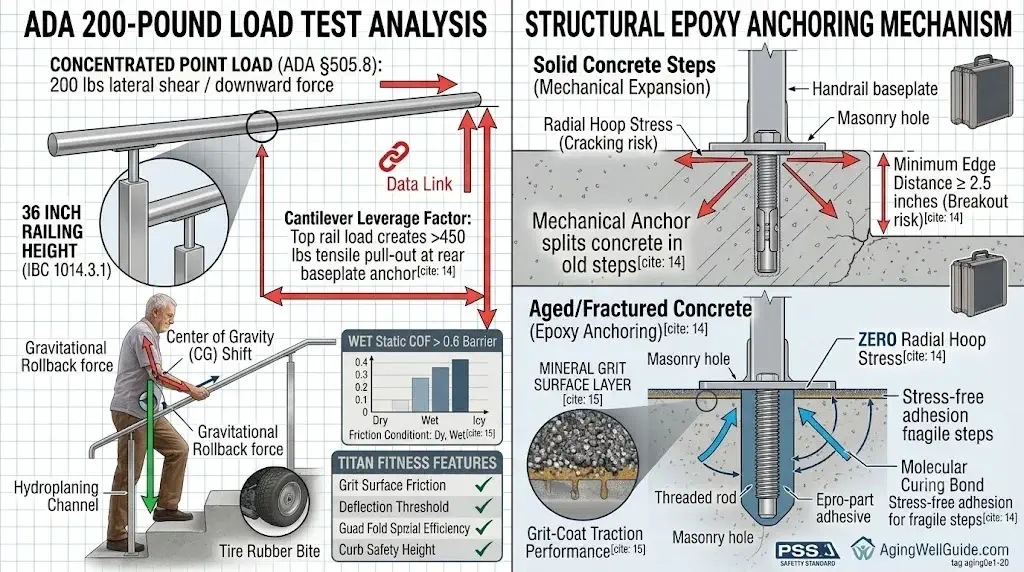
When deciding between mechanical wedge anchors and structural chemical adhesives:
- When to Choose Stainless Wedge Anchors: Solid, uncracked concrete steps with generous tread depth (over 10 inches) where holes sit at least 3 inches away from outer step borders. They install instantly with zero chemical curing delay.
- When to Choose Chemical Epoxy Anchoring: Spalled, crumbly, or thin precast concrete stairs, as well as historic masonry where anchors must be positioned within 2 inches of the edge. Structural epoxy (such as Simpson Strong-Tie SET-3G) creates a chemical molecular bond across the entire depth of the hole without outward pressure.
- Level Approach Complements: Once steps are equipped with rigid handrails, eliminate remaining doorway entrance lips using low-profile doorway threshold ramps for zero-trip threshold transitions.
Corrosion Engineering: Grade 304 and 316 Stainless Fasteners Prevent Concrete Rust Jacking
Moisture infiltration down anchor holes causes severe concrete degradation known as rust jacking. When standard zinc-plated carbon steel anchors get exposed to rain, snow, and winter de-icing salts, iron oxide expands to over six times the volume of the original steel. This internal volumetric expansion fractures concrete steps from the inside out, completely loosening handrail stanchions within two to three seasons.
Critical weatherproofing protocols to preserve outdoor step structural integrity include:
- Fastener Metallurgy: Always install AISI 304 stainless steel wedge anchors for inland climates, or marine-grade AISI 316 stainless anchors in coastal salt-air environments.
- Baseplate Sealing Bead: Run a continuous perimeter bead of 100% silicone or polyurethane masonry elastomeric sealant around the bottom rim of the baseplate, leaving a small 1/4-inch drainage gap on the downward slope side to prevent water pooling.
- Heavy Multi-Step Access Equipment: If physical stair climbing remains hazardous despite rigid handrails, compare commercial bariatric transition runways in our tested Titan Fitness multifold ramp review.
Building an Integrated Whole-Home Mobility Ecosystem
Knowing how to mount outdoor metal handrails into concrete steps provides essential physical fall prevention along exterior entries. To extend safety and biomechanical independence throughout your entire residential layout, combine robust handrail installations with these vetted architectural upgrades:
- Eliminate exterior doorway tripping lips with weather-sealed doorway threshold ramps.
- Calculate precise ADA runway requirements for wheelchair access using our guide to safe slope ratio for wheelchair ramps.
- Ensure comfortable living room recovery and lower joint relief by exploring the best power lift recliners for seniors.
- Secure bedroom transitions against nocturnal balance loss by installing tested bed assist rails with legs.
Frequently Asked Questions (FAQ)
What size anchor bolts are required to secure an outdoor metal handrail into concrete?
Standard outdoor metal handrail baseplates require 3/8-inch diameter by 3.0-inch to 3.5-inch long 304 or 316 stainless steel wedge anchors. Heavy commercial installations or hollow precast concrete steps mandate 1/2-inch structural epoxy threaded rods.
How far from the concrete edge should handrail mounting holes be drilled?
Holes must be drilled at least 2.5 inches (ideally 3.0 inches) inward from any concrete edge or nosing. Drilling closer than 2.0 inches creates radial expansion pressure that splits and shatters cured concrete treads under load.
Can you use Tapcon concrete screws to install outdoor metal handrails?
Standard 3/16-inch or 1/4-inch Tapcon screws do not meet the 200-lb lateral point load requirements mandated by ADA Section 505. Only heavy-duty 3/8-inch structural wedge anchors, sleeve anchors, or chemical epoxy systems are approved for human fall prevention.
What is the legal handrail height on residential outdoor concrete stairs?
According to IBC and ADA Section 505.4, top gripping surfaces of handrails must be installed between 34 inches and 38 inches vertically above stair tread nosings, measured continuously down the stairway rake.
