
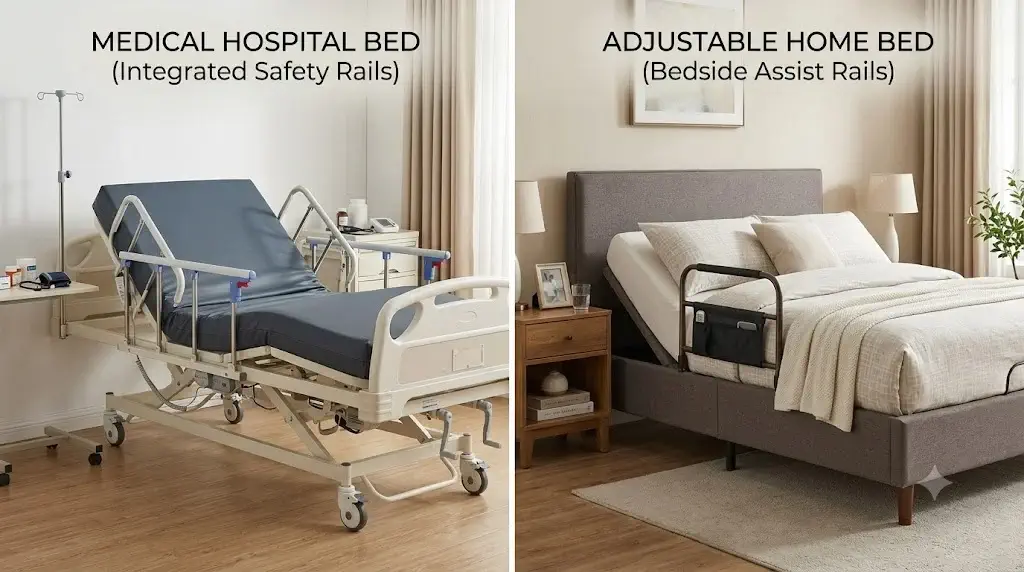
Hospital Bed vs. Adjustable Home Base with Safety Rails
Executive Engineering Summary: Clinical Bed Evaluation
This comparative technical audit on hospital bed vs adjustable home base with safety rails resolves the architectural, mechanical, and safety dilemmas faced by families managing long-term elder care at home. While high-end residential adjustable bases improve aesthetic integration, sleep comfort, and respiratory positioning, full-electric hospital beds provide essential clinical functionality: vertical Hi-Low deck elevation (raising the deck to 30 inches to eliminate caregiver back torque during hygiene changes, or lowering it to 7 inches for roll-out fall prevention), integrated frame-locked barrier rails, and true Trendelenburg posture alignment.
- Hi-Low Vertical Lift Kinematics: Medical hospital beds incorporate a third linear actuator dedicated to raising the entire mattress plane vertically, whereas adjustable home bases remain stationary at fixed leg heights.
- Structural Rail Safety Architecture: Hospital bed rails mount directly into welded steel chassis sockets, eliminating shifting gaps; conversely, aftermarket residential rails require specialized under-deck anchor straps to prevent dangerous entrapment pockets.
- Aesthetic vs. Clinical Hygiene: Home adjustable bases feature upholstered frames and standard residential dimensions, whereas hospital beds utilize wipe-down powder-coated carbon steel and antimicrobial vinyl decks.
- Bedroom Safety Silo Connections: Pairing modified residential beds with bed assist rails demands understanding how to secure bed rails on adjustable beds, or transitioning bedbound seniors onto clinical alternating pressure mattresses for tissue offloading.
Quick Reference Specification: Hospital Bed vs Adjustable Home Base with Safety Rails
Selecting between these two mobility platforms requires balancing clinical necessity, fall risk profile, and caregiver biomechanics. The comparison table below benchmarks the technical parameters of certified medical hospital beds against premium residential adjustable bed frames fitted with aftermarket safety rails:
| Mechanical & Clinical Parameter | Full-Electric Hospital Bed | Adjustable Home Base + Aftermarket Rails | Caregiver & Patient Impact |
|---|---|---|---|
| Deck Height Elevation (Hi-Low) | Yes: 7″ to 30″ (Motorized) | No (Fixed 12″ to 18″ bolt-on legs) | Hospital beds prevent caregiver lumbar strain and low-height fall injuries |
| Mattress Articulation | Head: 0°–70° | Knee: 0°–35° | Head: 0°–65° | Knee: 0°–45° | Both support Fowler’s position for pulmonary drainage and acid reflux |
| Bed Rail Attachment Architecture | Integrated welded chassis sockets | Clamp-on or strap-secured brackets | Hospital rails eliminate flex; aftermarket rails require constant torque checks |
| Trendelenburg / Reverse Tilt | Yes (12° to 15° mechanical tilt) | No (Zero gravity only) | Crucial for severe postural hypotension, edema, and sacral pressure relief |
| Sizing & Room Footprint | 36″ x 80″ or 84″ (Standard Twin XL) | Twin XL, Queen, Split King, Full | Home bases accommodate partner sleeping; hospital beds prioritize single care |
| Entrapment Mitigation Profile | FDA IEC 60601-2-52 Compliant | Requires manual safety audits | Consumer beds have varying mattress flex, increasing entrapment gap risks |
| Medicare / Insurance Coverage | Part B DME coverage eligible (HCPCS E0260) | 100% Out-of-pocket private expense | Hospital beds reduce financial burden for medically qualified patients |
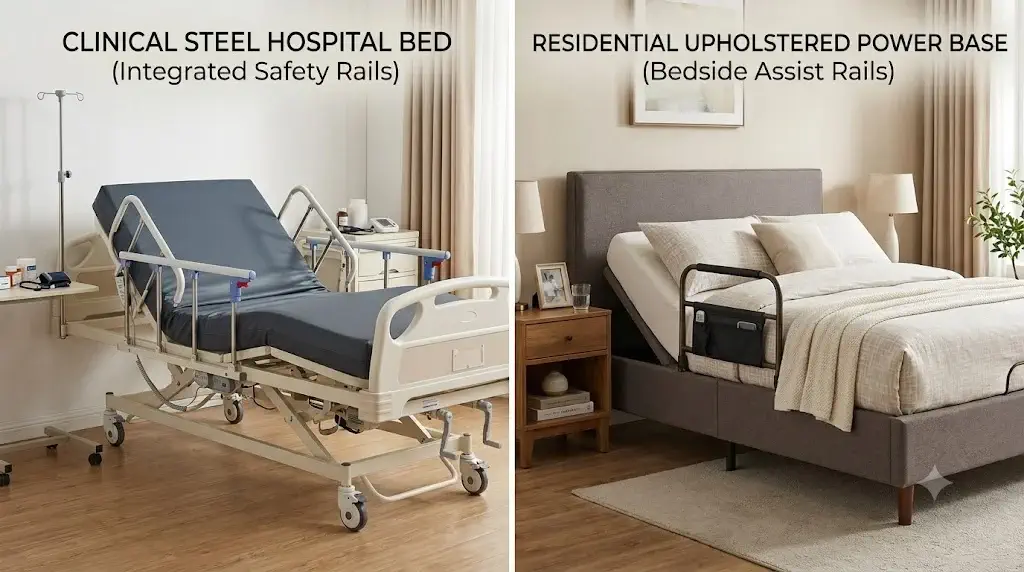
Side-by-side architecture: a medical full-electric Hi-Low hospital bed with locking casters versus a residential upholstered adjustable base retrofitted with safety rails.
Vertical Elevation Linear Actuators Protect Caregivers From Chronic Lumbar Injury
The functional distinction between medical hospital beds and consumer power bases lies in their vertical elevation kinetics. A residential adjustable base articulates solely within a fixed geometric plane—its four steel supporting legs remain bolted into fixed floor positions while independent motors pivot the backrest plate and knee gatch upward.
In contrast, a full-electric hospital bed employs a high-thrust vertical scissor or telescoping column actuator:
- Ergonomic Caregiver Working Height: The entire sleep deck can be raised vertically to 28 to 32 inches off the finished floor. This positions the mattress directly at the caregiver’s waist height, eliminating the dangerous forward-stooping posture that causes chronic lumbar disc compression during daily bed baths, wound dressings, and diaper changes.
- Ultra-Low Floor Fall Mitigation: Low-bed models (often termed “floor beds”) can descend until the sleep deck rests merely 7 to 9 inches off the carpet. For seniors with Alzheimer’s disease, Lewy body dementia, or severe sundowning agitation who repeatedly attempt to climb over bed rails, lowering the bed to floor height combined with a fall mat renders roll-out injuries non-hazardous.
- Optimized Sit-to-Stand Foot Placement: The motorized deck height can be adjusted dynamically so that the senior’s feet make flat, perpendicular contact with the floor before rising, eliminating the knee-joint shear common when dismounting from thick consumer pillow-top mattresses.
Rigid Chassis-Mounted Rail Sockets Prevent Lethal Sleep Surface Gaps
Safety rail mechanics present the most dangerous hazard when modifying consumer furniture for medical care. Hospital bed rails are engineered as integrated sub-assemblies governed by rigid international safety standards (IEC 60601-2-52), whereas aftermarket bedside handles must adapt to varying commercial mattress compressions and slat tolerances.
Analyzing structural rail attachment protocols demonstrates critical variances:
- Welded Structural Sockets: Hospital beds incorporate pre-welded, heat-treated steel sockets directly into the bed frame perimeter. Split-side rails or full-length drop rails lock mechanically into these anchor points with zero lateral flex, ensuring gap distances between the rail and mattress perimeter never exceed the FDA Zone 1–4 limit of 4.75 inches.
- Dynamic Shearing Risks on Consumer Bases: Retrofitting an aftermarket bed rail to a home adjustable base introduces dynamic entrapment pinch points. When the head or foot deck elevates, an improperly mounted rail can create a scissor shear trap against the moving frame or pull away from the mattress edge.
- Webbing Strap vs. Clamping Anchors: As documented in our detailed Stander EZ Adjust bed rail review, any rail applied to an adjustable mattress requires dedicated tension straps secured strictly around the stationary, non-moving center sub-frame to prevent dangerous outward migration.
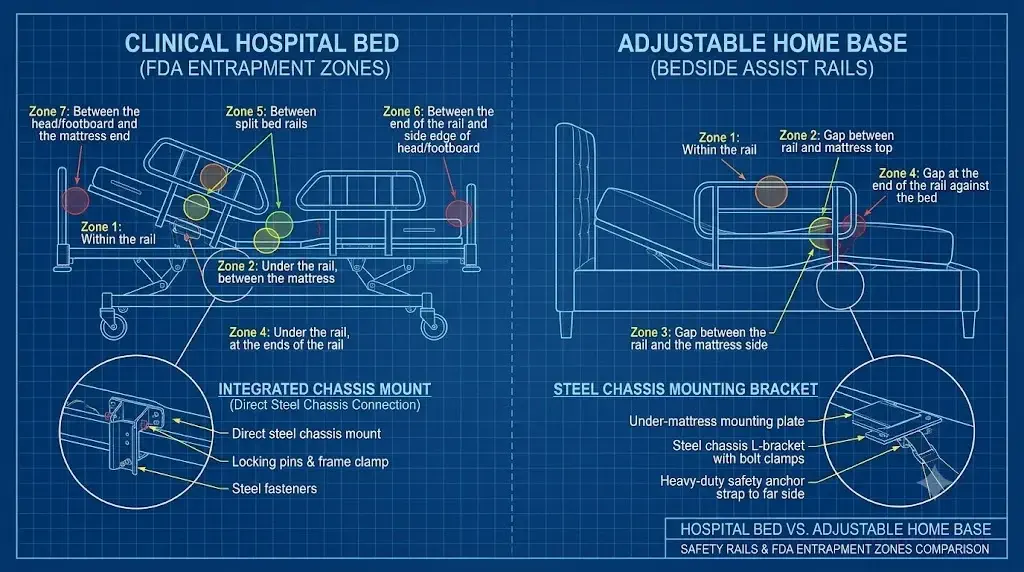
Safety audit: comparing an integrated welded hospital bed rail socket against an aftermarket clamp-on rail installed on an articulating power foundation.
Full Frame Angulation Controls Hemodynamic Shifting And Relieves Sacral Pressure
Consumer adjustable bases emphasize “Zero-Gravity” presets—a position pioneered by NASA that elevates both the head and knees slightly above the pelvic line to neutralize spinal pressure. While exceptionally restorative for healthy adults suffering from lower back discomfort or mild snoring, Zero-Gravity cannot address acute clinical hemodynamic needs.
Advanced clinical hospital beds provide two vital mechanical inclinations:
- True Trendelenburg Tilting (Head Down 12°–15°): Tilts the entire rigid sleep plane so the patient’s head rests lower than their pelvis and feet. Clinicians use this position to facilitate gravity-assisted central venous catheter placement, combat sudden orthostatic hypotension emergencies, and assist respiratory secretion drainage.
- Reverse Trendelenburg Tilting (Feet Down 12°–15°): Maintains an unbroken, straight spine alignment while tilting the entire mattress downward toward the floor. This posture dramatically lowers intracranial pressure, prevents gastroesophageal reflux in feeding-tube dependent seniors, and significantly relieves sacral tissue shear.
- Shear-Free Patient Repositioning: When a patient gradually slides toward the foot of the bed, elevating the bed into Trendelenburg allows caregivers to reposition them toward the headboard utilizing gravity, avoiding tissue shear forces across fragile skin.
Residential Upholstered Foundations Preserve Dignity And Combat Institutional Depression
The introduction of a clinical hospital bed into a private residence marks an undeniable emotional watershed for aging individuals. The harsh aesthetic of utilitarian steel grid decks, plastic laminated footboards, exposed drive screws, and dual chrome side rails can reinforce feelings of decline, invalidity, and loss of independence.
Balancing human psychological well-being against physical care requirements:
- Partner Co-Sleeping Continuity: Hospital beds are virtually exclusively single-occupant platforms (Twin XL 36″x80″). For couples married 50+ years, this forces physical separation. A Split-King residential adjustable base allows spouses to sleep side-by-side while preserving independent head and foot articulation.
- Aesthetic Blending: Consumer bases feature premium linen upholstery, concealed internal drive motors, whisper-quiet worm gears, and under-bed LED guide lighting that seamlessly harmonizes with bedroom decor.
- The Hybrid Care Path: When a senior’s mobility declines gradually—characterized by slow morning stiffness rather than total bedbound dependency—combining a sturdy consumer base with bolt-on, padded assist handles offers an ideal bridge between aesthetic dignity and physical standing stability.
Patient Functional Acuity Dictates The Proper Bed Selection Strategy
Selecting between an institutional hospital bed and a residential adjustable base requires a clinical audit of the senior’s mobility score and caregiver capacity:
- The patient is fully bedbound and requires extensive caregiver assistance with bathing, turning, and incontinence care.
- Caregivers are experiencing back, shoulder, or knee fatigue due to low bed heights.
- The patient has severe dementia and requires an ultra-low floor bed to neutralize fall impact.
- Stage 2–4 pressure ulcers necessitate specialized alternating pressure air overlays.
- Medicare Part B or private health insurance approves coverage for Durable Medical Equipment (DME).
- The senior can walk independently or transfer with minimal standing assistance.
- Partner co-sleeping in a Queen or Split-King configuration is a primary quality-of-life priority.
- Primary clinical objectives involve managing mild snoring, hiatal hernia, or leg swelling.
- Bedroom aesthetic warmth and emotional normalcy take precedence over clinical sanitation.
- You are prepared to strictly follow mechanical anchoring protocols for stationary rail mounting.
Frequently Asked Questions About Hospital Beds and Adjustable Bases
What is the critical mechanical difference between a hospital bed and an adjustable home base?
The hospital bed vs adjustable home base with safety rails comparison confirms that the defining difference is motorized vertical Hi-Low elevation. Hospital beds raise and lower the entire bed deck between 7 and 30 inches off the floor to safeguard caregiver ergonomics and eliminate fall injuries. Consumer adjustable bases articulate only the head and foot angles while resting on static legs.
Can you safely attach aftermarket safety rails to an adjustable home base?
Yes, provided the rails are bolted or tension-strapped exclusively to the stationary, non-articulating center sub-chassis. Securing aftermarket rails to moving deck segments causes dynamic mechanical pinching, bends bracket hardware, and violates FDA entrapment standards by opening widening gaps during recline.
Does Medicare Part B cover adjustable home bases?
Medicare does not cover residential adjustable bases, classifying them as consumer lifestyle furniture. Medicare Part B only reimburses certified semi-electric or full-electric hospital beds (under HCPCS billing codes E0260 or E0261) when prescribed by a physician for conditions requiring frequent postural drainage or complex body repositioning.
Which bed is superior for managing stage 2 to 4 pressure sores at home?
Full-electric hospital beds provide far superior decubitus ulcer management. They feature standardized 36-inch dimensions engineered specifically for medical alternating pressure pump mattresses, allow effortless caregiver turning access, and utilize Trendelenburg angulation to eliminate pelvic friction and tissue shear forces.
