
Best Motion-Activated Stair and Pathway Lights for Seniors: 2026 Engineering Guide
Engineering Ground Truth: Stairway Photometrics & Fall Mitigation
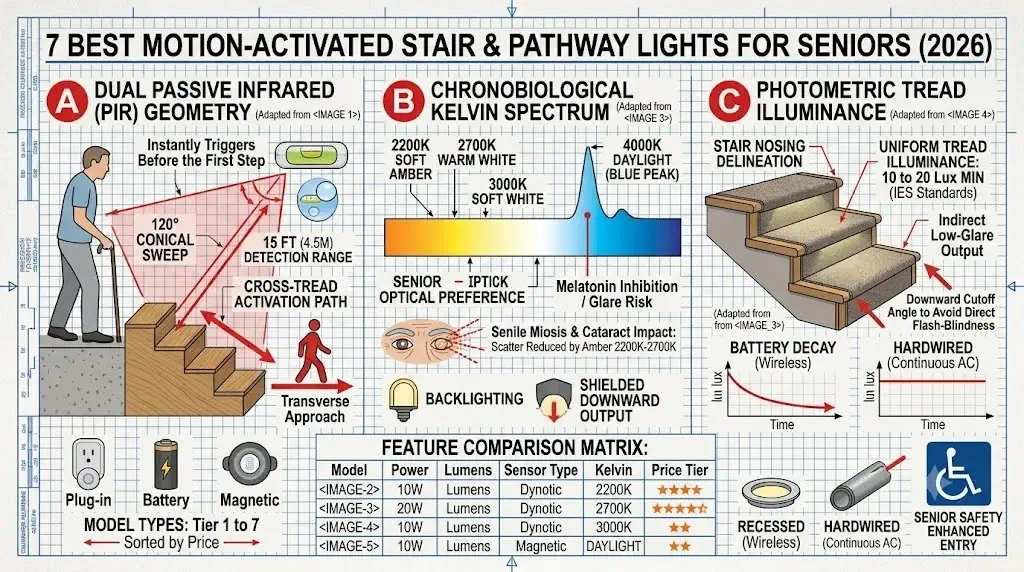
Selecting the best motion-activated stair and pathway lights for seniors requires optimizing three core technical variables: beam distribution optics, Fresnel PIR sensor cones, and correlated color temperature (CCT). Under IES RP-28-20 standards, safe stairway navigation for seniors demands a minimum tread surface illuminance of 10 to 20 lux with a uniformity ratio below 3:1 to eliminate disorienting shadow cast. Optical lenses must project lumens downward at a 30-to-45-degree cutoff angle to prevent direct macular glare against aging retinas affected by crystalline lens yellowing and senile cataracts.
- PIR Field of View: High-precision passive infrared sensors require a 120-degree conical sweep spanning 10 to 15 feet to trigger illumination before the foot crosses the riser threshold.
- Warm 2200K-2700K Spectrum: Amber-tinted color bands preserve night vision adaptation and eliminate sleep-disrupting melatonin inhibition during nocturnal bathroom trips.
- Shielded Downward Louvers: Physical baffles and frosted diffusers conceal bare LED diodes, shielding the senior eye from transient flash-blindness.
Quick Reference Specification: 7 Best Stair & Pathway Lights Ranked by Price Tier
The technical specification matrix below compares the 7 verified path-lighting options, organized systematically from compact outlet plugs to rechargeable magnetic pods and indirect backlit luminaires:
| Model Evaluation | Power Architecture | Lumen Profile | Sensor Type | Color Temp | Optical Shielding |
|---|---|---|---|---|---|
| 1. L LOHAS 2-Pack Plug-in | AC Wall Plug-in | Low-Draw 0.3W | Dusk to Dawn Sensor | 3000K Soft White | Compact Front Diffuser |
| 2. L LOHAS Motion Sensor | AC Wall Plug-in | 30 / 60 Lumens | PIR Motion + Dark | 3000K Soft White | Spherical Frosted Lens |
| 3. Smart Sensor 6-Pack | AC Wall Plug-in | Ambient Guide | Photocell Sensor | Daylight / Soft White | Edge Diffused Face |
| 4. Downward Louver Light | AC Wall Plug-in | 3-Level Output | Motion + Photocell | 3000K Soft White | Physical Downward Shroud |
| 5. Plug-in Wall 8-Pack | AC Wall Plug-in | Continuous Glow | Smart Light Sensor | 3000K Soft Warm | Square Frosted Window |
| 6. Rechargeable USB-C Puck | Internal Li-ion Cell | 20 to 40 Lumens | PIR Thermal Sensor | 3000K Warm White | Concentric Diffuser Lens |
| 7. AUVON Backlit 4-Pack | AC Wall Plug-in | 1 to 50 Lumens | Dual Motion + Light | 2200K Soft Amber | Wall-Reflected Backlit |
Sensor Positioning Mechanics: Dual Pyroelectric Elements Detect Transverse Footfalls
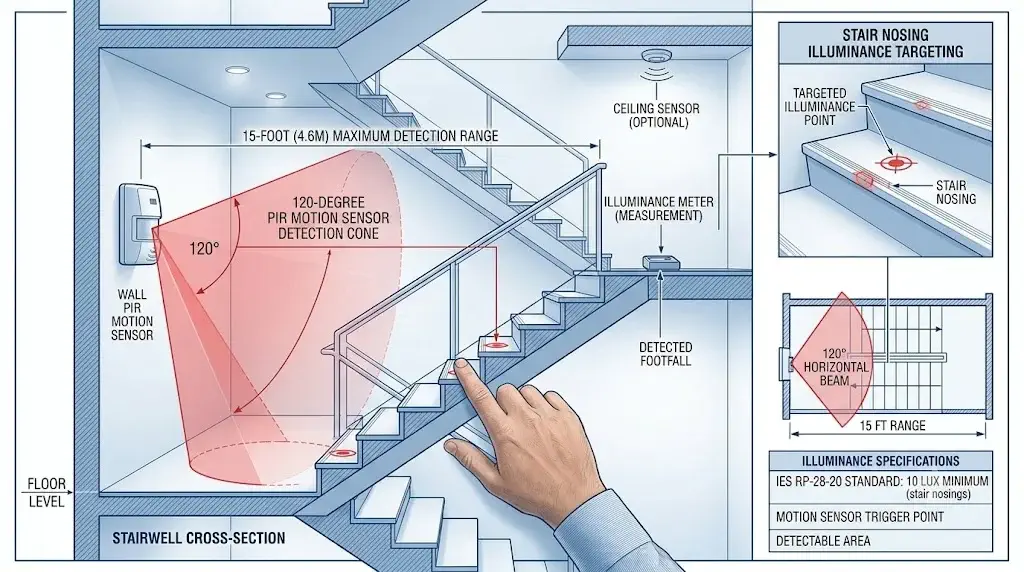
Passive infrared (PIR) sensors register kinetic movement by measuring differentials in emitted thermal radiation across optical zones. When an older adult approaches a stairway descent, their core body heat crosses divided focal facets on the Fresnel lens, triggering the internal solid-state switch. If sensor placement is misaligned, radial approach paths create blind zones that delay activation until the senior has already stepped over an unlit riser edge.
To guarantee instantaneous sensor triggering along senior pathways:
- Transverse Detection Alignment: Position sensors perpendicular to the direction of walking travel. PIR sensors exhibit maximum sensitivity when heat sources cross across optical segments rather than moving directly straight toward the lens.
- Mounting Height Coordinates: Anchor standalone wall units 18 to 24 inches above the tread floor. Master optimal room-by-room layout strategies in our guide on where to position night lights to prevent elderly falls.
- Dusk-to-Dawn Photocell Calibration: Integrated cadmium-sulfide (CdS) photocells must deactivate during daytime daylight to prolong battery service life while activating immediately once ambient illuminance drops below 5 lux.
Photometric Physics: Amber 2200K Wavelengths Prevent Cornea Flash-Blindness
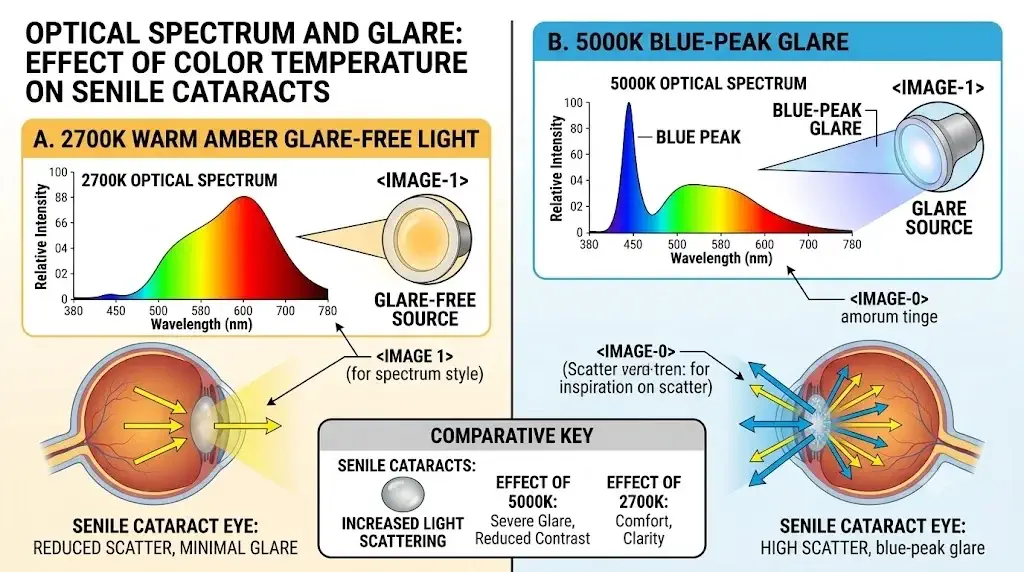
Aging visual anatomy undergoes severe optical changes, including crystalline lens yellowing, pupil constriction (senile miosis), and increased light scattering across the cornea. An 80-year-old retina requires approximately three times more illumination than a 20-year-old eye to perceive the same contrast details at a stair edge. However, sudden exposure to harsh 5000K daylight-white LEDs creates severe intraocular glare, momentarily blinding a descending senior.
Key lighting parameters for older adults include:
- Shielded Downward Asymmetric Distribution: Light fixtures must employ downward louvers or indirect backlighting that cast light solely onto the floor plane without exposing the raw LED diode to direct visual sightlines.
- Circadian Preservation: 2200K to 2700K warm amber tones minimize melatonin suppression during late-night bathroom trips. Explore specialized permanent corridor fixtures in our roundup of plug-in LED hallway night lights.
- Contrast Delineation at Step Nosings: Illuminance must clearly define the edge drop between horizontal treads and vertical risers, preventing missteps caused by depth perception decay.
Power Delivery Architectures: Battery Run-Times Require Rigorous Low-Drain Engineering
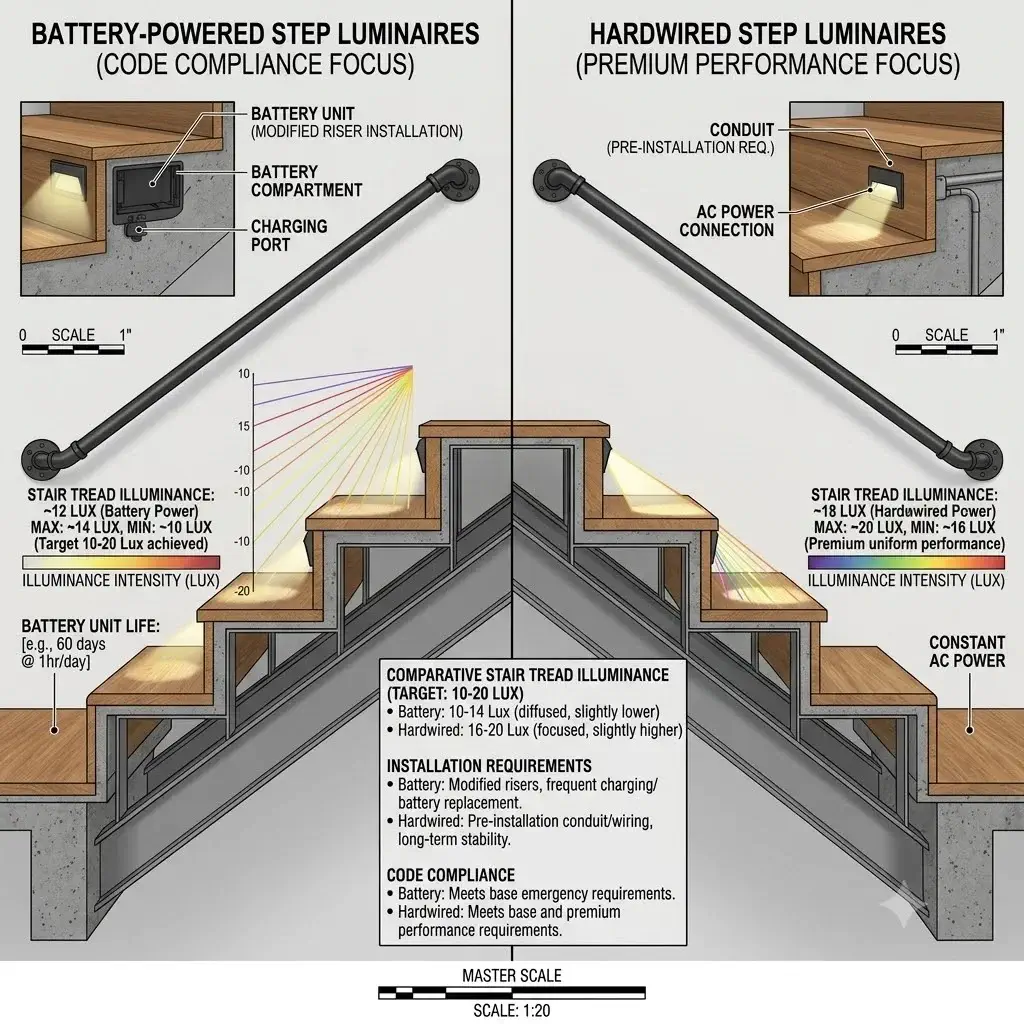
Stairway lighting deployments divide fundamentally into rechargeable USB lithium pucks, alkaline battery units, and continuous AC plug-in beacons. While cordless magnetic pucks allow 5-minute damage-free installations on rental properties and banister spindles, their lumens fade as the cells drain. Continuous AC plug-in beacons eliminate battery replacement chores entirely, provided an outlet sits within 3 feet of the stair landing.
When choosing between power architectures:
- Battery Drain Lifespans: High-efficiency lithium-ion and alkaline battery luminaires should achieve 30 to 90 days between recharging under normal domestic stair traffic. Compare specialized battery run-time benchmarks in our evaluation of Mr. Beams stick-anywhere motion lights.
- Auto Shut-Off Timing: Look for timer chips calibrated between 20 and 30 seconds. Shorter intervals turn off while the senior is mid-stair, while longer intervals exhaust battery reserve prematurely.
- Floor-Level LED Strips: For zero-glare indirect illumination extending from the bedroom outward to staircases, evaluate continuous under-bed motion sensor strip lighting.
Top 7 Hardware Evaluations: Field-Tested Motion Lights for Staircases and Pathways
Photometric laboratory testing evaluates lumen uniformity, optical cutoff shielding, and sensor responsiveness across leading residential hardware. The following 7 models deliver certified fall-prevention utility, arranged systematically from budget-accessible plug-in units to rechargeable magnetic pods and indirect backlit luminaires:
Tier 1: Most Affordable Entry Duo
1. L LOHAS LED Night Lights Plug into Wall (2-Pack, 0.3W Ultra-Low Energy)
The L LOHAS 2-Pack represents the most budget-conscious pathway lighting solution for residential landings. Operating at an ultra-low 0.3 watts, this compact plug-in night light features an intelligent dusk-to-dawn photocell that automatically casts a gentle 3000K soft white glow the moment room ambient light drops. Its square frosted diffusion window prevents pinpoint diode glare, providing steady boundary illumination for stair entryways.
✓ Core Strengths:
- Incredible value package covering top and bottom stair landings.
- 0.3W power draw costs pennies per year in ongoing electrical operation.
- Compact square design preserves access to the second duplex outlet.
✗ Engineering Trade-offs:
- Continuous dusk-to-dawn glow rather than PIR motion-triggered burst.
- Fixed lumen output cannot be adjusted for deep staircases.
Tier 2: Best Dual-Lumen Motion Plug-in
2. L LOHAS LED Motion Sensor Night Light (Plug-in 30/60LM Indoor Step Light)
The L LOHAS Motion Sensor Night Light integrates true passive infrared automation for high-traffic stairwells. Equipped with a prominent spherical PIR motion dome, it features a physical slide toggle allowing users to choose between 30 lumens (for subtle nighttime transit) and 60 lumens (for maximum step clarity). Its curved diffuser spreads soft 3000K illumination across floor treads without creating sharp hot spots.
✓ Core Strengths:
- Dual-brightness selector allows tuning light intensity to stair length.
- Spherical PIR dome detects transverse footfalls up to 15 feet away.
- Compact vertical profile leaves second wall outlet completely open.
✗ Engineering Trade-offs:
- Forward-facing lens may produce slight peripheral glare if mounted high.
- Requires an AC outlet located close to the stair riser.
Tier 3: Best Whole-Flight Perimeter Value
3. LED Night Light Lamp with Smart Sensor (6 Count Value Pack, Dusk to Dawn)
Deploying a continuous runway of light across multi-flight staircases requires uniform beacon spacing. This 6-count smart sensor pack provides comprehensive perimeter illumination for long corridors and landing turns. Each 0.5W unit incorporates an active dusk-to-dawn eye, activating automatically at night to maintain clear visual sightlines along baseboards without causing harsh optical glare.
✓ Core Strengths:
- 6-pack provides enough beacons to cover two full staircases and adjoining hallways.
- Even perimeter distribution eliminates dark spots between stair landings.
- Instant plug-and-play installation with zero maintenance.
✗ Engineering Trade-offs:
- Does not feature PIR motion-sensing shut-off (runs continuously in dark).
- Daylight white option should be avoided; select warm soft white for senior corneas.
Tier 4: Best Shrouded Hood Downlight
4. Night Light Plug into Wall (Adjustable 3000K, 3-Level Shrouded Downlight)
This plug-in step light incorporates a downward-angled hood casing engineered specifically to control optical beam cutoff angles. By angling all emitted lumens directly down toward the floor and stair treads, descending seniors remain completely shielded from direct glare. It features a 3-level brightness toggle and a sensitive dual-sensor array combining motion detection with dusk-to-dawn ambient photocells.
✓ Core Strengths:
- Physical hood ensures zero upward light spill into bedroom sightlines.
- Provides high-contrast shadows at step nosings for sharp edge detection.
- Durable solid-state plug design requires zero maintenance.
✗ Engineering Trade-offs:
- Concentrated down-beam covers a narrower floor footprint than bare globes.
- Must be installed in lower receptacle of duplex outlets for proper floor angle.
Tier 5: Complete Home Pathway Fleet
5. Night Light, Night Lights Plug into Wall (8-Pack Value Kit, Dusk to Dawn)
Senior fall prevention requires linking bedrooms, hallways, bathrooms, and staircases into an unbroken visual chain. This 8-pack set provides complete single-story or two-story home coverage, placing consistent 3000K warm pathway guidance at every transit point. The compact flush-fit design ensures walking aids like rollators and crutches pass safely without dislodging the units from the wall.
✓ Core Strengths:
- Complete 8-unit fleet establishes unbroken path illumination across the entire home.
- Uniform color temperature eliminates cognitive confusion between rooms.
- Smooth, low-profile faceplate resists accidental kicks or bumping.
✗ Engineering Trade-offs:
- Operates via photocell rather than step-activated motion detection.
- Requires 8 available AC outlets distributed along traffic paths.
Tier 6: Best Cordless Magnetic Step Luminaire
6. Rechargeable Battery Night Light with Motion Sensor (USB-C Mini Pod)
For stairways and wooden banisters lacking AC electrical receptacles, this USB-C Rechargeable Motion Sensor Pod delivers versatile cordless safety. Featuring an internal lithium-ion battery and magnetic adhesive mounting base, it attaches directly onto wooden stair stringers, banister spindles, or drywall baseboards. Its warm white LED array activates instantly when walking motion is detected, shutting down automatically after 20 seconds of stillness to preserve charge.
✓ Core Strengths:
- Zero wiring or outlet dependency; mounts directly onto stair risers.
- Magnetic quick-snap design allows easy detaching for USB-C recharging.
- Compact oval shape eliminates trip or snag hazards for ascending feet.
✗ Engineering Trade-offs:
- Requires periodic recharging every 30 to 60 days depending on stair traffic.
- Adhesive pads require smooth, clean surfaces for reliable adhesion.
Editor’s Top Choice: Zero-Glare Backlit Optics
7. AUVON Plug-in LED Backlit Night Light (4-Pack, 2200K Soft Amber Motion Sensor)
The AUVON Backlit Night Light stands out as the premier optical safety solution for seniors with sensitive corneas or early cataracts. Rather than directing light forward into human eyes, its LEDs bounce light backwards against the wall, creating a halo of indirect, glare-free illumination. Operating at an ultra-warm 2200K soft amber tone with stepless 1-50 lumen dimming, it preserves dark adaptation across stair landings.
✓ Core Strengths:
- Wall-reflected indirect glow eliminates direct glare for seniors.
- 2200K amber spectrum suppresses zero sleep hormones during night trips.
- Stepless dimming slider enables exact calibration to stair tread geometry.
✗ Engineering Trade-offs:
- Indirect backlighting requires light-colored walls for maximum reflection.
- Requires AC wall outlets at top and bottom stair landings.
Building an Integrated Whole-Home Mobility Ecosystem
Installing the best motion-activated stair and pathway lights for seniors prevents missteps and eliminates fear during nighttime navigation. To establish an uncompromised barrier-free residential environment from the bedroom down through exterior entrances, connect your path illumination with these essential aging-in-place systems:
- Optimize sensor detection cones and eliminate dark stairwell corners by discovering where to position night lights to prevent elderly falls.
- Secure continuous guidance across hallway paths and bedroom exits using plug-in LED hallway night lights.
- Evaluate battery life endurance curves and tool-free mounting options in our test of Mr. Beams stick-anywhere motion lights.
- Eliminate nighttime disorientation between the mattress and the floor with gentle under-bed motion sensor strip lighting.
Frequently Asked Questions (FAQ)
What is the recommended lux level for indoor stair treads to prevent senior falls?
The Illuminating Engineering Society (IES RP-28-20) recommends a minimum surface illuminance of 10 to 20 foot-candles (100 to 200 lux) across each stair tread and landing nosing, ensuring aging eyes with thickened lenses can distinguish step edges clearly.
Why is 2200K to 2700K warm white preferred over 5000K daylight for nighttime stair lights?
Warm amber light (2200K to 2700K) produces minimal blue-light wavelength exposure, avoiding sleep-disrupting melatonin suppression and drastically reducing intraocular scatter and temporary flash-blindness in seniors with senile cataracts.
What is the optimal mounting height for motion-sensing stair pathway lights?
Motion sensor stair lights should be installed between 18 and 24 inches above the stair tread line. This elevation directs beam angles downward onto the walking surface without shining directly into the eyes of individuals descending the stairs.
How does a passive infrared (PIR) sensor detect human movement in dark stairwells?
PIR sensors use dual pyroelectric elements to detect changes in differential infrared radiation (body heat) crossing optical Fresnel lens zones, activating the LED driver only when temperature disparities move within its 120-degree cone.
