
Best Anti-Scald Thermostatic Shower Valves for Elderly Skin
Executive Engineering Summary: Anti-Scald Thermostatic Protection
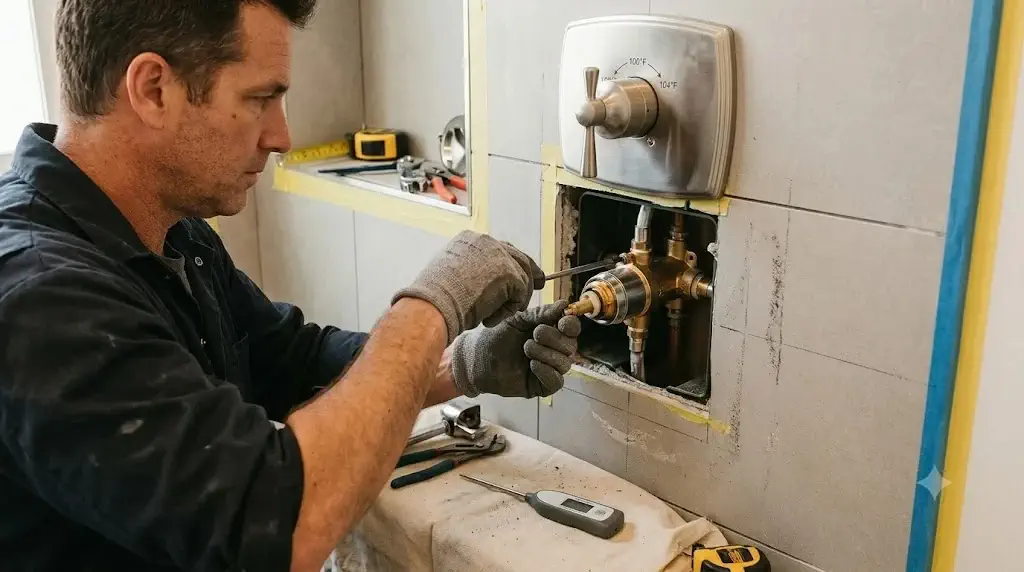
Selecting the best anti scald thermostatic shower valves for elderly skin requires replacing basic pressure-balancing fixtures with precision thermostatic mixing technology. Because aging skin suffers from dermal thinning, diminished cutaneous thermoreceptors, and reduced subcutaneous insulating fat, exposure to hot water over 120°F causes rapid, deep-tissue thermal burns. True ASSE 1016 Type T thermostatic cartridges actively modulate water temperature via paraffin wax motors, locking maximum outflow to a safe 104°F threshold and terminating flow within milliseconds if cold water fails.
- Thermal Vulnerability Threshold: At 140°F (the default setting on many domestic water heaters), elderly skin sustains a third-degree scalding burn in less than 2 seconds.
- Wax-Core Temperature Response: Thermostatic cartridges expand and contract mechanically at a microscopic level, holding mixed outlet temperatures stable within ±2°F even during major municipal pressure drops.
- Thermal Shock Jump Prevention: Stabilizing water temperature stops the abrupt reflexive jumps and panic steps that directly trigger falls on slick shower floors.
- Integrated Bathroom Defense: Pairing thermostatic valves with zero-barrier entries creates optimal walk-in shower safety, reinforced by handheld shower bars and wall-anchored shower grab bars.
Quick Reference Specification: Best Anti Scald Thermostatic Shower Valves for Elderly Skin
Evaluating the best anti scald thermostatic shower valves for elderly skin involves examining valve technologies, safety response speeds, temperature limiting caps, and ease of physical operation. The matrix below contrasts the core metrics across residential safety valves:
| Operational Parameter | Thermostatic Mixing Valve (ASSE 1016 Type T) | Pressure-Balance Valve (ASSE 1016 Type P) | Geriatric Clinical & Safety Impact |
|---|---|---|---|
| Temperature Control Mechanism | Expanding Paraffin Wax Motor Cartridge | Sliding brass/plastic diaphragm spool | Wax motors sense actual temperature, not just line pressure |
| Temperature Accuracy Margin | Maintains within ±2°F (±1.1°C) | Fluctuates by ±3°F to ±6°F under heater variance | Eliminates dangerous temperature spikes that blister fragile skin |
| Cold Water Failure Response | Instant automatic shut-off (< 0.5 seconds) | Slow flow restriction (bleeds residual hot water) | Zero thermal burn risk during complete municipal cold line cut |
| Integrated Max Limit Stop | Physical mechanical lock set at 100°F–104°F | Rotational limit ring (often bypassed or uncalibrated) | Prevents seniors with dementia or arthritis from forcing high heat |
| Volume vs. Temp Separation | Dual handles (Independent volume & temp) | Single handle (Turn farther for hotter water) | Allows full water pressure at safe, mild lukewarm temperatures |
| Thermal Shock Mitigation | 100% elimination of scalding surges | Partial (fails if water heater supply temperature surges) | Stops reflexive flinching that causes catastrophic fall injuries |
| Hardware Longevity / Descaling | Ceramic discs + polymer wax capsule (7–12 yrs) | Spool valves prone to mineral lockup (3–6 yrs) | High resistance to hard water lime scaling and calcification |
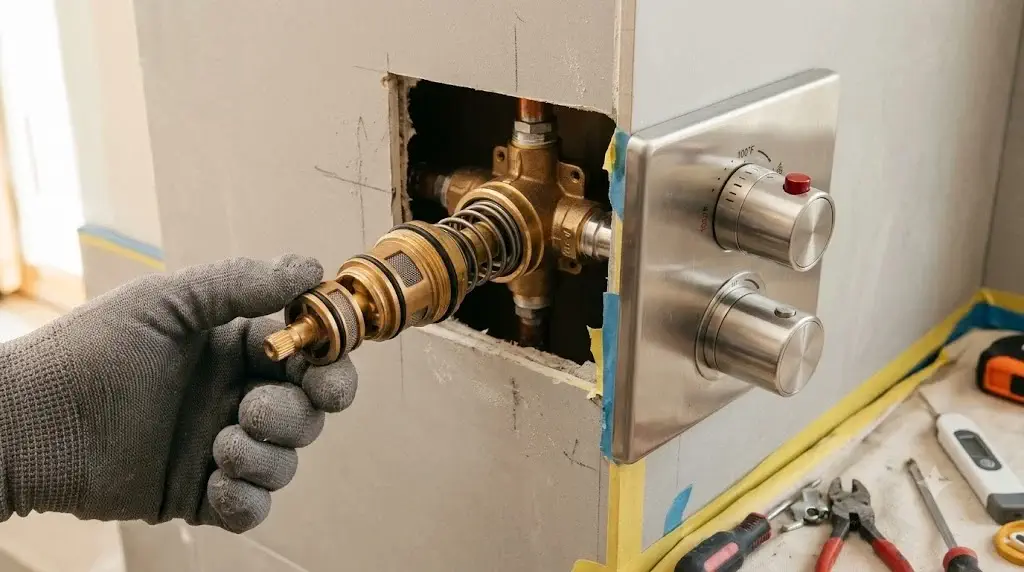
Precision safety engineering: cross-section of a thermostatic shower valve cartridge with an expanding wax element that automatically controls hot and cold water mixing.
Geriatric Epidermal Thinning Accelerates Third-Degree Scalding Rates Within Five Seconds
Aging skin undergoes significant physiological changes that dramatically lower its resistance to heat. Over decades of cellular aging, the human epidermis loses up to 20% of its thickness, while collagen synthesis declines and the subcutaneous adipose layer (fat insulation) thins out. Consequently, heat passes straight into the delicate capillary beds and dermal nerve endings with little natural protection.
These structural skin changes are compounded by sensory decline:
- Peripheral Neuropathy: Reduced cutaneous thermoreceptor density makes it harder for older adults to quickly notice that water has reached dangerous temperatures.
- Delayed Reflex Withdrawal: Cognitive and neuromuscular delays mean seniors take twice as long to pull their hands or bodies away from a sudden stream of hot water.
- Mobility Constraints: Seniors with arthritic joints, balance issues, or those using shower benches cannot easily step out of the spray when hot water suddenly surges.
The clinical time-temperature relationship for thermal burns clearly highlights this vulnerability. In healthy adults, water at 130°F takes roughly 30 seconds to produce a second- or third-degree burn. In an older adult with thinned skin, 130°F water causes irreversible full-thickness scalds in under 5 seconds, and water at 140°F burns the skin in less than 2 seconds.
Paraffin Wax Motors Regulate Mixed Water Temperatures Independently of Supply Pressures
Standard residential plumbing historically relied on pressure-balancing valves (certified under ASSE 1016 Type P). These valves feature a sliding piston or flexible rubber diaphragm that slides back and forth in response to pressure changes. When a nearby toilet flushes and siphons cold water, the valve slides to reduce the hot water flow proportionately, maintaining a balance between the two lines.
However, pressure-balancing valves do not actually measure temperature. If your water heater thermometer spikes, or if incoming cold water gets warmer in the summer, a pressure-balance valve will deliver dangerous water without adjusting.
True thermostatic valves (ASSE 1016 Type T) operate on thermal expansion physics. Inside the valve cartridge sits a copper capsule packed with specialized paraffin wax. When water passes over it:
- Immediate Volumetric Expansion: Rising water temperatures cause the wax inside the capsule to melt and expand instantly, pushing a piston that closes the hot-water port.
- Proportional Cold Blending: As the hot port restricts, the cold port opens wider, balancing the mix to maintain the dial’s exact setpoint within ±2°F.
- Automatic Thermal Cut-Off: If the cold water line loses pressure completely, the wax expands fully, blocking the hot water port entirely within fractions of a second to prevent burns.
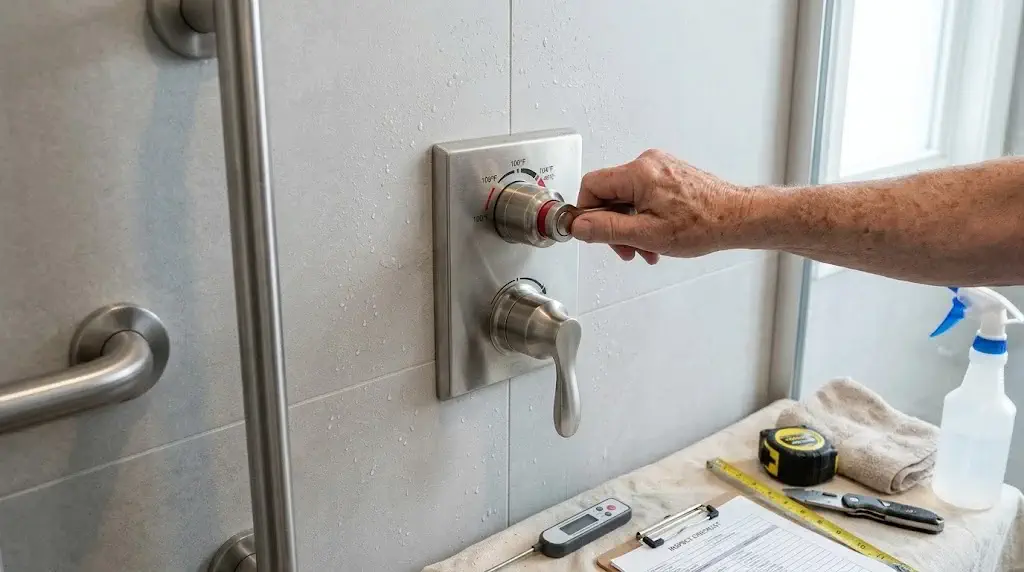
Safety controls: an accessible dual-handle thermostatic shower valve with large lever controls and a mechanical 104°F limit stop button.
Top Thermostatic Valve Systems Combine Precise Anti-Scald Stops and Ergonomic Levers
When choosing the best anti scald thermostatic shower valves for elderly skin, look for systems that offer both precision thermal protection and accessible, easy-to-use controls. These three leading systems stand out across residential aging-in-place installations:
1. Moen ExactTemp Thermostatic System (S3371 Rough-In Valve + TS3411 Trim Kit)
The Moen ExactTemp system delivers unmatched commercial-grade thermal stability. Its internal wax thermostatic motor continuously samples incoming hot and cold streams, automatically adjusting to keep water within ±2°F of your target. Because temperature and volume are controlled separately, seniors can leave the dial locked at a skin-safe 100°F (38°C) without ever having to re-adjust it each shower.
Check TS3411 Trim Kit on Amazon
2. Grohe 34159003 Grohtherm 1000 Dual-Handle Thermostatic Valve
Grohe uses their proprietary TurboStat technology, which features an ultra-responsive wax thermocouple that reacts to temperature fluctuations in just 0.3 seconds. Its SafeStop button physically halts the dial at 100°F (38°C), requiring a deliberate push of a safety tab to turn it higher. The exterior trim also incorporates CoolTouch channel routing, preventing the outer chrome body from getting dangerously hot to the touch.
3. Delta Faucet T17T267-SS TempAssure 17T Series Thermostatic Trim Kit
Delta’s 17T Series integrates an independent temperature-sensing wax cartridge inside their universal MultiChoice R10000 rough-in body. Its dual-function handle lets users fine-tune their water volume without shifting their selected temperature. An adjustable red rotational limit stop lets installers easily cap maximum rotation to meet ADA-recommended safety limits.
Accurate Temperature Calibration Demands Digital Submersible Thermocouple Gauges
Installing a thermostatic valve requires precise temperature calibration during rough-in to guarantee that the anti-scald limit stop functions correctly. Never rely on the factory preset markings on the trim plate; variances in domestic water heater supply temperatures can throw these off by 5°F to 15°F.
Follow these essential calibration steps during installation:
- Run Full Hot Water: Open the shower valve fully to hot and let it run for 3 to 5 minutes until your water heater reaches peak delivery temperature.
- Measure the Water Stream: Hold a calibrated digital thermocouple probe in the center of the water spray, roughly 2 inches below the showerhead or handheld wand.
- Adjust the Limit Cam: Remove the handle escutcheon to access the internal splined limit gear. Rotate the red limit stop gear clockwise to lower maximum temperature, or counterclockwise to raise it, until the digital thermometer reads exactly 102°F to 104°F (38.8°C to 40°C).
- Lock the Splined Gear: Push the gear firmly back onto the cartridge spline, tighten the brass retaining screw, and reinstall the trim knob.
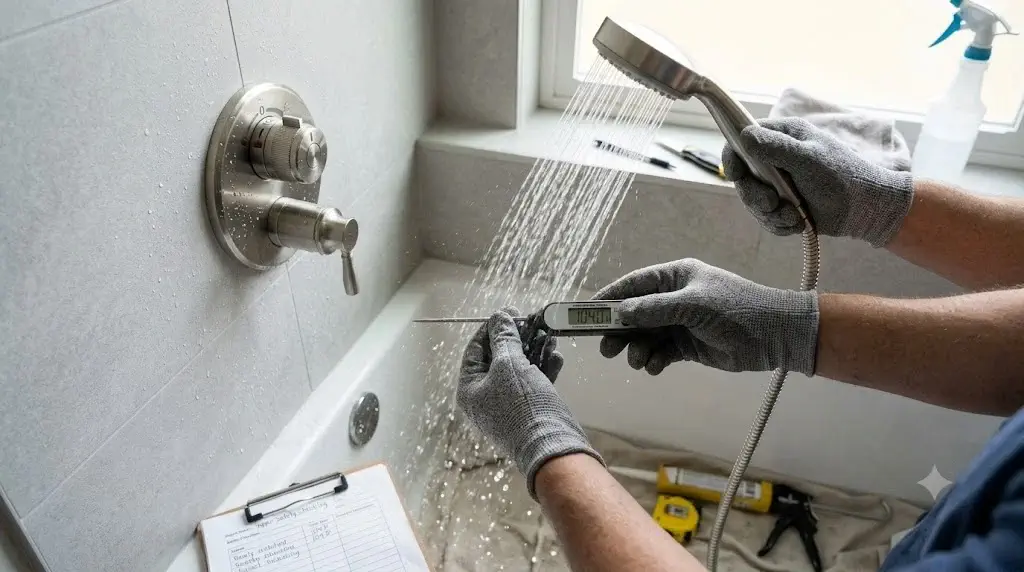
Calibration check: using a digital probe thermometer to calibrate the rotational limit stop gear on a thermostatic valve to a safe 104°F.
Uncontrolled Thermal Shock Triggers Reflexive Jumps That Cause Catastrophic Hip Fractures
Anti-scald valves do more than prevent burns—they play a vital role in preventing severe slip-and-fall injuries. When an older adult is unexpectedly hit with a surge of scalding hot or freezing water, their body experiences an involuntary sensory shock reaction. This reflex causes the bather to instinctively jump or step backward away from the spray.
On a wet, soapy shower surface, an unexpected backward step can easily result in a dangerous slip. Because older adults often experience loss of bone mineral density, the resulting fall against hard tile or a tub threshold frequently leads to broken hips or severe head trauma.
By ensuring water temperatures remain completely stable, thermostatic mixing valves eliminate the startle reflex that triggers these sudden slips. For complete protection, pair your valve upgrades with low-barrier thresholds and secure handholds to give seniors reliable, worry-free support during every shower.
Frequently Asked Questions About Anti-Scald Thermostatic Shower Valves
Why is elderly skin significantly more vulnerable to shower scalding?
The best anti scald thermostatic shower valves for elderly skin address age-related dermal thinning. As skin ages, the epidermis thins by up to 20% and loses its subcutaneous fat layer, which significantly reduces its natural insulation. Combined with peripheral neuropathy that delays sensory perception, water at 130°F (54.4°C) can cause full-thickness third-degree burns in an older adult in under 5 seconds, compared to 30 seconds for younger adults.
What is the difference between pressure balance valves and thermostatic valves?
Pressure balance valves (ASSE 1016 Type P) simply respond to changes in incoming line pressure, shifting a diaphragm to balance the ratio of hot and cold water. Thermostatic valves (ASSE 1016 Type T) directly measure the mixed water temperature using an internal paraffin wax motor. They dynamically adjust the mix to keep the temperature stable within ±2°F and shut down completely if the cold water line fails.
What is the safest maximum temperature setting for a senior’s shower?
Plumbing safety codes and geriatric specialists recommend capping maximum shower temperatures between 100°F and 104°F (37.7°C to 40°C). Setting the mechanical limit stop inside a thermostatic valve to 104°F prevents bathers from accidentally turning the dial into a dangerous temperature range.
Does an anti-scald valve protect against slipping and fall accidents?
Yes, by preventing thermal shock. Sudden bursts of scalding or freezing water cause an involuntary, reflexive jump or backward step. On slick shower tile, this sudden movement is a leading trigger for severe slip-and-fall accidents and hip fractures among older adults.
