
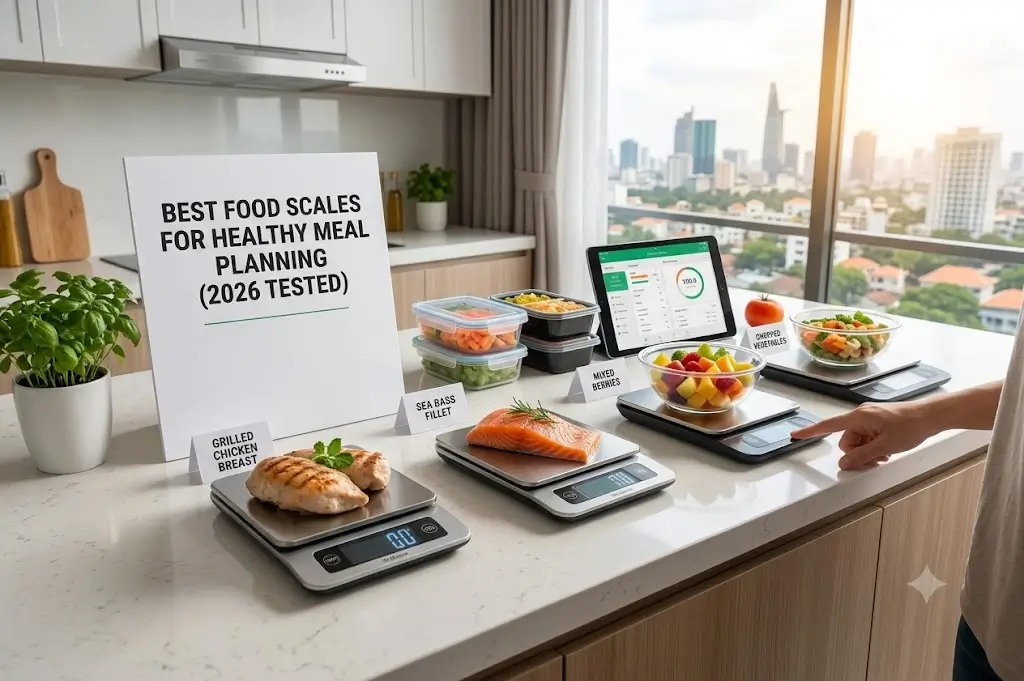
For older adults, usability matters as much as measurement capability. A scale that is accurate but difficult to read under a large bowl is less useful than one with a clear display and simple controls.
What Are the Best Food Scales for Healthy Meal Planning?
| Pick | Best for | Why it stands out |
|---|---|---|
| Escali Primo Digital Food Scale | Best overall | Lightweight, compact, simple two-button operation, 11-lb capacity |
| OXO Good Grips 11-Pound Stainless Steel Scale | Best display design | Pull-out display remains visible when using large bowls |
| Greater Goods Compact Digital Food Scale | Best compact option | Very small footprint while retaining an 11-lb capacity |
| Etekcity Food Kitchen Scale | Best budget direction | Simple digital weighing with common kitchen units |
| My Weigh KD-8000 | Best high-capacity option | Higher capacity for large batch preparation and baking |
Best overall: Escali Primo is the strongest choice when simplicity, compact size, and straightforward operation matter most. Food Network named it Best Overall in its 2026 kitchen-scale testing, while Bon Appétit continues to rank it highly after years of testing.
Affiliate Disclosure: AgingWellGuide may earn an affiliate commission from qualifying purchases made through links on this site. Our evaluations are independently determined by ergonomic practicality, accessibility, and consumer food-safety standards.
Why Use a Food Scale for Healthy Meal Planning?
A food scale provides a consistent way to measure ingredients by weight.
This can be useful for:
- Dividing a batch recipe into similar portions
- Measuring ingredients for recipes
- Comparing ingredient quantities
- Preparing meals for one or two people
- Reducing guesswork when recipes specify grams or ounces
- Keeping meal-prep containers reasonably consistent
- Measuring ingredients such as grains, beans, nuts, cheese, and produce (see how these anchor your intake in our guide to getting more protein from everyday foods)
A scale does not make a diet healthier by itself. Its value is that it provides a more consistent measurement method.
What Should You Look for in a Food Scale for Meal Planning?
| Feature | Why it matters |
|---|---|
| Readable display | Makes measurements easier to see |
| Tare function | Allows ingredients to be weighed in a bowl or container |
| 1-gram resolution | Provides useful precision for most meal-prep tasks |
| 11-lb or greater capacity | Handles most everyday kitchen containers and ingredients |
| Large weighing platform | Provides more room for bowls and plates |
| Low-profile design | Easier to store in a drawer or cabinet |
| Easy-clean surface | Reduces cleanup effort |
| Simple controls | Reduces unnecessary operating steps |
For most meal planning, you do not need laboratory-level precision. A scale that reads in 1-gram increments is sufficient for common ingredients and portioning tasks.
What Is the Best Overall Food Scale for Healthy Meal Planning?
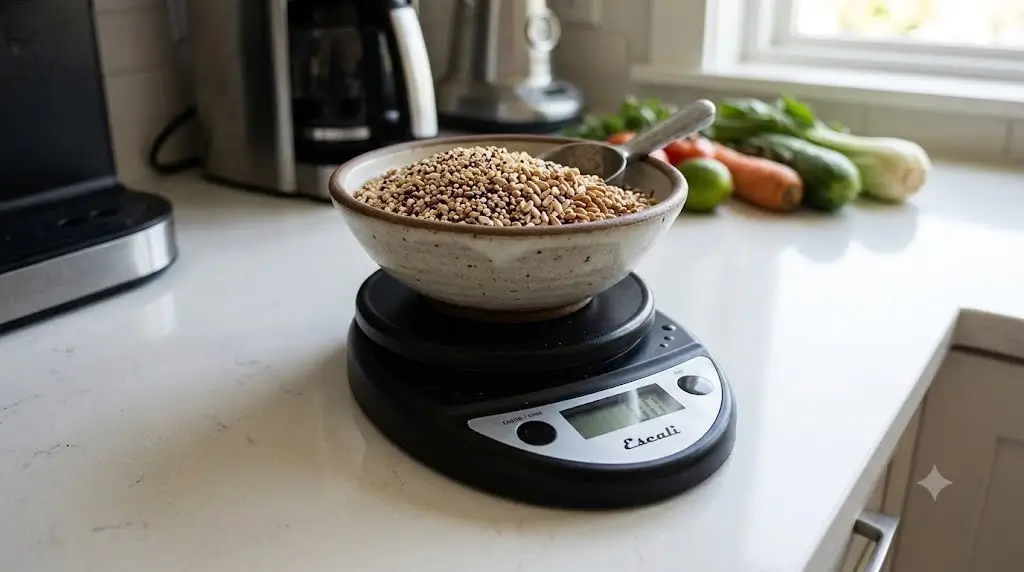
Escali Primo Digital Food Scale
Best for: most home meal-planning routines.
The Escali Primo is a compact digital scale with an 11-pound capacity and 1-gram increments. Bon Appétit currently lists it as its best kitchen scale overall and highlights its lightweight, compact design and accuracy. Food Network also selected it as its Best Overall kitchen scale in its 2026 testing.
The interface is deliberately simple, using two primary buttons for power/tare and unit selection.
Why it works well for meal planning:
- Compact footprint
- Lightweight construction
- 11-lb capacity
- 1-gram increments
- Simple controls
- Suitable for everyday ingredient measurement
Potential limitation: the display is not backlit. If lighting or visual contrast is a concern, the OXO’s pull-out display may be more useful.
What Is the Best Food Scale for Reading Measurements Under Large Bowls?
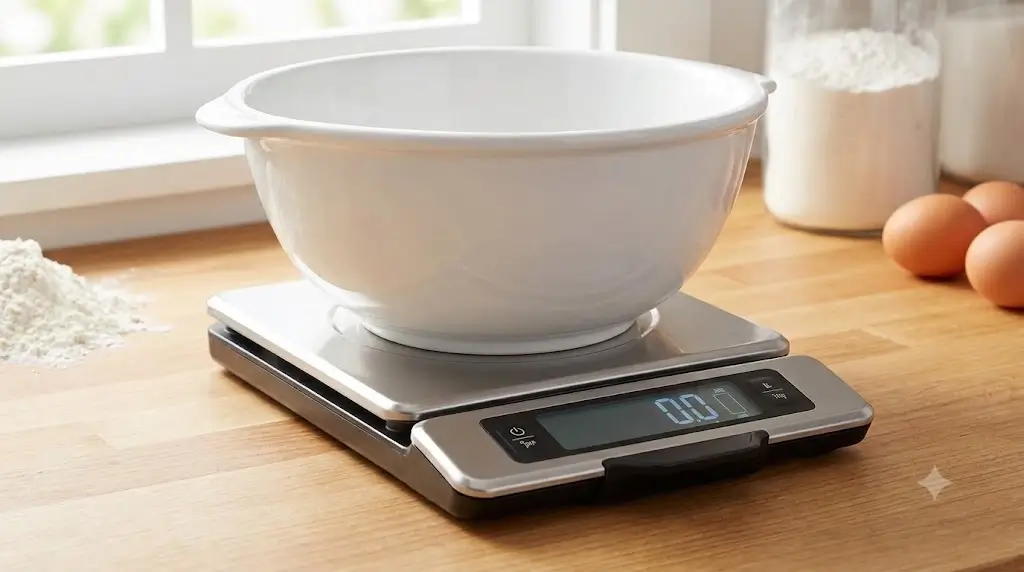
OXO Good Grips 11-Pound Stainless Steel Food Scale
Best for: users who frequently weigh food in large bowls.
The OXO Good Grips 11-Pound Stainless Steel Food Scale uses a pull-out display designed to remain visible when a large bowl would otherwise block the readout.
Food Network selected it as its Best for Large Measurements in 2026, while other current testing also highlights the pull-out display as its main usability advantage.
This feature is particularly useful when:
- You prepare large batches.
- You use large mixing bowls.
- You frequently weigh several ingredients in one container.
- You find it difficult to lean over a large bowl to read a display.
The stainless-steel weighing surface is also easier to wipe clean than many textured surfaces.
Potential limitation: the OXO occupies more space and generally costs more than the simplest compact scales.
What Is the Best Compact Food Scale for Meal Planning?
Greater Goods Compact Digital Food Scale
Best for: small kitchens, limited counter space, and simple everyday weighing.
Food Network selected the Greater Goods Compact Digital Kitchen Scale as its Best Compact option after testing 10 digital scales. It has a very small footprint while retaining an 11-pound maximum capacity. Food Network also found it accurate, stable, easy to clean, and easy to operate.
This makes it particularly useful when the scale needs to be stored in a drawer between uses.
Why choose it:
- Very small footprint
- 11-lb capacity
- Simple controls
- Easy-clean surface
- Useful for small kitchens
Potential limitation: a compact platform can become crowded when weighing large bowls or plates.
What Is the Best Budget Food Scale for Healthy Meal Planning?
Etekcity Food Kitchen Scale
Best for: basic weighing at a lower price.
Etekcity’s basic digital food scales are widely available and offer the fundamental functions needed for meal preparation: digital weight readings, common measurement units, tare operation, and everyday kitchen capacity.
Food Network selected an Etekcity Food Kitchen Scale as its Best for Liquids in its 2026 testing.
A basic Etekcity model can make sense if you primarily need:
- Ingredient weighing
- Recipe measurement
- Simple meal prep
- Occasional portion measurement
- A low-cost replacement for measuring by volume
Potential limitation: model features vary, so check the exact model’s capacity, display, dimensions, and cleaning instructions before buying.
What Is the Best High-Capacity Food Scale?
My Weigh KD-8000
Best for: large batches and users who regularly weigh substantial quantities.
The My Weigh KD-8000 is designed for higher-capacity kitchen weighing and is particularly relevant to large-batch cooking and baking.
Current 2026 meal-prep comparisons list it at a 17.6-pound capacity, substantially above the 11-pound capacity common among compact household scales.
For ordinary meal planning, that extra capacity is usually unnecessary.
Choose it when you regularly work with:
- Large mixing bowls
- Large batches of dough
- Bulk meal preparation
- Heavy ingredients
- Large food-preparation containers
Potential limitation: it is larger than the compact scales most households need for ordinary meal preparation.
Is 1-Gram Accuracy Enough for Healthy Meal Planning?
Yes, for most everyday meal-planning tasks.
A scale displaying 1-gram increments is sufficiently precise for weighing common foods such as:
- Rice
- Oats
- Beans
- Vegetables
- Fruit
- Meat
- Fish
- Nuts
- Cheese
More precise 0.1-gram scales exist, but that additional resolution is generally more relevant to very small quantities, specialized baking, spices, coffee, or other precision tasks than ordinary meal planning.
Is a 0.1-Gram Food Scale Better Than a 1-Gram Scale?
Not necessarily.
More displayed digits do not automatically make a scale more useful for meal planning.
| Resolution | Best suited to |
|---|---|
| 1 g | Everyday meal prep and ingredient measurement |
| 0.1 g | Very small ingredients and specialized precision tasks |
For most households, choosing a scale with an easy-to-read display and simple controls is more valuable than paying extra for extremely fine resolution.
Why Is the Tare Function Important?
Tare is one of the most useful features on a food scale.
It lets you place an empty bowl on the scale, reset the display to zero, and then weigh the food without manually subtracting the bowl’s weight.
For example:
- Place the container on the platform.
- Press tare.
- Add the first ingredient.
- Record or use the measurement.
- Press tare again if adding another ingredient to the same bowl.
This makes batch cooking and recipe preparation considerably simpler.
Why Does Display Readability Matter for Older Adults?
Because an accurate measurement is not useful if the number is difficult to see.
Display design becomes particularly important when:
- A large bowl partially blocks the display.
- The kitchen has limited lighting.
- The user needs larger digits.
- The scale sits at an awkward viewing angle.
- The user does not want to lean over the container.
This is where the OXO’s pull-out display has a meaningful advantage over many conventional layouts.
Is a Backlit Display Important?
It can be useful, but it is not essential.
A backlit display can improve visibility in a darker kitchen. However, a large high-contrast display positioned where it remains visible can be just as useful.
The Escali Primo illustrates the trade-off: Bon Appétit rates it highly for its simplicity and accuracy but notes that its display is not backlit.
If display visibility is a major concern, prioritize the actual viewing angle and digit size rather than looking only for the word “backlit.”
What Capacity Is Best for Meal Planning?
An 11-pound capacity is enough for most households.
It accommodates ordinary bowls and ingredients while keeping the scale relatively compact.
| Capacity | Typical use |
|---|---|
| Up to 6 lb | Small ingredients and basic cooking |
| About 11 lb | Most meal prep and everyday cooking |
| 13–18 lb+ | Large batches and heavier containers |
Unless you regularly prepare large batches, buying a very high-capacity scale may simply increase its size without providing a meaningful benefit.
Should You Choose a Stainless-Steel or Glass Platform?
Both can work well, but they have different practical characteristics.
| Platform | Advantages | Considerations |
|---|---|---|
| Stainless steel | Easy to wipe, durable, useful for food prep | Can show fingerprints |
| Glass | Smooth, easy to wipe, often very thin | Can be less forgiving if struck or dropped |
| Plastic | Lightweight and inexpensive | May show scratches or stains depending on material |
The most important factor is whether the weighing surface is easy to clean after normal food preparation.
Electrical Kitchen Safety Notice: Never submerge an electronic kitchen scale in a sink or place it in the dishwasher. Liquid seepage beneath the platform destroys load sensors. Clean exclusively with a damp cloth and mild dish soap.
Are Food Scales Easy to Use for Older Adults?
Most basic digital scales are straightforward, but some design choices can make a significant difference.
Prioritize:
- Large, high-contrast numbers
- Clearly separated buttons
- A simple tare button
- Minimal menu navigation
- Stable feet
- A platform large enough for normal bowls
- A display that remains visible during use
For an older adult with limited dexterity, two or three obvious buttons may be preferable to a touchscreen or app-dependent interface.
Do You Need a Smart Food Scale With an App?
No. A connected scale can be useful for people who specifically want digital food databases or automated nutrition tracking, but it is not necessary for healthy meal planning.
A conventional scale can accomplish the core task:
Place food on scale → tare → read weight → prepare or divide the food.
For AgingWellGuide’s practical meal-planning use case, simplicity is usually a stronger priority than adding an app.
Should You Buy a Nutrition-Tracking Scale?
Only if you specifically want the additional tracking features.
Some nutrition scales can connect food weights with nutrient databases, but database accuracy and food-entry quality can vary. The underlying measurement is still only as useful as the food identification and serving information associated with it.
For general healthy meal planning, a simple accurate scale is usually enough.
Can a Food Scale Help With Meal Prep for One?
Yes. A scale can be particularly useful when cooking for one because it helps divide ingredients without relying on approximate volume measurements.
For example, you can weigh:
- A batch of cooked rice before dividing it.
- Prepared vegetables into individual containers.
- Ingredients for several breakfasts.
- Nuts or seeds for snacks.
- Ingredients for a soup or stew.
For a broader system focused specifically on planning meals for one person, see Healthy Meal Planning for One Person.
Can a Food Scale Help With Meal Prep for Two?
Yes. It can make batch preparation easier when two people want reasonably consistent portions.
For example, after preparing a large recipe, you can divide the finished food among several containers using weight rather than trying to estimate equal portions visually.
This is especially useful for foods that are difficult to divide evenly by volume.
Can a Food Scale Replace Measuring Cups?
Not completely. The two methods serve different purposes.
| Tool | Best use |
|---|---|
| Food scale | Weight-based ingredient measurement |
| Measuring cups | Volume-based recipes and liquids |
| Measuring spoons | Small-volume ingredients |
When a recipe specifies grams or ounces, a scale provides the most direct measurement.
For liquid ingredients, cups and spoons can remain convenient, although many scales also provide volume modes for certain liquids.
How Do You Use a Food Scale for Meal Planning?
- Place the scale on a stable, level surface.
- Turn it on.
- Select grams or another appropriate unit.
- Place the empty container on the platform.
- Press tare.
- Add the ingredient.
- Record the weight if needed.
- Tare again before adding another ingredient to the same container.
Should You Weigh Food Before or After Cooking?
Follow the measurement convention used by the recipe or food database.
Cooking can change the water content and therefore the weight of many foods.
For example, rice and pasta can gain substantial weight after absorbing water, while meat can lose weight during cooking. Therefore, “100 grams” of a food before cooking is not necessarily equivalent to “100 grams” after cooking. Consistency matters more than choosing one universal method.
How Can a Food Scale Make Batch Cooking Easier?
A scale can turn a large batch into consistent containers.
For example:
- Prepare the complete recipe.
- Place an empty meal-prep container on the scale (pair with our reviewed best meal prep containers for older adults).
- Tare it.
- Add the prepared food.
- Stop at your chosen portion size.
- Repeat for the remaining containers.
This creates more consistent portions without requiring several measuring cups.
What Are the Biggest Food Scale Buying Mistakes?
- Buying based only on maximum capacity: most households do not need extremely high capacity.
- Ignoring display placement: large bowls can hide poorly positioned displays.
- Choosing unnecessary smart features: apps add complexity if you only need weighing.
- Ignoring the tare button: tare is one of the most useful features for meal preparation.
- Buying a scale that is too small: tiny platforms can be frustrating with normal bowls.
- Overvaluing ultra-fine precision: 0.1-gram resolution is rarely necessary for everyday meal planning.
- Ignoring cleaning: food residue can accumulate around buttons and platform edges.
- Forgetting battery requirements: check the power source before buying.
How Should You Choose Between the Best Food Scales?
| If your priority is… | Best choice |
|---|---|
| Simple everyday meal planning | Escali Primo |
| Large bowls and maximum display visibility | OXO Good Grips 11-Pound |
| Smallest practical footprint | Greater Goods Compact |
| Lower-cost basic weighing | Etekcity Food Kitchen Scale |
| Large batches | My Weigh KD-8000 |
How Does a Food Scale Fit Into Healthy Meal Planning?
A food scale is best viewed as a consistency tool, not a health solution.
It can help you:
- Follow recipes more consistently.
- Divide batch meals evenly.
- Reduce guesswork.
- Measure ingredients by weight.
- Prepare repeatable meals.
- Organize food into containers.
It does not determine what foods you should eat or how much any particular person needs. For a broader guide to constructing balanced meals, see How to Plan Balanced Meals for Older Adults.
What Is the Best Food Scale for a Small Kitchen?
Greater Goods Compact Digital Food Scale is the strongest choice when counter and storage space are limited. Food Network specifically selected it as its Best Compact option and found it accurate and easy to operate despite its small footprint.
Escali Primo is another strong choice because it combines a compact form with an 11-pound capacity.
What Is the Best Food Scale for Someone Who Has Difficulty Seeing the Display?
OXO Good Grips 11-Pound is the most interesting option because its pull-out display can move away from the weighing platform.
This is particularly useful when a large bowl would otherwise block the display. If visual accessibility is a significant concern, consider the display in the actual kitchen environment rather than relying only on the listed screen specifications.
What Is the Best Food Scale for Someone Who Wants Simple Controls?
Escali Primo is a strong choice because its interface is deliberately simple. Bon Appétit highlights its two-button operation as part of its long-running appeal.
A simple interface can be preferable to app-connected or touchscreen scales when the primary job is simply measuring ingredients.
Food Scale Buying Checklist
- ☐ Is the display easy to see?
- ☐ Can you easily find the tare button?
- ☐ Is 1-gram resolution sufficient for your normal tasks?
- ☐ Is the platform large enough for your bowls?
- ☐ Is the scale light enough to move and store easily?
- ☐ Is the weighing surface easy to clean?
- ☐ Is the capacity appropriate for your largest normal batch?
- ☐ Are the controls simple enough to use comfortably?
- ☐ Does the scale use readily available batteries or another convenient power source?
- ☐ Do you actually need app or nutrition-database features?
Frequently Asked Questions
What is the best food scale for healthy meal planning?
Escali Primo is the strongest overall choice for most households because it is compact, lightweight, simple to operate, and has an 11-pound capacity. Food Network and Bon Appétit both currently rate it highly.
What is the best food scale for older adults?
A scale with a readable display, simple controls, easy tare operation, and manageable weight is generally the best fit. OXO is particularly useful when display visibility is a priority, while Escali Primo is attractive when simplicity and low weight matter most.
Is a food scale necessary for healthy eating?
No. A scale is an optional tool that improves consistency when measuring ingredients or dividing prepared meals. It is not required for a healthy eating pattern.
Is 1-gram accuracy enough for meal prep?
Yes. One-gram resolution is sufficient for most everyday meal-preparation and ingredient-weighing tasks.
Do I need a smart food scale?
No. Smart scales can be useful if you specifically want app-based nutrition tracking, but a conventional digital scale is sufficient for measuring ingredients and preparing consistent portions.
What is the best food scale for large bowls?
The OXO Good Grips 11-Pound scale is particularly useful because its pull-out display can remain visible when a large bowl sits on the platform.
What is the best compact food scale?
Food Network selected the Greater Goods Compact Digital Kitchen Scale as its Best Compact option in 2026. It combines a very small footprint with an 11-pound capacity.
Can you use a food scale for meal prep containers?
Yes. Place the empty container on the scale, press tare, and add the prepared food. This can help make portions more consistent across several containers.
Should food be weighed before or after cooking?
Use whichever measurement convention your recipe or food database specifies and remain consistent. Cooking changes the water content and therefore the weight of many foods.
Can a food scale replace measuring cups?
Not completely. A scale measures weight, while cups and spoons measure volume. Both remain useful depending on the recipe and ingredient.
Is 0.1-gram precision better than 1 gram?
Not necessarily. Fine precision is useful for very small quantities, but 1-gram resolution is adequate for most meal-planning tasks.
What capacity should a food scale have?
An 11-pound capacity is sufficient for most household meal prep. Higher capacity becomes useful for large batches or heavy containers.
The Bottom Line
The best food scale for healthy meal planning is not necessarily the most precise or feature-rich model. It is the one that makes weighing ingredients simple enough that you will actually use it.
Escali Primo is the best overall choice for straightforward meal planning. OXO Good Grips 11-Pound is better when display visibility and large bowls are priorities. Greater Goods Compact is the better choice for small kitchens, while Etekcity makes sense for basic budget weighing and My Weigh KD-8000 for unusually large batches.
For most households, prioritize readability, tare operation, appropriate capacity, easy cleaning, and simple controls before paying extra for smart features or ultra-fine precision.
Editorial Methodology
This guide evaluates food scales specifically for healthy meal-planning workflows rather than weight-loss tracking. The criteria include display readability, tare operation, capacity, platform size, portability, cleaning, control simplicity, and usefulness for batch meal preparation. Current independent testing from Food Network and Bon Appétit was used for product-category context. AgingWellGuide does not claim hands-on testing of these products unless explicitly stated.
Sources
- Food Network — 5 Best Kitchen Scales of 2026, Tested and Reviewed
- Bon Appétit — Best Kitchen Scales, Tested Over a Decade, 2026
- Serious Eats — Escali Kitchen Scale Review, 2026
- Kitchen Gear Central — Best Kitchen Scales for Meal Prep 2026
Editorial standard: AgingWellGuide evaluates everyday kitchen essentials through an ergonomic, accessibility, and practical meal-prep lens tailored specifically to older adults and home cooks prioritizing long-term health consistency.
