
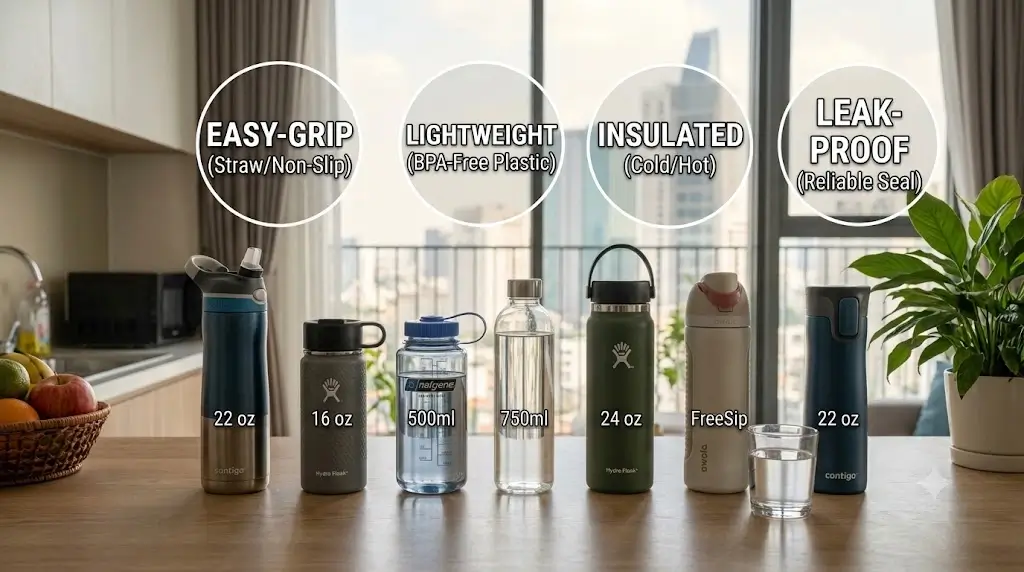
There is no single best bottle for everyone. Hand strength, dexterity, drinking preference, portability, and whether the bottle will be used mainly at home or outdoors can change the best choice.
Current 2026 water-bottle testing from REI emphasizes practical factors such as carrying weight, ease of cleaning, and real-world usability rather than simply judging bottles by capacity or insulation.
What Are the Best Water Bottles for Older Adults?
| Pick | Best for | Why it stands out |
|---|---|---|
| Owala FreeSip 24 oz | Best overall | Push-button opening, two drinking methods, carry loop, leakproof lid |
| Contigo Cortland Chill 2.0 24 oz | Best for one-handed drinking | Push-button AUTOSEAL operation and integrated carry handle |
| Nalgene 32 oz On-The-Fly | Best lightweight option | Lightweight body and one-hand lock-top opening |
| CamelBak Eddy+ 25 oz | Best straw bottle | Lightweight, carry handle, flip-bite-sip design |
| Nalgene 32 oz Wide Mouth | Best simple bottle | Very light, wide opening, dishwasher-safe, simple screw lid |
Best overall: Owala FreeSip 24 oz is the strongest all-around choice when convenient opening, flexible drinking, and portability matter more than minimizing weight.
Affiliate Disclosure: AgingWellGuide may earn an affiliate commission from qualifying purchases made through links on this page. Our selections are based strictly on independent testing, ergonomic accessibility for aging hands, and daily usability standards.
What Should Older Adults Look for in a Water Bottle?
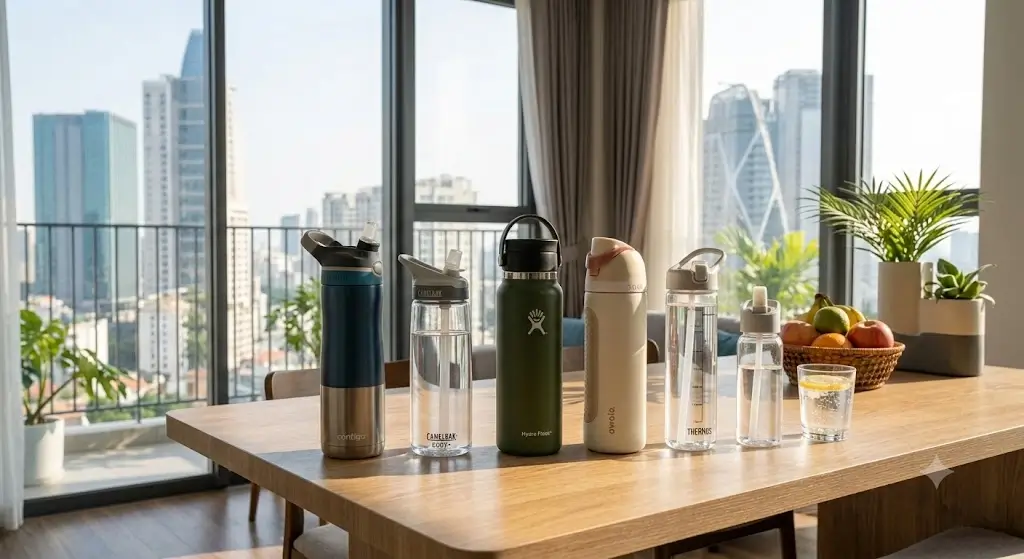
The most important features are related to daily usability, not marketing features.
| Feature | Why it matters |
|---|---|
| Low weight | Easier to lift when full |
| Easy-open lid | Reduces hand and finger effort |
| Comfortable grip | Makes repeated handling easier |
| One-handed operation | Useful when the other hand is occupied |
| Leak-resistant design | Reduces spills during carrying |
| Clear or visible water level | Makes it easier to see whether the bottle needs refilling |
| Easy cleaning | Reduces maintenance effort |
| Appropriate capacity | Avoids unnecessary weight when full |
REI’s 2026 testing is a useful reminder that a bottle’s weight can become much more noticeable after it has been carried for a while.
What Is the Best Overall Water Bottle for Older Adults?
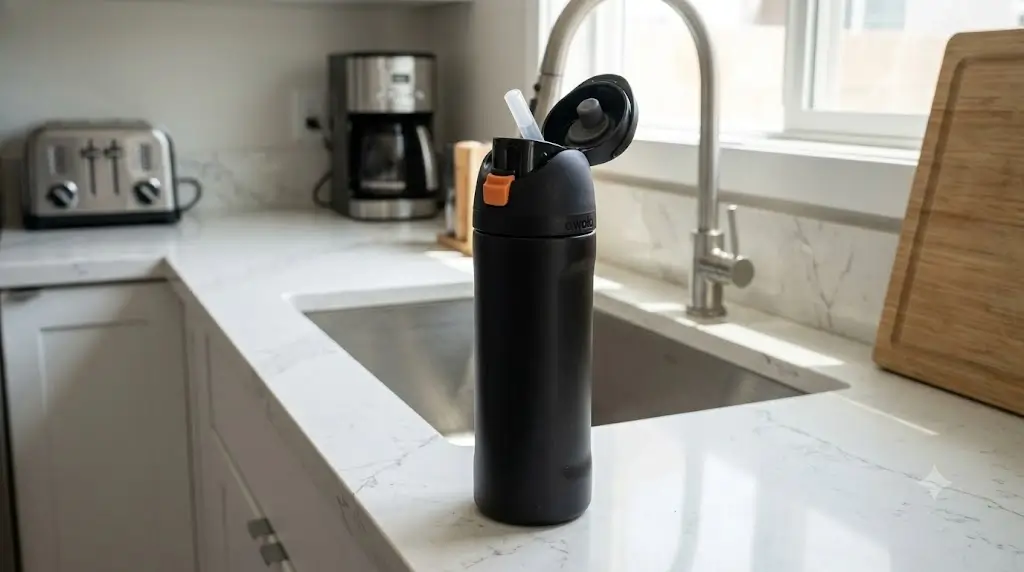
Owala FreeSip 24 oz
Best for: most everyday users who want an easy, versatile bottle.
The Owala FreeSip combines a push-button lid with two ways to drink: through its built-in straw or through the larger opening. The 24-ounce model is 10.68 inches tall and 3.12 inches in diameter. Owala says the bottle is leakproof, has a carry loop, and uses a wide opening for cleaning and adding ice.
That combination makes it unusually flexible. Someone who prefers sipping through a straw can do so without changing bottles, while someone who prefers drinking from a conventional opening can tilt the bottle and drink that way.
Why it works well for older adults:
- Push-button lid instead of a traditional screw cap
- Two drinking methods
- Integrated carry loop
- Leakproof lid
- Wide opening for cleaning
- 24-ounce size is easier to handle than larger versions
Potential drawback: the stainless-steel insulated construction makes it substantially heavier than lightweight plastic bottles. If lifting weight is the main concern, a Nalgene or CamelBak plastic bottle may be a better fit.
What Is the Best Water Bottle for One-Handed Drinking?
Contigo Cortland Chill 2.0 24 oz
Best for: users who prefer push-button, one-handed operation.
The Contigo Cortland Chill 2.0 uses an AUTOSEAL button. Press the button to drink; release it and the spout automatically seals. Contigo also adds a button lock, protective spout cover, and integrated carry handle.
The 24-ounce stainless-steel model is vacuum insulated and designed to keep beverages cold for up to 24 hours. The lid is top-rack dishwasher-safe, and Contigo says the underside opens for easier cleaning.
Why choose it:
- Push-button drinking
- Automatic sealing after releasing the button
- Integrated carry handle
- Protective spout cover
- Dishwasher-safe lid
Potential drawback: the button-and-lock system adds more components than a basic screw-top bottle. Someone who prefers maximum simplicity may find a conventional wide-mouth bottle easier.
What Is the Best Lightweight Water Bottle for Older Adults?
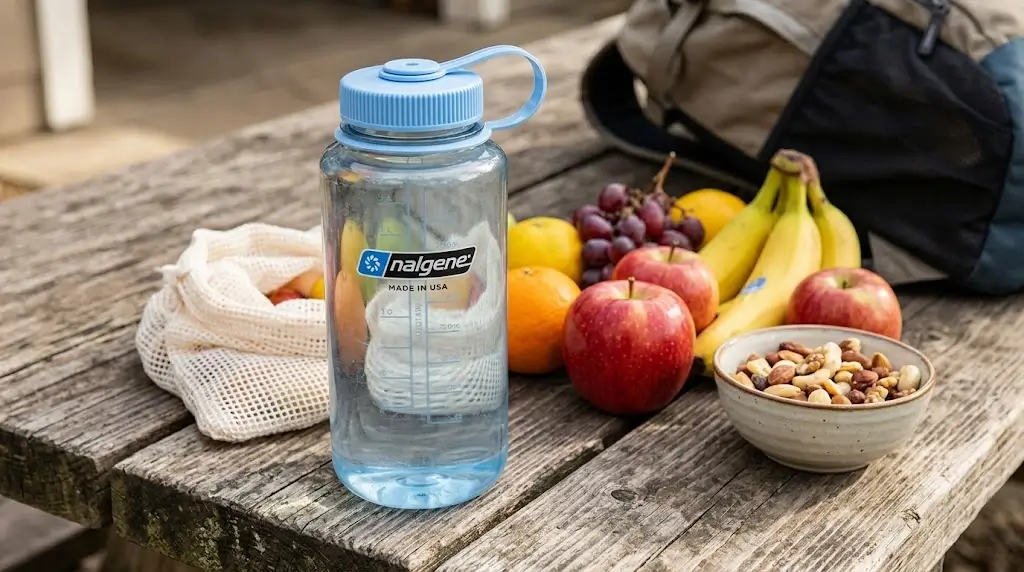
Nalgene 32 oz On-The-Fly
Best for: minimizing bottle weight while retaining one-handed opening.
The Nalgene On-The-Fly combines the company’s lightweight Tritan Renew bottle with a lock-top design. The 32-ounce version weighs 4.8 ounces according to Nalgene and has a one-hand opening mechanism. Nalgene also lists it as dishwasher-safe and leakproof.
That low empty weight is a meaningful advantage when the bottle will be carried frequently.
Why choose it:
- Only 4.8 ounces empty
- One-hand opening
- 32-ounce capacity
- Dishwasher-safe
- Leakproof design
- Tritan Renew construction
Potential drawback: it does not provide the insulated cold retention of the stainless-steel picks. It is primarily a lightweight everyday hydration tool.
What Is the Best Straw Water Bottle for Older Adults?
CamelBak Eddy+ 25 oz
Best for: people who prefer drinking through a straw.
The CamelBak Eddy+ uses a flip, bite, and sip drinking system. The 25-ounce Tritan Renew bottle weighs 174 grams (6 ounces), has a comfortable carry handle, and is dishwasher-safe. CamelBak describes it as leakproof when closed and spillproof when open.
The straw-style design means the bottle does not have to be tilted as much during normal drinking.
Why choose it:
- Straw drinking
- Lightweight 174-gram body
- Large carry handle
- Dishwasher-safe bottle and cap
- Leakproof when closed
- 25-ounce capacity
Potential drawback: the bite valve and straw create additional parts that need to be cleaned. People who prefer the simplest possible lid may prefer Nalgene.
What Is the Best Simple Water Bottle for Older Adults?
Nalgene 32 oz Wide Mouth
Best for: people who want a lightweight bottle without a complicated drinking mechanism.
The classic Nalgene 32-ounce Wide Mouth weighs 6.25 ounces and uses a straightforward wide-mouth screw lid. Nalgene lists it as leakproof and dishwasher-safe, with a 2.5-inch cap diameter and a 3.5-inch bottle diameter.
The wide opening is useful for adding ice and makes the inside relatively accessible during cleaning.
Why choose it:
- Simple screw-top design
- 6.25-ounce empty weight
- Large opening
- Dishwasher-safe
- Leakproof
- Durable Tritan Renew construction
Potential drawback: the screw-top lid requires twisting. For someone with limited hand strength or difficulty with repetitive twisting, a push-button or straw bottle may be easier.
Is a Lightweight Water Bottle Better for Older Adults?
Often, yes. Bottle weight matters twice: the weight of the empty bottle and the weight after it is filled.
A large stainless-steel bottle can become noticeably heavy when full. That may be irrelevant to someone with strong grip and arm strength but important to someone who finds lifting or carrying difficult.
| Priority | Better direction |
|---|---|
| Lowest bottle weight | Nalgene On-The-Fly |
| Lightweight + simple | Nalgene Wide Mouth |
| Lightweight + straw | CamelBak Eddy+ |
| Insulation + easy opening | Owala or Contigo |
If lifting is difficult, it can be smarter to use a smaller bottle and refill it more frequently rather than carrying a very large bottle.
Are Stainless Steel Water Bottles Too Heavy for Older Adults?
Not necessarily. Stainless steel is useful when insulation and durability are priorities, but the extra weight should be considered.
The Owala FreeSip, for example, combines stainless-steel insulation with a 24-ounce capacity, while the Nalgene and CamelBak plastic options emphasize lower weight.
The right choice depends on the user’s ability to lift a full bottle comfortably.
Is a Straw Bottle Better for Older Adults?
It depends on drinking preference and handling ability.
A straw can reduce the need to tilt a bottle, which may be convenient for some users. CamelBak Eddy+ is specifically designed around a flip-bite-sip straw system.
However, straw systems contain additional components that require cleaning.
| Drinking style | Best fit |
|---|---|
| Straw | CamelBak Eddy+ |
| Straw or wide opening | Owala FreeSip |
| Push-button spout | Contigo Cortland |
| Traditional opening | Nalgene Wide Mouth |
What Type of Water Bottle Lid Is Easiest to Open?
There is no single answer because hand strength and dexterity differ.
Generally:
- Push-button lids: can reduce twisting.
- Straw lids: can allow drinking without removing a cap.
- Wide-mouth screw tops: have fewer moving parts but require twisting.
- Lock-top lids: can combine one-handed opening with a relatively simple mechanism.
For someone who struggles with twisting, a push-button or one-hand lid is worth considering first.
What Water Bottle Is Best for Limited Hand Strength?
Start with a bottle that minimizes twisting and does not require a strong pinch.
Contigo Cortland uses a push-button AUTOSEAL mechanism, while Nalgene’s On-The-Fly uses a one-hand lock-top. Owala uses a push-button opening with an integrated carry loop.
When possible, test the actual opening motion rather than judging a bottle by its description.
What Water Bottle Is Best for Small Hands?
A narrower, smaller-capacity bottle is generally easier to grip than a very wide or oversized model.
Capacity should not be the only consideration. A 40-ounce bottle may reduce refilling, but its diameter and full weight can make it substantially harder to handle.
For many users, a 20- to 25-ounce format offers a practical compromise between capacity and handling.
Are Water Bottles With Handles Better for Older Adults?
They can be. A carry handle provides another way to hold the bottle, particularly when gripping a smooth cylindrical body is uncomfortable.
Contigo includes an integrated carry handle, CamelBak Eddy+ has a large carry handle, and Owala uses a hinged carry loop.
However, the handle should still be comfortable when the bottle is full. A small loop is useful for carrying but may not function as a comfortable lifting handle for everyone.
Should Older Adults Choose a Transparent Water Bottle?
It can be useful if seeing the water level helps with routine building.
A transparent or translucent bottle makes it easy to see whether it needs refilling without opening it.
This is particularly useful for people who are trying to make regular drinking part of their daily routine.
It is a convenience feature, not a medical requirement.
Are Measurement Markings Useful?
Measurement markings can help some people understand how much water remains in the bottle.
They are especially useful when a person wants a simple visual cue for refilling.
Clinical Fluid Restriction Caution: While water bottle measurement lines help monitor daily fluid intake, individuals diagnosed with congestive heart failure (CHF), chronic kidney disease (CKD), or severe hyponatremia must strictly adhere to their nephrologist’s or cardiologist’s daily fluid prescription rather than attempting to maximize intake.
However, markings should not be interpreted as a universal prescription for how much an individual must drink. Fluid needs vary considerably between people. For foundational advice on balancing hydration with other dietary elements, explore our complete guide to healthy eating after 50.
What Size Water Bottle Is Best for Older Adults?
Choose the smallest capacity that comfortably fits the person’s normal routine.
| Capacity | Best use |
|---|---|
| 16–20 oz | Small hands, bedside use, short outings |
| 20–25 oz | Everyday carrying and commuting |
| 32 oz | Fewer refills, home or longer outings |
| 40 oz+ | Large-volume use when weight is not a concern |
There is no nutritional advantage to choosing a larger bottle simply because it holds more water. The practical question is whether the person can comfortably lift and use it.
Are Insulated Water Bottles Worth It?
They can be worth it if temperature matters.
Owala FreeSip and Contigo Cortland Chill both use insulated stainless-steel construction and are designed to keep beverages cold for extended periods.
Insulation can make cold water more appealing during hot weather or long outings.
The trade-off is weight. If a person rarely needs cold-water retention, a lightweight plastic bottle may be more practical.
What Is Easier to Clean: a Straw Bottle or Wide-Mouth Bottle?
A wide-mouth bottle is generally simpler to clean because it has fewer small drinking components.
Straw bottles can still be easy to clean, but the straw and valve need attention.
CamelBak says the Eddy+ bottle and cap are dishwasher-safe, while Owala describes its FreeSip design as easy to disassemble with minimal hard-to-reach surfaces.
For someone who dislikes bottle maintenance, simplicity may be more important than drinking-style features.
What Water Bottle Is Best for Home Use?
For primarily home use, a lightweight bottle with a simple lid is often sufficient.
Nalgene Wide Mouth is particularly practical when insulation is not important. Its 32-ounce bottle weighs 6.25 ounces and is dishwasher-safe.
A larger bottle can also reduce the number of trips to the kitchen, provided the user can comfortably lift it when full.
What Water Bottle Is Best for Walking or Exercise?
For walking, portability and grip matter more than maximum capacity.
A 20- to 25-ounce bottle with a carry loop or handle is usually easier to carry than a large 40-ounce bottle.
For outdoor use, insulation can be useful during hot weather, while a lightweight plastic bottle can be preferable when carrying weight is the primary concern.
What Water Bottle Is Best for Bedside Use?
A smaller, stable bottle with an easy-open lid is usually more practical beside the bed.
Look for:
- Compact size
- Leak-resistant lid
- Easy opening
- Stable base
- Comfortable grip
- Easy cleaning
A 32- or 40-ounce insulated bottle can be unnecessarily large for a bedside table.
What Are the Biggest Water Bottle Buying Mistakes for Older Adults?
- Choosing capacity over usability: a larger bottle is not automatically better.
- Ignoring full weight: consider the weight after filling.
- Choosing a difficult lid: complicated mechanisms can defeat the purpose of the bottle.
- Buying a straw bottle without considering cleaning: valves and straws need maintenance.
- Assuming insulated means better: insulation adds weight.
- Choosing a bottle that is too wide: diameter can matter more than capacity.
- Ignoring portability: a bottle should be easy to carry where it will actually be used.
- Buying based only on appearance: usability should come first.
How Should You Choose Between the Best Water Bottles?
| If your priority is… | Best choice |
|---|---|
| Best overall balance | Owala FreeSip 24 oz |
| One-handed push-button drinking | Contigo Cortland Chill 2.0 |
| Low weight + one-hand opening | Nalgene On-The-Fly 32 oz |
| Straw drinking + low weight | CamelBak Eddy+ 25 oz |
| Simple lightweight design | Nalgene Wide Mouth 32 oz |
How Can a Water Bottle Make Hydration Easier After 50?
The bottle itself cannot determine how much fluid a person needs, but it can remove practical barriers.
A good bottle can make drinking easier by:
- Keeping water within reach
- Reducing opening effort
- Making the bottle easier to carry
- Allowing a preferred drinking method
- Making the water level visible
- Reducing spills
- Making regular drinking more convenient
Staying adequately hydrated is also vital when increasing dietary bulk; see our step-by-step approach on how to add more fiber to your diet after 50. For practical daily hydration routines, see our dedicated guide to easy ways to drink more water after 50.
How Should You Test a Water Bottle Before Keeping It?
If possible, evaluate the bottle with water inside it rather than judging it empty.
- Fill the bottle to your normal level.
- Lift it with one hand.
- Open the lid.
- Drink using the intended mechanism.
- Close it again.
- Carry it for several minutes.
- Check whether the grip remains comfortable.
- Wash the lid and bottle to assess cleaning effort.
A bottle that looks perfect on a product page can feel very different once filled.
Water Bottle Buying Checklist for Older Adults
- ☐ Is it light enough when full?
- ☐ Can you open the lid without excessive effort?
- ☐ Can you drink comfortably from it?
- ☐ Is the grip comfortable?
- ☐ Is there a carry handle or loop if needed?
- ☐ Is the capacity appropriate?
- ☐ Does it fit where you plan to store or carry it?
- ☐ Is it leak-resistant?
- ☐ Is it easy to clean?
- ☐ Is it dishwasher-safe if that matters to you?
- ☐ Can you see the water level if that is useful?
- ☐ Does the drinking mechanism match your preference?
Frequently Asked Questions
What is the best water bottle for older adults?
Owala FreeSip 24 oz is a strong overall choice because it combines push-button opening, two drinking methods, a carry loop, and a leakproof lid. People who prioritize low weight may prefer Nalgene or CamelBak instead.
What is the easiest water bottle to open for older adults?
Push-button and one-handed designs can be easier than traditional screw caps for people who find twisting difficult. Contigo Cortland uses a push-button AUTOSEAL system, while Nalgene’s On-The-Fly uses a one-hand lock-top.
Are stainless steel water bottles good for older adults?
They can be excellent when insulation is important, but they are generally heavier than lightweight plastic bottles. Consider the full weight before choosing one.
Are straw water bottles easier to use?
They can be convenient for people who prefer sipping without repeatedly tilting the bottle. The trade-off is additional cleaning of the straw and valve.
What size water bottle is easiest to carry?
A 20- to 25-ounce bottle is often a practical compromise, but the ideal size depends on hand size, strength, carrying distance, and how often the bottle can be refilled.
Is a 32-ounce water bottle too big for older adults?
Not necessarily. A lightweight 32-ounce bottle such as the Nalgene Wide Mouth can be manageable, but a full 32-ounce bottle will weigh considerably more than the empty bottle.
What is the best lightweight water bottle?
The Nalgene 32-ounce On-The-Fly is particularly light at 4.8 ounces empty, while the CamelBak Eddy+ 25-ounce weighs 6 ounces.
What is the best water bottle for limited hand strength?
Look for a push-button or one-handed opening system that minimizes twisting. Contigo Cortland, Owala FreeSip, and Nalgene On-The-Fly are useful formats to consider.
Are water bottles with handles better for older adults?
They can be easier to carry, especially when gripping a smooth cylindrical bottle is uncomfortable. A handle does not eliminate the need to consider the bottle’s full weight.
Should older adults use a water bottle with measurement markings?
Measurement markings can make the water level easier to see and can help with routine tracking. They are a convenience feature rather than a universal hydration prescription.
What is the easiest water bottle to clean?
A wide-mouth bottle with few components is generally the simplest design to clean. Straw and valve systems can also be dishwasher-safe but have more parts that need attention.
Does an older adult need a special water bottle?
No. There is no special bottle required simply because someone is older. The useful features depend on individual needs such as grip, dexterity, weight tolerance, drinking preference, and portability.
The Bottom Line
The best water bottle for an older adult is the one that removes the specific barrier that makes drinking inconvenient.
Choose Owala FreeSip for the best overall combination of easy opening and flexible drinking. Choose Contigo Cortland when one-handed push-button operation is the priority. Choose Nalgene On-The-Fly for low weight with one-hand opening. Choose CamelBak Eddy+ for straw drinking, or Nalgene Wide Mouth when simplicity and low weight matter most.
Most importantly, do not buy the largest or most feature-packed bottle automatically. Weight, lid operation, grip, and cleaning are the features that determine whether a bottle becomes something you actually use every day.
Editorial Methodology
This guide evaluates water bottles through an older-adult usability framework: empty and practical carrying weight, lid operation, drinking mechanism, grip, capacity, portability, leak resistance, and cleaning. Product specifications were checked against manufacturer information where available. Independent product testing from REI and Healthline was used for broader market context. AgingWellGuide does not claim hands-on testing of these products unless explicitly stated.
Sources
- REI — The 6 Best Water Bottles of 2026, Tested
- Healthline — 6 Best Water Bottles to Meet Your Hydration Goals
- Owala — FreeSip Official Product Information
- Contigo — Cortland Chill 2.0 Official Product Information
- Nalgene — 32 oz Wide Mouth and On-The-Fly Official Product Information
- CamelBak — Eddy+ 25 oz Official Product Information
Editorial standard: AgingWellGuide independently evaluates consumer hydration gear through an ergonomic, accessibility, and daily adherence lens specifically tailored to older adults and individuals with reduced hand strength.
