
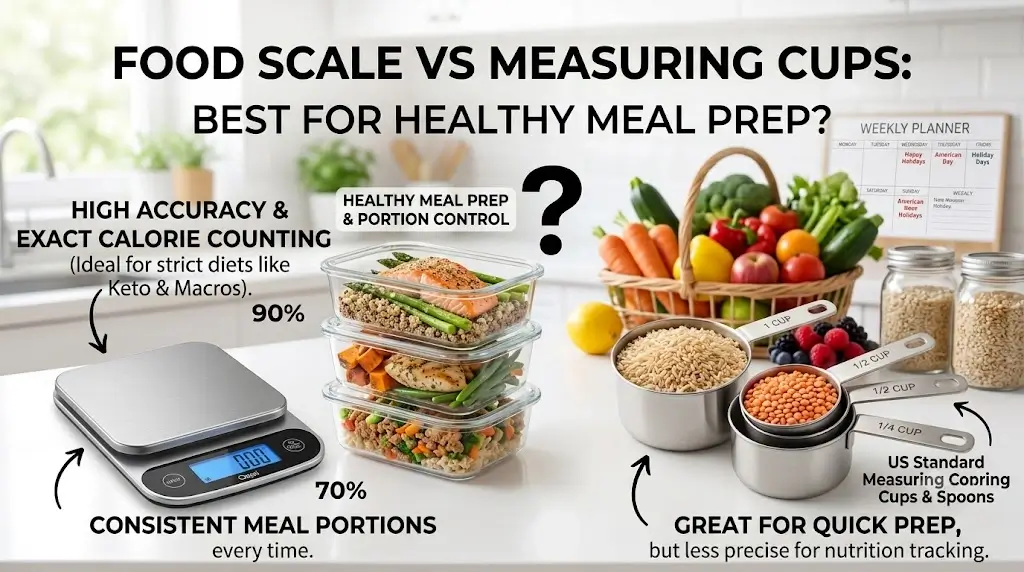
Food Scale vs Measuring Cups: Which Is Better for Healthy Meal Planning?
A food scale is usually better when you need consistent weight-based measurements, while measuring cups are more convenient for liquids and recipes written in volume. For everyday healthy meal planning, you do not need to choose one and abandon the other. The most practical kitchen usually uses a scale for ingredients where weight matters and cups or spoons for measurements where volume is more convenient.
The biggest difference is simple: a scale measures weight, while a measuring cup measures volume. USDA distinguishes weight measurements such as grams and ounces from volume measurements such as cups, tablespoons, teaspoons, and fluid ounces.
Is a Food Scale Better Than Measuring Cups?
| Task | Better tool | Why |
|---|---|---|
| Baking with gram-based recipes | Food scale | Weight is more consistent |
| Measuring flour | Food scale | Volume can vary depending on how flour is packed |
| Dividing a batch into equal portions | Food scale | Weight makes repeated portions easier to match |
| Measuring water | Measuring cup | Volume is convenient and familiar |
| Measuring milk | Either | Both weight and volume can work when the recipe specifies the method |
| Small amounts of spices | Measuring spoon | Usually faster for everyday cooking |
| Following a recipe written in cups | Measuring cups | No conversion is necessary |
| Consistent meal-prep portions | Food scale | Weight makes portions easier to reproduce |
Bottom line: a food scale wins when consistency and weight-based measurement matter. Measuring cups win when volume is simpler, especially for liquids and recipes already written in cups.
Editorial Notice: AgingWellGuide provides objective, evidence-based nutritional analysis. We test kitchen tools for usability, legibility, and clinical relevance. If you purchase through our links, we may earn a commission at no additional cost to you.
What Is the Difference Between Weight and Volume?
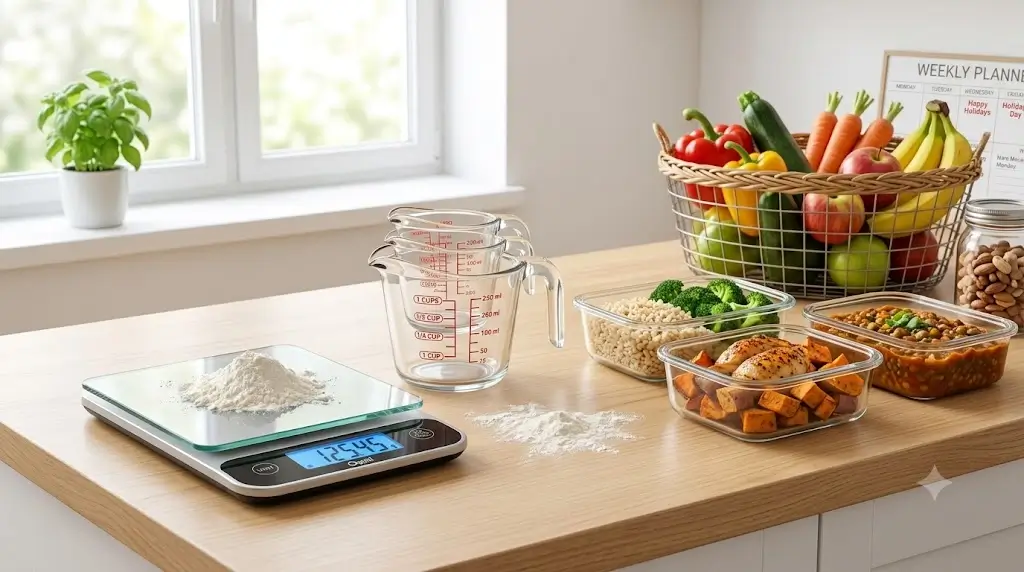
Weight tells you how heavy something is. Volume tells you how much space it occupies.
| Measurement | Examples |
|---|---|
| Weight | grams, kilograms, ounces, pounds |
| Volume | cups, tablespoons, teaspoons, fluid ounces |
USDA specifically notes that the same volume of different foods does not necessarily weigh the same. For example, a cup of one ingredient can have a very different weight from a cup of another ingredient.
This is why you cannot simply assume that 1 cup always equals the same number of grams.
Why Is a Food Scale More Consistent Than Measuring Cups?
Weight is less affected by how densely an ingredient is packed into a container.
Flour is a classic example. If you scoop flour directly from a container, shake the cup, or press the flour down, you can end up with different amounts even though the cup technically contains the same volume.
King Arthur Baking recommends weighing ingredients because volume measurements can vary, particularly for flour. Its testing guidance gives 120 grams as the weight of one cup of its all-purpose flour and recommends using a scale for best results.
With a scale, the target is expressed directly:
120 g of flour = 120 g of flour
With a cup, the actual weight can depend on how the ingredient was placed into that cup.
When Is a Food Scale Better Than Measuring Cups?
A food scale is especially useful when:
- The recipe provides ingredients in grams or ounces.
- You want repeatable results.
- You are baking.
- You are dividing a large batch into similar portions.
- You are measuring ingredients with variable density.
- You want to reduce the number of measuring utensils used.
- You are preparing several meals from one batch.
King Arthur Baking notes that weighing ingredients can also save time because ingredients can be added directly to the mixing bowl and the scale can be tared between ingredients.
When Are Measuring Cups Better Than a Food Scale?
Measuring cups remain useful when:
- The recipe is written in cups.
- You are measuring liquids.
- You need a quick everyday measurement.
- You do not want to set up a scale.
- The ingredient is not particularly sensitive to small measurement differences.
For liquids, a transparent liquid measuring cup can be especially convenient because you can see the level directly. King Arthur Baking recommends using a liquid measuring cup for liquids and reading the measurement at eye level for better accuracy.
Is a Food Scale Better for Baking?
Usually, yes.
Baking is more sensitive to ingredient ratios than many everyday cooking tasks. Small differences in ingredients can affect dough, batter, texture, and final results. King Arthur Baking strongly recommends weighing ingredients for baking because volume measurements can vary depending on how ingredients are measured.
This is especially relevant for:
- Flour
- Sugar
- Butter
- Chocolate
- Nuts
- Oats
- Other dry ingredients
A scale is not mandatory for successful baking, but it can reduce one important source of variation.
Why Is Flour a Good Example of Scale vs Measuring Cup?
Flour can become more densely packed when handled or scooped, which means two people can fill the same measuring cup and end up with different weights. King Arthur Baking explains that its test kitchen uses weight measurements because the amount of flour in a cup can vary depending on how the cup is filled.
If a recipe specifies 120 g flour, you can measure that directly with a scale. If the recipe says 1 cup flour, you need to use the recipe’s intended measuring method or an appropriate ingredient weight chart rather than assuming a universal conversion.
Can You Convert Cups to Grams?
Yes, but the conversion depends on the ingredient.
There is no universal grams-per-cup number because different foods have different densities.
| Ingredient | Why conversion varies |
|---|---|
| Flour | Can be packed more or less densely |
| Sugar | Different types have different densities |
| Chopped nuts | Piece size and packing affect volume |
| Oats | Flake size and packing affect density |
| Water | Density is relatively predictable |
| Oil | Different density from water |
King Arthur Baking maintains ingredient-specific weight charts rather than using one universal cup-to-gram conversion.
Can You Measure Liquids With a Food Scale?
Yes. A scale can measure the weight of a liquid in a container. However, you should not automatically interpret a weight measurement as the same thing as a fluid-volume measurement.
USDA explicitly distinguishes weight ounces from fluid ounces. They describe different measurements.
- Weight: grams or ounces on a scale
- Volume: cups, tablespoons, teaspoons, or fluid ounces
If a recipe specifies fluid ounces, use a volume measurement or a reliable conversion appropriate to that particular liquid.
Are Fluid Ounces and Ounces the Same?
No. This is one of the most important distinctions when comparing scales and measuring cups.
A weight ounce measures mass/weight, while a fluid ounce measures volume. USDA gives an illustrative example showing how dramatically the two can differ for foods with low density. Therefore, do not place a recipe calling for “8 fluid ounces” on a scale and assume the target should be 8 ounces by weight.
Is a Food Scale Better for Meal Prep?
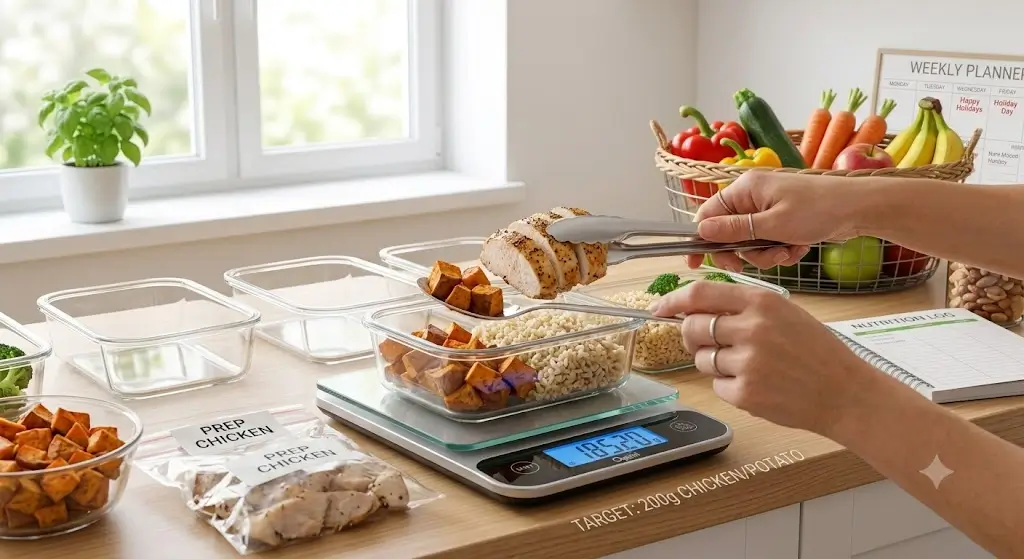
Usually, yes, when you want consistent portions across several containers.
Suppose you prepare one large batch of a meal and want several containers to contain approximately equal amounts. With a scale:
- Place the empty container on the scale.
- Press tare.
- Add the prepared food.
- Stop at your chosen weight.
- Repeat for the remaining containers.
This can be easier than trying to divide a large batch visually or using several measuring cups. To ensure your batch-cooked meals stay fresh and leak-free, pair your weighing routine with the best meal prep containers for older adults.
Clinical Portioning Notice (Diabetes & Renal Care): For older adults managing Chronic Kidney Disease (CKD) or insulin-dependent diabetes, a digital food scale eliminates estimation errors. Weighing protein (grams of chicken or fish) and complex carbohydrates provides clinical accuracy that volume cups cannot guarantee.
Is a Food Scale Useful When Cooking for One?
Yes. A scale can help when recipes need to be reduced or ingredients need to be divided. Weight can make recipe reduction straightforward because the quantities can be divided mathematically.
King Arthur Baking specifically recommends weight measurements when reducing recipes because dividing gram amounts is often simpler than dividing awkward volume measurements such as 1⅓ cups. For a complete system covering shopping, portions, leftovers, and weekly meal planning for one person, see our in-depth guide on healthy meal planning for one person.
Is a Food Scale Useful When Cooking for Two?
Yes. It can help divide ingredients and prepared foods more consistently. For example, a large batch can be weighed and divided into two or more containers without relying entirely on visual estimation. For balanced dinner pairings, explore our healthy dinner ideas for adults over 50.
Can Measuring Cups Be Accurate Enough?
Yes. Measuring cups are not inherently inaccurate. The main issue is that accuracy depends on using the correct cup and technique.
For dry ingredients, King Arthur Baking recommends gently spooning the ingredient into the cup and leveling off the excess rather than packing it. For liquids, it recommends a liquid measuring cup and reading the level at eye height.
A more accurate statement is: weight generally provides greater consistency for many ingredients, while volume can work well when measured correctly and when the recipe is written that way.
What Is the Best Way to Measure Dry Ingredients?
Use a food scale when the recipe gives a weight measurement. Otherwise, use the recipe’s specified volume method carefully.
For dry ingredients measured by cup:
- Use a dry measuring cup.
- Loosen or fluff the ingredient if appropriate.
- Gently spoon it into the cup.
- Do not deliberately compress it unless the recipe says to.
- Level the top.
King Arthur Baking calls this the “fluff, sprinkle, and scrape” approach for flour when measuring by volume.
What Is the Best Way to Measure Liquids?
Use a liquid measuring cup for ordinary volume-based liquid measurements.
Place the cup on a level surface and read the measurement at eye level. Common liquid measurements include water, milk, broth, oil, and juice. When the recipe specifies grams, however, a scale can be used directly.
Does a Food Scale Reduce Kitchen Cleanup?
It can. When weighing ingredients, you can often place one bowl on the scale and tare between ingredients instead of using a separate measuring cup for every dry ingredient. King Arthur Baking specifically identifies reduced cleanup as an advantage of weighing ingredients.
Which Is Easier for Older Adults: a Scale or Measuring Cups?
It depends on the user’s vision, dexterity, kitchen setup, and familiarity with each tool.
| Situation | Potentially easier choice |
|---|---|
| Difficulty reading small markings | Scale with large, backlit display |
| Difficulty lifting heavy bowls | Lightweight measuring cup or small scale setup |
| Difficulty handling several utensils | Scale with tare function |
| Simple liquid measurement | Liquid measuring cup with high-contrast text |
| Batch portioning | Food scale |
| Traditional recipes using cups | Measuring cups |
Senior Usability & Vision Note: Older adults with tremors, arthritis, or low vision often struggle to read tiny engraved lines on metal measuring cups. A digital scale with an oversized backlit LCD and prominent physical tare buttons reduces eye strain and minimizes spills.
Is a Food Scale More Accurate for Portioning?
It can make repeated portions more consistent.
USDA describes weight as a direct way to measure how much food weighs, while volume measures how much space the food occupies. When several portions need to be similar, weight can therefore be easier to reproduce than trying to fill identical cups to exactly the same level.
However, consistency does not mean that one particular portion size is appropriate for everyone. Healthy meal planning should account for individual needs rather than treating one measured amount as universally correct.
Should You Weigh Food for Every Meal?
No. A food scale is a tool, not a requirement for healthy eating. Misusing scales to obsess over every single calorie is one of the common healthy eating mistakes after 50 that can lead to unnecessary eating stress.
A scale is useful for:
- Learning what a recipe’s weight-based portions look like
- Preparing consistent batches
- Following baking recipes
- Reducing recipes
- Measuring ingredients when precision matters
When Should You Use Measuring Spoons Instead?
Measuring spoons are usually faster for very small quantities.
They are convenient for:
- Salt
- Spices
- Extracts
- Baking powder
- Baking soda
- Small amounts of oils
- Condiments
A scale can measure small quantities, but standard kitchen scales may be less useful at very low weights. King Arthur Baking notes that some scales can become less reliable below an ounce and that older scales may display measurements in relatively large increments.
Can You Use Both a Food Scale and Measuring Cups?
Yes — and that is often the best approach.
| Kitchen task | Preferred tool |
|---|---|
| Flour for baking | Scale |
| Rice for a recipe | Scale if recipe specifies weight; cup if specified by volume |
| Water for soup | Cup |
| Milk for a recipe | Cup or scale according to recipe |
| Salt | Measuring spoon for most everyday cooking |
| Batch meal portions | Scale |
| Liquid ingredients | Liquid measuring cup |
This hybrid approach gives you precision where it helps without making simple cooking unnecessarily complicated.
What Are the Biggest Mistakes When Comparing Scales and Measuring Cups?
- Assuming grams and cups are interchangeable: they measure different things.
- Assuming every cup of an ingredient weighs the same: density and packing vary.
- Confusing ounces with fluid ounces: weight and volume ounces are different.
- Using a liquid cup for dry ingredients: use the measurement method appropriate to the recipe.
- Ignoring recipe instructions: use the units the recipe was developed around when possible.
- Buying an ultra-precise scale unnecessarily: most meal planning needs only ordinary kitchen precision.
- Measuring every food obsessively: a scale should simplify cooking, not make it stressful.
How Should You Choose Between a Food Scale and Measuring Cups?
| If your main goal is… | Better choice |
|---|---|
| Consistent baking | Food scale |
| Reducing recipes | Food scale |
| Equal meal-prep portions | Food scale |
| Measuring liquids | Measuring cup |
| Quick everyday cooking | Measuring cups/spoons |
| Recipes written in grams | Food scale |
| Recipes written in cups | Measuring cups |
| Small amounts of spices | Measuring spoons |
How Does This Choice Fit Into Healthy Meal Planning?
The purpose of measuring food is to make cooking and meal preparation more consistent, not to turn healthy eating into a constant calculation.
A practical system might look like this:
- Use a scale when recipes provide weights.
- Use cups for convenient liquid measurements.
- Use measuring spoons for small quantities.
- Use a scale when dividing batch-cooked meals.
- Stop measuring when the extra precision no longer provides useful information.
For a broader hardware review of senior-friendly digital models, read our buyer’s guide to the best food scales for healthy meal planning.
What Is the Best Measurement Method for a Healthy Eating Routine?
Use the simplest method that gives you the consistency you actually need.
If you are preparing a quick soup, measuring cups may be perfectly practical. If you are baking bread, weighing flour can substantially improve repeatability. If you are dividing a large meal-prep batch, a scale can make equal portions easier to create. If you are adding a teaspoon of a spice, a measuring spoon is usually faster.
The best kitchen is not the one with the most precise tools. It is the one where the right tool is easy to use for the task at hand.
Food Measurement Decision Checklist
- ☐ Does the recipe specify grams or ounces?
- ☐ Does it specify cups or tablespoons?
- ☐ Am I measuring a liquid?
- ☐ Does ingredient density make volume inconsistent?
- ☐ Am I baking?
- ☐ Am I reducing a recipe?
- ☐ Am I dividing a batch into several portions?
- ☐ Would a scale reduce the number of utensils I need?
- ☐ Is a measuring cup faster for this particular ingredient?
- ☐ Am I adding unnecessary complexity to a simple meal?
Frequently Asked Questions
Is a food scale better than measuring cups?
A food scale is generally better when consistent weight measurements matter, particularly for baking and batch portioning. Measuring cups are often more convenient for liquids and recipes written in volume.
Are grams more accurate than cups?
Weight measurements can be more consistent because they are less affected by how densely an ingredient is packed into a cup. This is particularly important for ingredients such as flour.
Can I replace measuring cups with a food scale?
You can replace many dry-ingredient measurements with a scale when the appropriate weight is known, but measuring cups remain useful for volume-based recipes and liquids.
Is 1 cup always the same number of grams?
No. A cup measures volume, while grams measure weight. Different foods have different densities, so the weight of one cup varies by ingredient.
Is an ounce the same as a fluid ounce?
No. An ounce can refer to weight, while a fluid ounce is a volume measurement. USDA specifically distinguishes weight ounces from fluid ounces.
Should you use a food scale for baking?
Generally, yes. Weight measurements can make baking more consistent, especially for flour and other dry ingredients.
Are measuring cups accurate enough for cooking?
Yes. Measuring cups can provide useful results when the correct type of cup and appropriate technique are used. For dry ingredients, fill and level the cup according to the recipe’s instructions; for liquids, read the measurement at eye level.
What is better for measuring water: a scale or cup?
Either can work, but a liquid measuring cup is often more convenient when the recipe specifies cups or fluid ounces.
What is better for meal-prep portions?
A food scale is usually more convenient when you want several portions to have approximately the same weight.
Can a food scale help when cooking for one?
Yes. Weight measurements make it easier to reduce recipes and divide ingredients without awkward volume calculations.
Do I need a food scale to eat healthy?
No. A scale is simply a measurement tool. Healthy eating does not require weighing every ingredient or portion.
Should I use a food scale for every meal?
No. Use it when measurement improves consistency or solves a practical problem. For many everyday meals, cups, spoons, or simple visual portions are sufficient.
The Bottom Line
Food scales and measuring cups are not competing tools so much as tools for different measurement systems.
Use a food scale when weight-based precision and repeatability matter — especially for baking, recipe reduction, and dividing meal-prep batches.
Use measuring cups when volume is more convenient — especially for liquids and recipes written in cups.
Use measuring spoons for small amounts of spices, extracts, and other ingredients.
The simplest rule is:
If the recipe gives you grams, weigh it. If it gives you cups, follow the volume measurement unless you have a reliable ingredient-specific weight conversion. For liquids, use the measurement system the recipe specifies.
For healthy meal planning, consistency is useful, but unnecessary precision is not. Choose the tool that makes the food easier to prepare and the result easier to repeat.
Editorial Methodology
This comparison evaluates food scales and measuring cups by measurement type, consistency, ease of use, recipe compatibility, meal-prep practicality, and usability for everyday cooking. Weight-versus-volume distinctions are grounded in USDA measurement guidance, while baking-specific accuracy considerations are supported by King Arthur Baking’s recipe and measurement guidance. The article does not treat precise measurement as a requirement for healthy eating.
Sources
- USDA Agricultural Research Service (ARS) — How to Measure Quantities
- USDA Food Buying Guide — Resource Center
- USDA Food and Nutrition Service (FNS) — Measures for Portion Control
- King Arthur Baking — A Digital Kitchen Scale Is an Essential Baking Tool
- King Arthur Baking — Weighing Ingredients
- King Arthur Baking — Recipe Success Guide
- King Arthur Baking — Ingredient Weight Chart
Editorial standard: AgingWellGuide independently evaluates kitchen equipment and meal planning systems for adults over 50. We emphasize practical ergonomics, visual accessibility, and clinical dietary compliance.
