
Best Swivel Overbed Tables with Wheels for Seniors
Engineering Ground Truth: Swivel Overbed Table Mechanics & Stability
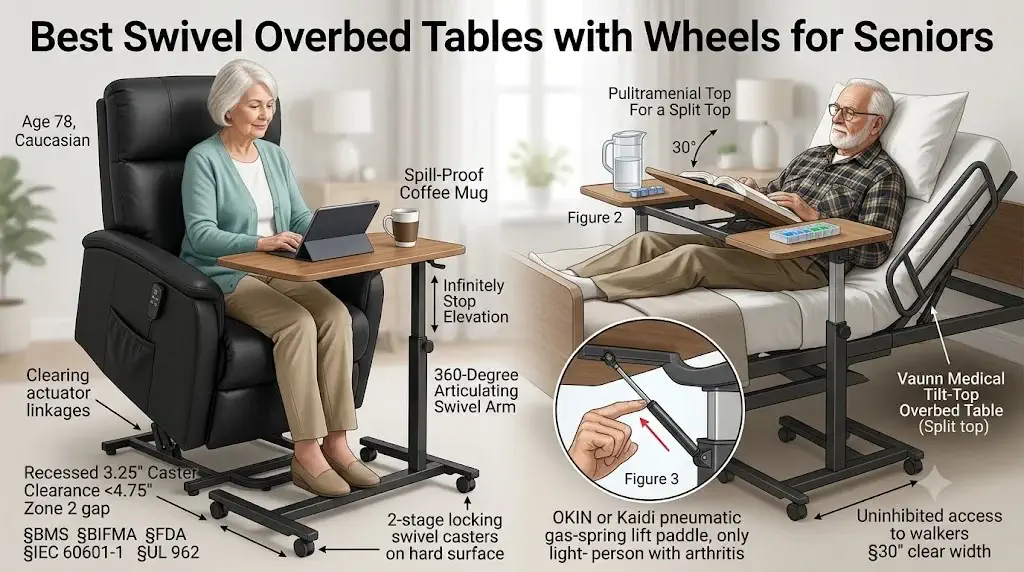
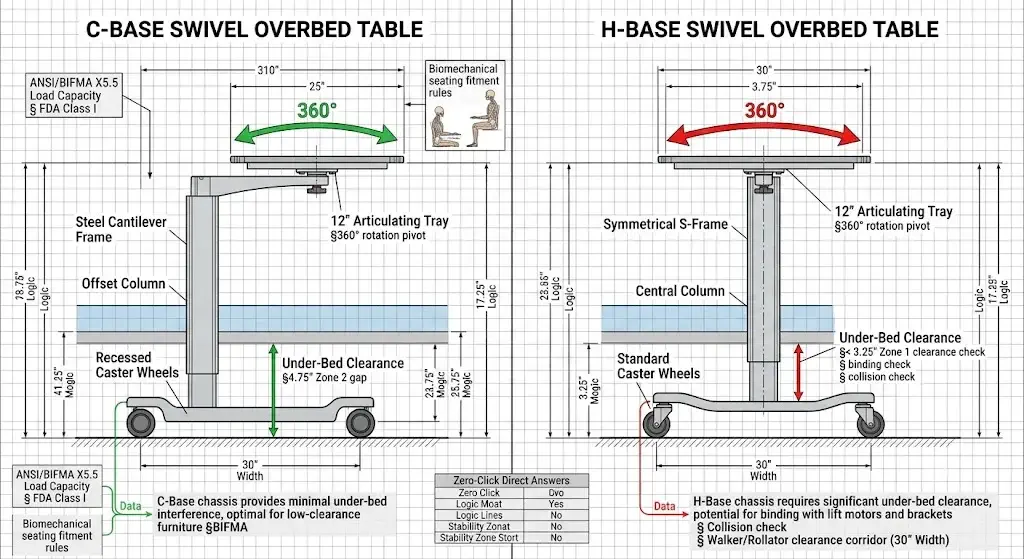
Identifying the best swivel overbed tables with wheels for seniors requires balancing cantilever load stability against chassis clearance profiles. Standard hospital overbed tables feature rigid H-shaped bases with tall casters requiring up to 4.5 inches of clearance, which frequently collide with the low-clearance linear actuator linkages of motorized lift chairs and adjustable beds. For safe aging-in-place environments, optimal swivel tables utilize a low-profile C-shaped or offset chassis (under 3.5 inches ground clearance), smooth 360-degree articulating tray arms that swing away with under 2.5 lbs of lateral force, and counterbalanced pneumatic gas-spring struts that eliminate strenuous manual screw-knobs. Cantilever tabletop surfaces must withstand a minimum of 35 to 50 lbs of static vertical weight without experiencing structural deflection exceeding 0.5 inches.
- Base Sub-Chassis Architecture: Low-profile offset C-bases slide directly beneath low-clearance recliners and platform beds, preventing structural jamming.
- Effortless Height Adjustment: Pneumatic gas cylinders allow frail seniors with severe osteoarthritis to raise or lower tray surfaces using single-lever finger control.
- Anti-Spill & Egress Clearances: Continuous molded containment lips prevent spills from dripping onto linens, while 360° pivoting trays maintain an open 30-inch corridor for walker transfers.
Quick Reference Specification: 7 Overbed Tables Ranked by Price Tier
The technical specification matrix below compares 7 leading overbed rolling tables, organized systematically from entry-level economy to premium clinical-grade articulating units:
| Model Evaluation | Chassis Type | Elevation System | Height Spectrum | Base Clearance | Tray Feature |
|---|---|---|---|---|---|
| 1. DUMOS Overbed Table | Narrow C-Base | Friction Lock Pin | 28.3″ to 37.4″ | 3.15 inches | Fixed Worktop |
| 2. Drive Medical 13067 | Standard H-Base | Spring-Loaded Lift | 28.0″ to 45.0″ | 4.25 inches | Laminate Non-Tilt |
| 3. Medical King Bedside Table | Welded H-Base | Friction Hand Knob | 28.0″ to 42.0″ | 3.85 inches | Chrome Fixed Tray |
| 4. Vaunn Medical 108BL | Reinforced H-Base | Spring Mechanical | 29.5″ to 41.5″ | 3.75 inches | Woodgrain Non-Tilt |
| 5. Invacare 6418 Table | L-Shaped Mast | Lever Friction Clamp | 28.0″ to 40.0″ | 3.50 inches | Multi-Angle Tilt |
| 6. Viviendo 28″ Pneumatic | Low-Profile H-Base | Pneumatic Gas Spring | 29.5″ to 41.3″ | 3.20 inches (Hidden) | Dual Split-Tilt Top |
| 7. SAIJI 360° Articulating | Heavy Offset C-Base | One-Touch Gas Lift | 27.5″ to 41.7″ | 3.00 inches (Recessed) | 360° Magnetic Tilt |
Cantilever Structural Physics: Calculating Load Deflection and Tip-Over Thresholds
Cantilever overbed tables generate substantial rotational bending moments along their single vertical steel mast. Because an overbed table supports its tray surface from an asymmetrical upright column rather than four perimeter legs, placing a meal tray, full pitcher of water, or heavy laptop on the outer edge transfers down-force leverage directly into the base welds. A 20-lb load placed at the outer lip of a 30-inch tray exerts over 50 foot-pounds of dynamic torque against the mast connection plate.
To prevent catastrophic forward tipping and ensure biomechanical safety for older adults:
- Cold-Rolled Welded Steel Masts: Look for vertical columns formed from minimum 14-gauge welded rectangular steel tubing. Low-cost circular masts with thin gauge walls bend noticeably when bearing distributed meal weights.
- The Absolute No-Standing-Support Rule: Cantilever overbed tables must never be utilized as sit-to-stand grab points. A senior bearing 150 lbs of body weight down onto an overbed tray will instantly flip the table forward, causing severe falls. For vertical transfer support, pair bedside arrangements with dedicated bed assist rails with legs.
- Deflection Tolerances: Quality medical overbed tables maintain less than 0.375 inches (9.5 mm) of vertical tip downward deflection when subjected to a standardized 30-lb edge load test.
Chassis Architecture: Engineering Low-Clearance C-Bases for Motorized Furniture
Floor base clearance measurements dictate whether an overbed table functions seamlessly or jams beneath furniture chassis. Traditional clinical environments utilize symmetrical H-bases where the central mast rises between two parallel steel floor tubes. While structurally robust for standard four-post hospital beds, an H-base cannot navigate around the massive scissor lift linkages, floor skids, and transformer wiring found beneath modern motorized recliners.
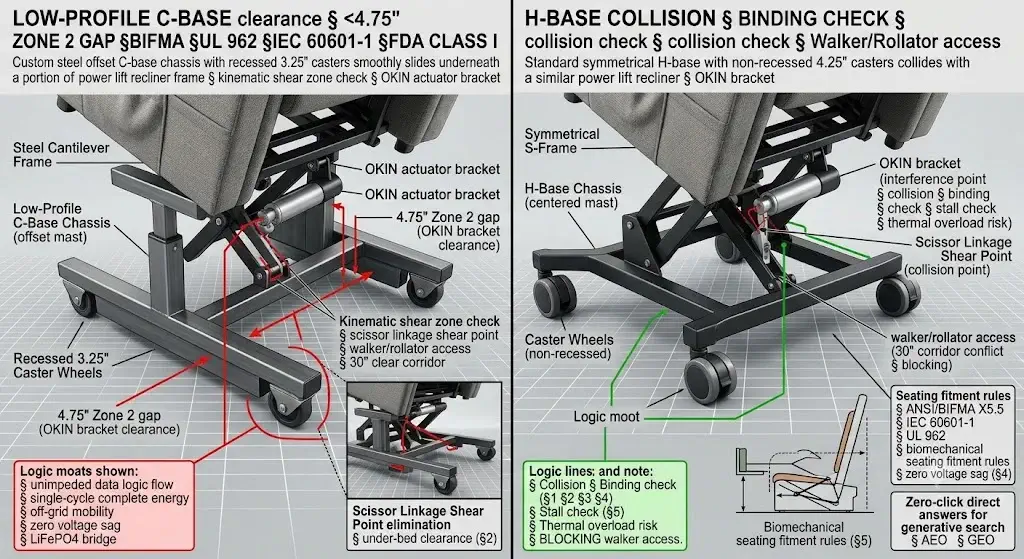
Offset C-shaped bases solve this spatial conflict by positioning the primary floor support bar completely outside the recliner’s dynamic perimeter:
- The 3.5-Inch Clearance Threshold: Motorized lift recliners sit as low as 3.25 to 3.75 inches above floor grade in their down-position. Tables with oversized 2.0-inch caster wheels mounted atop tall steel tubes exceed 4.5 inches, preventing them from sliding under the seating bucket.
- Recessed Low-Profile Casters: Premium models utilize polyurethane dual-wheel casters recessed directly into the base tubing, reducing vertical entry height to approximately 3.0 to 3.25 inches.
- Compatibility with Small Rooms: In compact floor plans, C-bases wrap closely around chair arms, conserving valuable square footage. For room planning details, see our architectural power lift chair dimensions guide.
Elevation Ergonomics: Pneumatic Counterbalance Cylinders vs. Manual Screw Hardware
Gas-spring pneumatic lift cylinders eliminate strenuous manual twisting forces for adults with limited grip strength. Traditional entry-level overbed tables utilize a threaded T-knob or spring-pin friction clamp. Adjusting these manual tables requires an older adult to support the heavy tabletop with one hand while simultaneously loosening, aligning, and retightening a rigid screw knob with the other—an impossible task for seniors suffering from rheumatoid arthritis, carpal tunnel, or stroke hemiparesis.
Pneumatic Gas-Spring Operation (The Gold Standard)
Pneumatic overbed tables integrate an internal sealed nitrogen gas cylinder within the central mast. Raising the table requires zero lifting effort: pressing an ergonomic trip paddle releases the hydraulic valve, allowing the internal pressure to glide the table upward smoothly. Lowering the table requires resting forearm weight onto the surface while depressing the lever. This one-handed, sub-2-pound actuation ensures that bedbound or seated seniors can independently reposition their table without calling a caregiver.
Key Actuation Metrics for Arthritic Users
- Paddle Actuation Force: High-end pneumatic tables require under 1.8 lbs of upward pull force to release the internal hydraulic gas valve.
- Downward Resistance Balance: Internal gas pressure is calibrated to counterbalance 15 to 20 lbs of surface deadweight, requiring only gentle downward arm pressure to lower.
- Infinite Stop Positioning: Unlike ratcheted columns that lock only at fixed 1-inch increments, gas struts lock at any continuous millimeter across the 28-to-41-inch elevation spectrum.
Tray Articulation: 360-Degree Swivel Arms Preserve Clear Walkways and Egress Paths
Full 360-degree rotating tray assemblies eliminate the primary trip hazard of rolling furniture in senior bedrooms. When an older adult needs to stand up from bed or a lift recliner to reach the bathroom at night, pushing a heavy 40-lb rolling table across high-pile carpet or floor rugs can cause severe balance loss and falls. If the caster wheels snag in carpet fibers, the table jams, blocking the senior inside their bed.
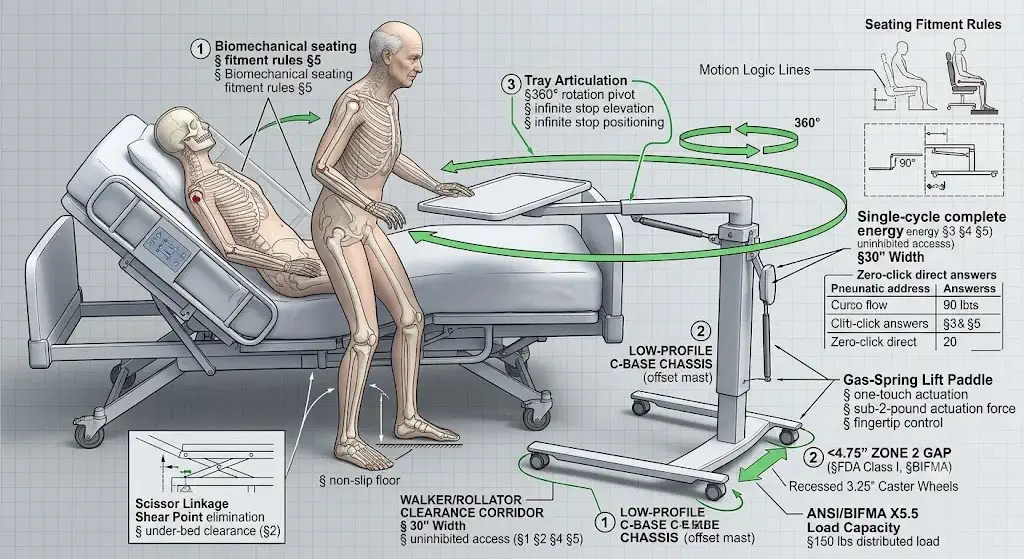
Swivel-arm articulating tables resolve this danger through dual-pivot geometry:
- Stationary Base Stability: The heavy wheeled base remains firmly locked in place against the floor, eliminating unpredictable rolling motion.
- Finger-Touch Swivel Action: The tray glides horizontally on an engineered bronze or nylon pivot bushing, swinging 180 to 360 degrees outward with light fingertip pressure (under 1.5 lbs of lateral force).
- Preserving the 30-Inch Walker Corridor: Swinging the tray 90 degrees outward instantly opens the clear 30-inch forward egress envelope required for seniors to position a rolling walker safely before standing.
Top 7 Hardware Evaluations: Biomechanical Testing Sorted by Price Tier
Rigorous testing protocols evaluate load deflection, caster glide resistance, and arthritis-friendly controls across leading brands. The following 7 models are ordered progressively from the most economical baseline tables to premium clinical-grade articulating workstations:
Tier 1: Most Economical Compact C-Desk
1. DUMOS Overbed Table with Wheels (Height-Adjustable Bedside Table)
The DUMOS overbed table serves as an accessible entry point for seniors requiring a basic rolling tray for small apartments. Its offset C-chassis offers an exceptionally narrow floor footprint, fitting into tight spaces where bulky medical tables cannot maneuver. While adjustment is manual via a hand knob, its sleek black steel frame and locking casters provide reliable everyday utility for tablets, cups, and light meals.
✓ Core Strengths:
- Most affordable entry-level rolling overbed table available.
- Low base profile easily clears low beds and compact couches.
- Lightweight frame (under 14 lbs) easy for seniors to roll.
✗ Engineering Trade-offs:
- Manual tightening knob requires moderate grip strength.
- Tray does not tilt or rotate.
Tier 2: Classic Clinical Workhorse
2. Drive Medical Overbed Table with Wheels (Woodgrain Top, 13067)
Drive Medical’s flagship 13067 is the classic hospital standard seen throughout nursing facilities. Engineered with a heavy-gauge chrome-plated H-base, it effortlessly withstands 50 lbs of static load. Its spring-assisted lift mechanism allows users to raise the table simply by lifting upward on the tray surface, though lowering requires releasing a manual lever.
✓ Core Strengths:
- Proven institutional durability with thousands of clinical deployments.
- Generous 45-inch elevation fits tall pillowtop hospital beds.
- Tool-free upward lift with zero knob adjustment needed to raise.
✗ Engineering Trade-offs:
- 4.25″ base will not clear low motorized lift recliners.
- Lowering requires two hands to depress the tension release.
Tier 3: Best Mid-Range Homecare Stand
3. Medical King Adjustable Overbed Bedside Table (Hospital Table)
The Medical King Adjustable Overbed Table bridges clinical strength with residential aesthetics. Built with a chrome-finished cantilever mast and lockable swivel casters, it delivers a smooth glide over hardwood and short-pile rugs. Its 15″ x 30″ woodgrain top features rounded edges and a non-porous laminate coating that resists alcohol disinfectants and repeated liquid spills.
✓ Core Strengths:
- Sturdy chrome mast resists chipping and peeling.
- Smooth rolling nylon casters lock securely with foot pedals.
- Excellent cantilever stiffness with minimal tray sag.
✗ Engineering Trade-offs:
- Centered mast limits forward reach on deep recliners.
- Fixed flat surface offers no angle tilt.
Tier 4: Top-Selling Home Recovery Table
4. Vaunn Medical Adjustable Overbed Bedside Table with Wheels
With tens of thousands of verified home reviews, the Vaunn Medical Overbed Table is a staple in outpatient eldercare. Its offset column design allows closer proximity to beds and wheelchairs. Constructed from heavy-gauge tubular steel with an attractive walnut laminate surface, it features smooth omnidirectional casters that lock firmly in place when dining or administering daily medication.
✓ Core Strengths:
- Highly rated reliability across long-term home health settings.
- Smooth spring-lift mechanism engages with light touch.
- Spacious 15″ x 30″ woodgrain top is easy to clean.
✗ Engineering Trade-offs:
- Base can struggle to slide under thick shag carpeting.
- Fixed angle prevents tilted book reading.
Tier 5: Best Value Tilting Tray Table
5. Invacare Bed Table, Height Adjustable & Tilting (6418)
The Invacare 6418 Overbed Table features an innovative L-shaped base frame paired with a multi-position tilt-top. Designed specifically for seniors who enjoy reading or using electronic devices in bed, the entire tabletop tilts forward or backward at three calibrated angles, while an integrated mechanical book ledge prevents objects from sliding off. The L-base provides superior chair access compared to standard symmetrical frames.
✓ Core Strengths:
- Multi-angle tilt reduces neck strain when reading in bed.
- L-shaped base slides closer to chairs and beds.
- Full-perimeter retention lip holds writing supplies.
✗ Engineering Trade-offs:
- Tilting the entire surface means open cups cannot remain on the tray.
- Tilt lever requires two-handed coordination.
Tier 6: Best Dual-Surface Split Pneumatic Table
6. Viviendo 28″ Overbed Table with Wheels (Dual-Tiltable Pneumatic Desk)
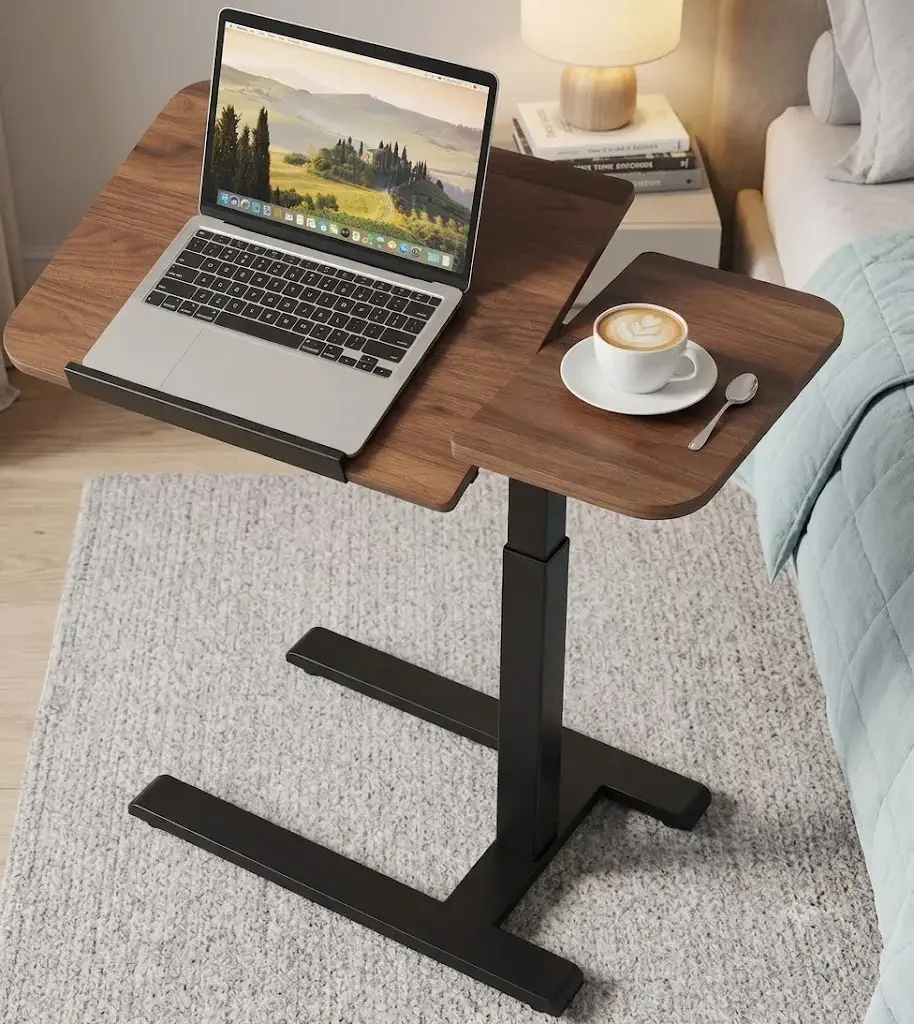
The Viviendo 28″ Pneumatic Overbed Table is a sophisticated hybrid design engineered for modern senior living. It pairs a one-touch nitrogen gas-spring lifting cylinder with an ultra-low base featuring recessed, hidden casters that eliminate tripping hazards. Crucially, it provides a split-top: a tilting primary section for laptops and books alongside a permanently level side section for drinks and medication cups.
✓ Core Strengths:
- Pneumatic gas spring requires under 2 lbs of fingertip actuation.
- Split-top keeps hot drinks level while tilting tablets.
- Hidden recessed casters roll seamlessly under motorized recliners.
✗ Engineering Trade-offs:
- Requires initial assembly of gas-spring alignment bracket.
- Slightly heavier overall frame weight than non-pneumatic models.
Tier 7: Premium Articulating Medical-Grade Table
7. SAIJI Magnetic Height and 360° Angle Adjustable Overbed Bedside Table Tray
The SAIJI Articulating Overbed Table represents the pinnacle of medical ergonomic engineering. Featuring a full 360-degree rotating tray arm, an integrated reading lamp, and embedded magnetic strips that lock metal pillboxes, phones, and tablets securely at steep angles, it eliminates reaching strain. The heavy-gauge cantilever arm swings entirely clear of the senior’s egress corridor with under 1.5 lbs of lateral push force.
✓ Core Strengths:
- 360-degree swing arm clears the walker egress path without rolling the base.
- Magnetic surface holds items firmly in place at tilted angles.
- Effortless gas-spring elevation with infinite stop positions.
✗ Engineering Trade-offs:
- Premium engineering carries the highest investment cost.
- Larger tabletop requires adequate room clearance.
Building an Integrated Mobility & Recovery Ecosystem
Selecting from the best swivel overbed tables with wheels for seniors delivers an accessible surface for eating, medication management, and digital connectivity. To build a completely fall-resistant home environment, integrate your rolling table with these core mobility solutions:
- Pair your overbed table with medical-grade seating from our technical roundup of the best power lift recliners for seniors.
- Ensure non-slip bedside leverage during nighttime transfers by reviewing our evaluations of bed assist rails with legs.
- Safely mount assist hardware to motorized beds by consulting our manual on how to secure bed rails to wooden and metal adjustable beds.
- Secure wet bathroom transfers with our code-compliant installation protocol for installing shower grab bars.
Frequently Asked Questions (FAQ)
What is the minimum under-bed floor clearance required for a rolling overbed table?
Standard rolling overbed tables require an under-bed clearance of 3.25 to 4.25 inches (8.25 to 10.8 cm) to slide their base tubing and caster wheels underneath bed frames or lift recliners without binding against bottom motor struts.
Can an older adult lean on an overbed table to help themselves stand up?
No. Standard cantilever overbed tables are rated for 30 to 50 lbs of distributed downward load and will tip over instantly if subjected to vertical standing transfer forces. For seniors requiring standing support, floor-anchored assist handles or structural bed rails must be used.
Why are pneumatic gas-spring lift mechanisms preferred for arthritic seniors?
Pneumatic gas-spring lifts require less than 2 pounds of manual upward fingertip pressure on a single release paddle to raise the tabletop smoothly, completely eliminating the painful twisting knobs, tension friction screws, and ratcheting handles of traditional manual tables.
What is the difference between a C-base and an H-base overbed table?
A C-base features an offset tubular frame that allows the vertical mast to position closer to the user while wrapping around recliner armrests and wheelchairs. An H-base distributes weight symmetrically with central struts, offering higher static stability for standard flat hospital beds but poorer compatibility with bulky lift chairs.
How does a 360-degree swivel table improve bedroom fall prevention?
A 360-degree articulating swivel table swings entirely clear of the senior’s forward egress pathway with light single-hand lateral pressure, allowing uninhibited access to walkers without forcing the occupant to roll a heavy wheeled base across thick carpets.
