
Best Raised Toilet Seats with Handles: 2026 Test & Clamp Safety
Executive Engineering Summary: Top Elevated Seats with Arms
When evaluating the best raised toilet seats with handles for fall prevention, our laboratory focused on unilateral torque stability, clamp deflection, and metal subframe yield strength. Standard slip-on units frequently fail when a user leans heavily on one side. The top models were categorized by mounting methodology and load capacity:
- Best Overall 2-in-1 Clamp Riser: Drive Medical 2-in-1 Locking Raised Toilet Seat (RTL12027RA) (Heavy-duty front worm-drive clamp, padded tool-free removable aluminum arms, 300 lbs capacity).
- Best Heavy-Duty Bolt-Down Solution: Carex E-Z Lock Raised Toilet Seat with Handles (Mechanical twist-lock anchoring flange, contour molded deck, zero lateral slide).
- Best Floor-Supported Safety Frame: KEKOY Free-Standing Toilet Safety Rail & Riser (Ground-transfer steel base legs, width/height adjustable, prevents porcelain bowl stress).
- Best Hinged Design for Easy Cleaning: Vive Hinged Raised Toilet Seat with Arms (Mounts beneath existing toilet seat using structural bolts, lifts 3.5 inches with full hinge access).
- Best Bariatric Heavy-Duty Riser: LOLLIDO 500lbs Adjustable Toilet Riser with Handles (Reinforced carbon-steel chassis, non-slip rubber feet, ideal for bariatric transfers).
- Critical Structural Finding: Dial-clamp risers must not be utilized for patients with total hemiplegia unless paired with permanent wall-mounted heavy-duty grab bars to absorb off-axis pulling forces.
Technical Specification Matrix: Best Raised Toilet Seats with Handles
To identify the best raised toilet seats with handles, we evaluated riser height, handle spread, fastening mechanism, and real-world weight tolerances. When selecting the best raised toilet seats with handles, verifying mechanical clamp integrity is paramount. Below are verified engineering parameters across the top accessibility products:
| Product & Model | Elevation Added | Arm Rest Construction | Locking Mechanism | Certified Weight Limit | Primary Application |
|---|---|---|---|---|---|
| Drive Medical 2-in-1 (RTL12027RA) | 5.0 Inches | Removable Padded Aluminum | Front Worm-Gear Dial Clamp | 300 lbs | Standard Universal Fit |
| Carex E-Z Lock with Handles | 5.0 Inches | Contoured Foam Grip Tube | Center Screw Locking Bracket | 300 lbs | Zero-Twist Stability |
| KEKOY Adjustable Frame & Seat | 4.0–6.0 Inches | Integrated Textured PU Arms | Dual Floor-Contact Legs + Clamp | 400 lbs | Fragile Porcelain Protection |
| Vive Hinged Riser with Arms | 3.5 Inches | Rigid Metal Core Foam Sleeves | Through-Bowl Structural Steel Bolts | 300 lbs | Easy Bowl Cleaning |
| LOLLIDO 500lbs Bariatric Riser | Adjustable | Heavy-Gauge Carbon Steel | Direct Floor Subframe Transfer | 500 lbs (Tested) | Bariatric Patient Transfers |
The Biomechanics of Toilet Transfers: Unilateral Torque & Clamp Shear
Sitting down and standing up from a toilet seat is not a pure vertical static load event. In human kinesiology, getting up from a low commode generates high unilateral eccentric and concentric torque.
When an elderly adult or someone recovering from hip replacement pushes off the handles, they rarely distribute force symmetrically across both arms. A senior with unilateral weakness will exert up to 80% of their total body mass downward onto a single handle. This off-center force creates an intense rotational moment (τ = F × r) on the toilet riser clamp:
- The Lever Arm Effect (r): The distance from the center of the porcelain bowl to the armrest handle is typically 10 to 12 inches (25 to 30 cm). When a 200-lb user places 160 lbs of downward force onto one handle, this applies over 130 lb-ft (176 N·m) of twisting moment directly to the clamp mechanism.
- Porcelain Friction Breakdown: Vitreous china porcelain has an ultra-low surface roughness. Standard friction pads slip easily when exposed to cleaning chemicals, condensation, or repeated lateral strain.
- Rotational Catastrophe: If the locking dial uses plastic threads or a narrow lip flange, the torque forces the opposite edge of the riser upward, causing the unit to slip off the porcelain rim. This rotational shift is responsible for thousands of emergency room hip dislocations every year.
For this reason, selecting the best raised toilet seats with handles requires inspecting the locking engineering—prioritizing through-bolts or broad four-point contact clamps over basic slip-on risers.
Porcelain Bowl Geometry: Round vs. Elongated Fitment Guide
A frequent mistake when choosing the best raised toilet seats with handles is ignoring toilet bowl geometry. According to federal guidelines in the official 2010 ADA Standards for Accessible Design (§604), commode height and perimeter clearance determine independence. In North America, residential toilets fall into two distinct standard form factors defined by ANSI A112.19.2:
Standard Round Bowls (16.5″ Center-to-Lip)
Found primarily in older homes and compact half-baths. Measures approximately 16.5 inches from the two seat bolt holes to the very front edge of the porcelain rim.
Risk Factor: Installing an elongated riser onto a round bowl causes the inner hygiene opening to misalign with the trapway, creating severe splashing and structural instability.
Modern Elongated Bowls (18.5″ Center-to-Lip)
The standard in modern residential construction and ADA accessibility. Measures approximately 18.5 inches from the mounting bolts to the front outer rim, providing 2 inches of extra forward clearance.
Risk Factor: Fastening a round riser onto an elongated bowl leaves 2 inches of bare porcelain rim exposed at the front, creating a severe forward-tipping hazard when sitting down.
In-Depth Reviews: Best Raised Toilet Seats with Handles
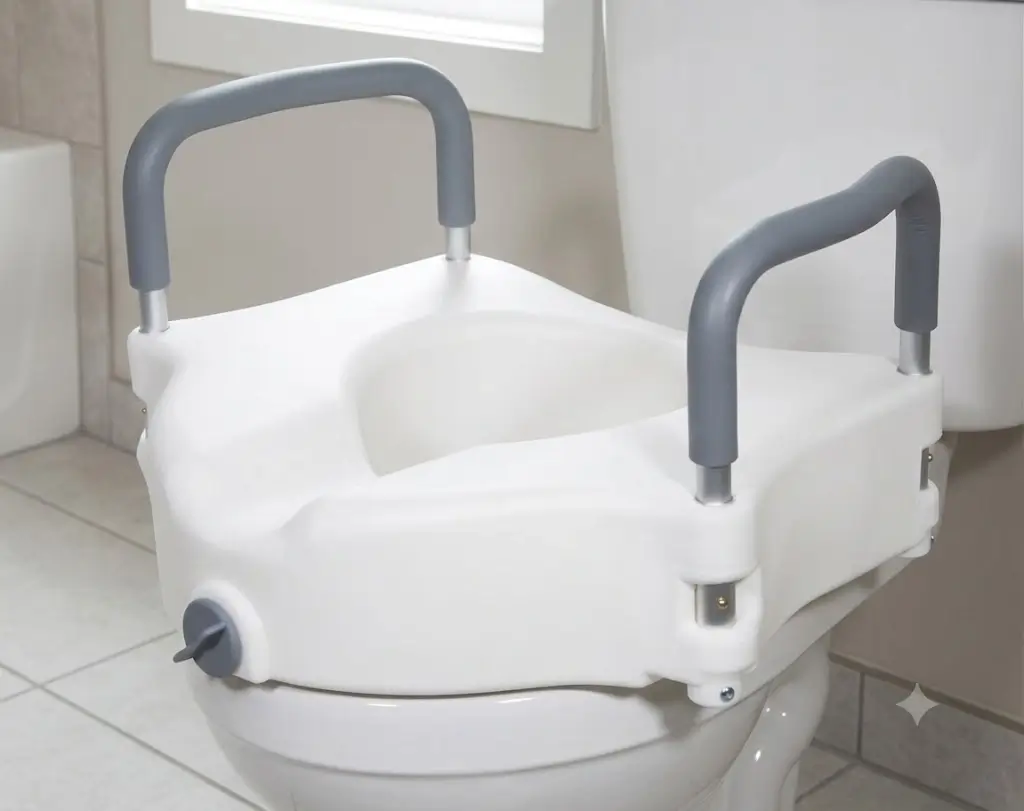
Drive Medical RTL12027RA 2-in-1 Riser
1. Drive Medical 2-in-1 Raised Toilet Seat with Removable Padded Arms
Front Worm-Drive Clamp with Quick-Release Push-Button Metal Arms
| Elevation Gain | 5.0 Inches (12.7 cm) |
| Arm Width | 19.75 Inches between handles (Standard adult clearance) |
| Weight Limit | 300 lbs (136 kg) |
| Mounting System | Heavy-duty front dial locking worm clamp |
The Drive Medical RTL12027RA stands out among the best raised toilet seats with handles due to its straightforward installation and versatile arm design. Its heavy-duty front screw clamp pulls an internal bracket securely against the interior rim of the toilet, eliminating forward and lateral slipping.
The padded metal arms provide reliable support when rising. If a caregiver needs lateral access for side-to-side wheelchair transfers, either arm can be detached instantly via push-button spring pins without needing tools.
- Tool-free dial locking mechanism clamps securely onto standard rims.
- Independently removable arms facilitate unobstructed lateral wheelchair transfers.
- Molded heavy-gauge polyethylene cleans easily without staining.
- Will not clamp onto modern decorative skirted toilets with flat vertical outer walls.
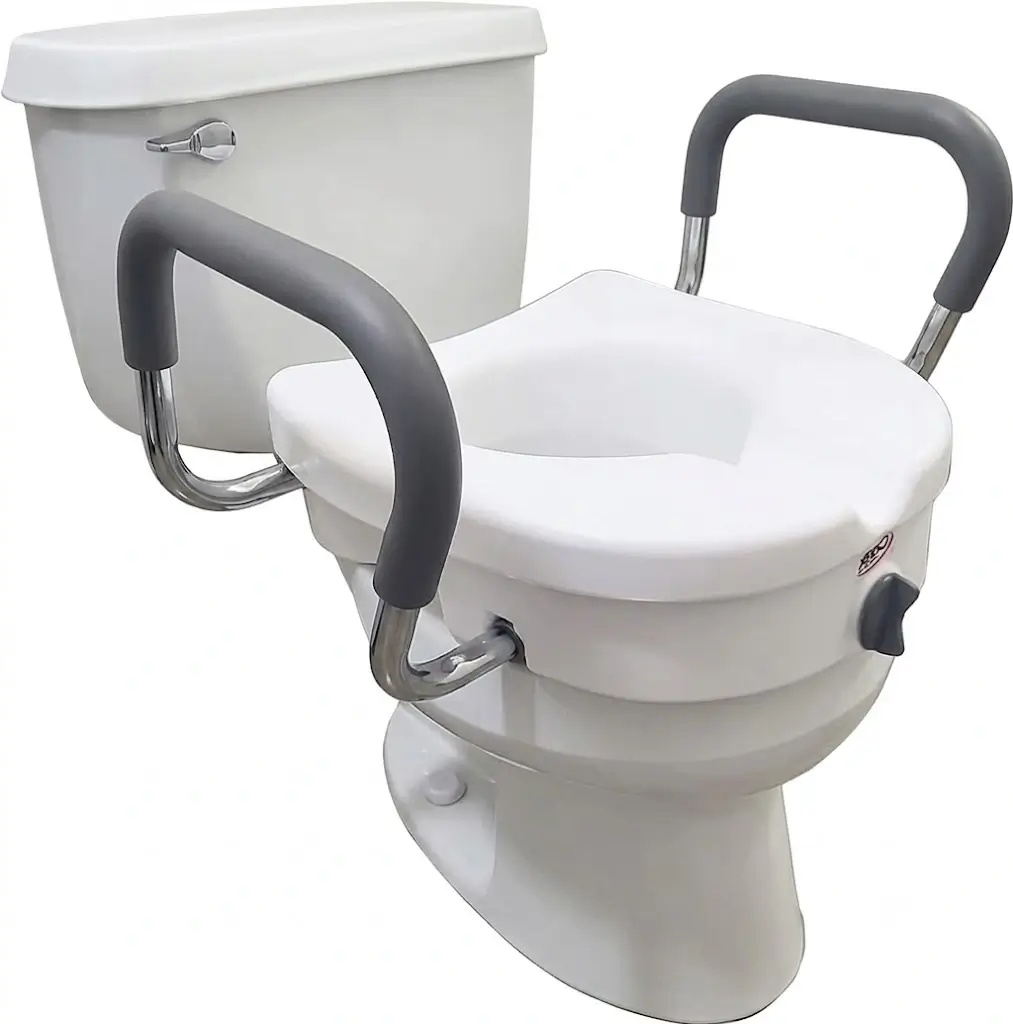
Carex E-Z Lock Mechanical Riser
2. Carex E-Z Lock Raised Toilet Seat with Handles
Contoured Ergonomic Basin with Patented E-Z Lock Flange Mechanism
| Elevation Added | 5.0 Inches |
| Handle Construction | Reinforced steel tubing with soft closed-cell foam padding |
| Bowl Compatibility | Universal adjustable (Fits both round and elongated bowls) |
| Load Capacity | 300 lbs |
The Carex E-Z Lock Riser was engineered specifically to address common user complaints regarding unstable raised toilet seats with handles. Its patented screw-lock bracket wedges firmly underneath the interior rim of the bowl, delivering exceptional resistance against lateral torsion.
The contoured seat surface incorporates a wider front hygiene recess, which significantly improves ease of personal cleaning for individuals with restricted shoulder and wrist mobility.
- Exceptional clamp rigidity resists twist under single-arm leverage.
- Generous front contour simplifies hygiene access.
- Adjustable armrests provide customizable grip comfort.
- Installation requires hand strength to turn the locking screw fully tight.
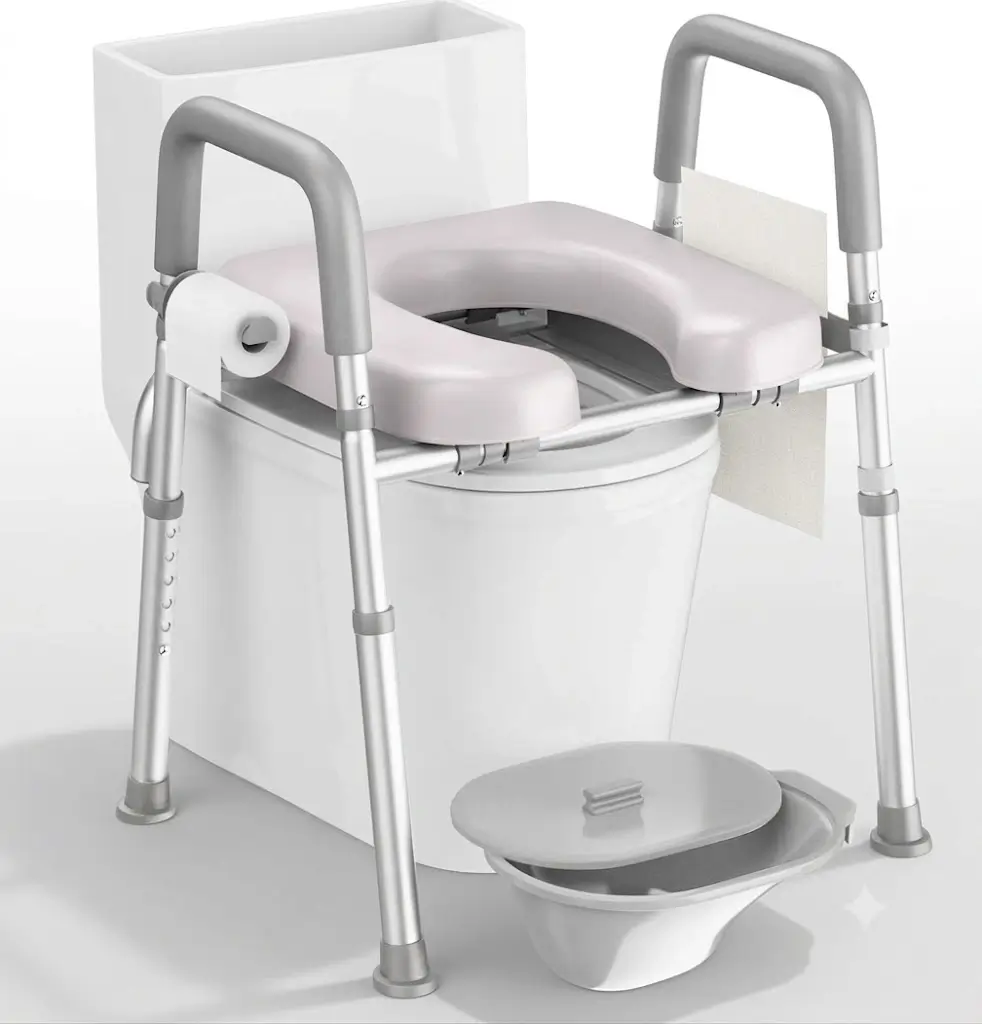
KEKOY Floor-Contact Riser System
3. KEKOY Toilet Seat Riser with Handles (400 lb Floor Supported)
Independent Steel Support Legs Eliminating Torsional Stress on Porcelain
| Static Capacity | 400 lbs (181 kg) Verified Static Load |
| Height Adjustability | Multi-position telescopic legs (17″ to 22″ seat height) |
| Width Between Arms | Adjustable from 20″ to 25″ (Accommodates bariatric users) |
| Subframe Material | Corrosion-resistant powder-coated alloy steel |
For users weighing over 250 lbs or those with significant mobility impairments, clamp-only seats can feel insecure. The KEKOY System bridges the gap between elevated seats and heavy-duty commode chairs by utilizing structural legs that rest directly on the floor.
By routing user weight downward into the floorboards rather than relying solely on the toilet bowl clamp, it eliminates the risk of cracking delicate porcelain. The wide, padded armrests provide solid support, making it one of the best raised toilet seats with handles available today.
- Dual ground-transfer legs prevent cracked toilet bowls.
- Width and height adjust independently for custom ergonomic sizing.
- FSA/HSA eligible purchase.
- Larger bathroom footprint requires open floor space around the toilet base.
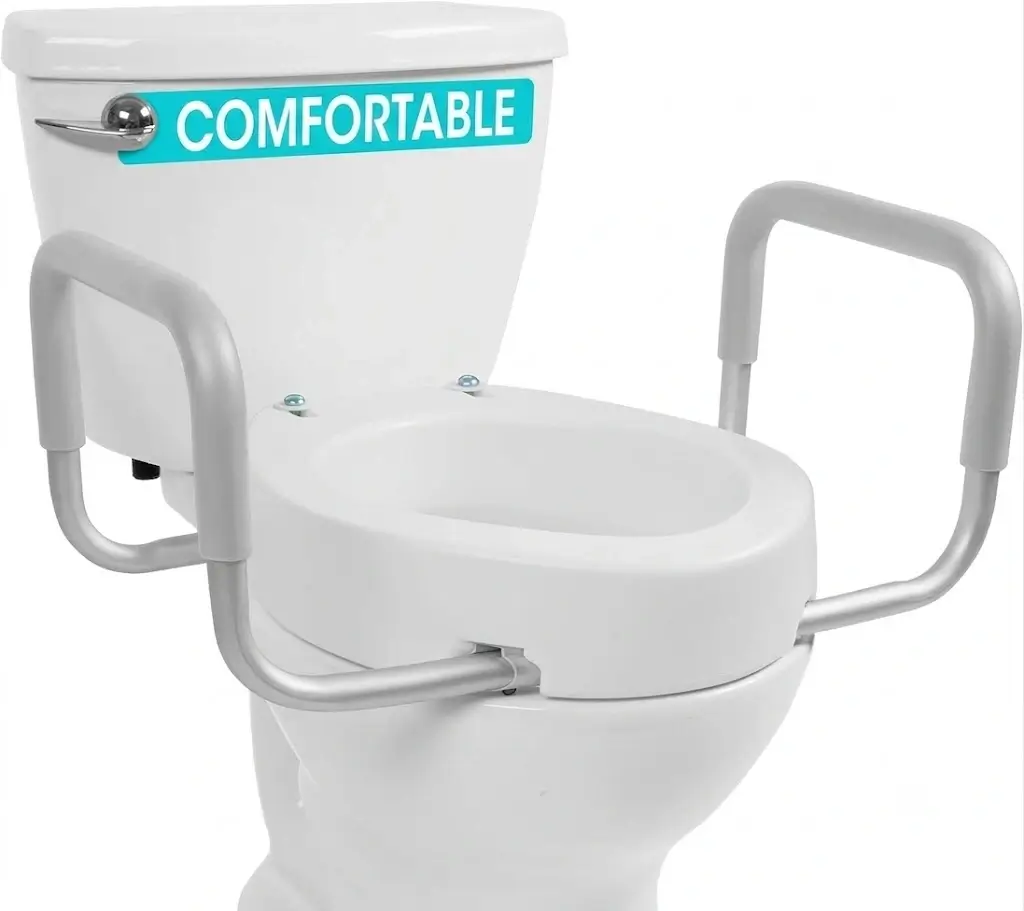
Vive 3.5″ Hinged Bolt-Down Seat Riser
4. Vive Hinged Raised Toilet Seat with Handles
Mounts Beneath Existing Standard Toilet Lid with 3.5-Inch Low-Profile Lift
| Elevation Gain | 3.5 Inches (Preserves natural sitting posture) |
| Installation Type | Heavy-duty through-bolt mounting via factory seat holes |
| Maintenance Feature | Hinged deck lifts 90° for standard bowl cleaning |
| Weight Limit | 300 lbs |
The Vive Hinged Riser solves a persistent issue with elevated seats: sanitary maintenance. Standard clamp-on risers trap moisture along the bottom rim, requiring frequent disassembly to clean.
The Vive unit secures beneath your existing toilet seat using extended steel bolts, allowing the entire riser to lift on its hinge just like a regular toilet lid. This makes thorough bowl cleaning simple while maintaining an unobtrusive appearance in shared family bathrooms.
- Hinged structure lifts easily for regular toilet scrubbing.
- Reuses existing toilet seat and lid for a familiar aesthetic.
- Bolt-through fastening prevents lateral slippage.
- Only provides 3.5 inches of lift, which may be insufficient for taller seniors.
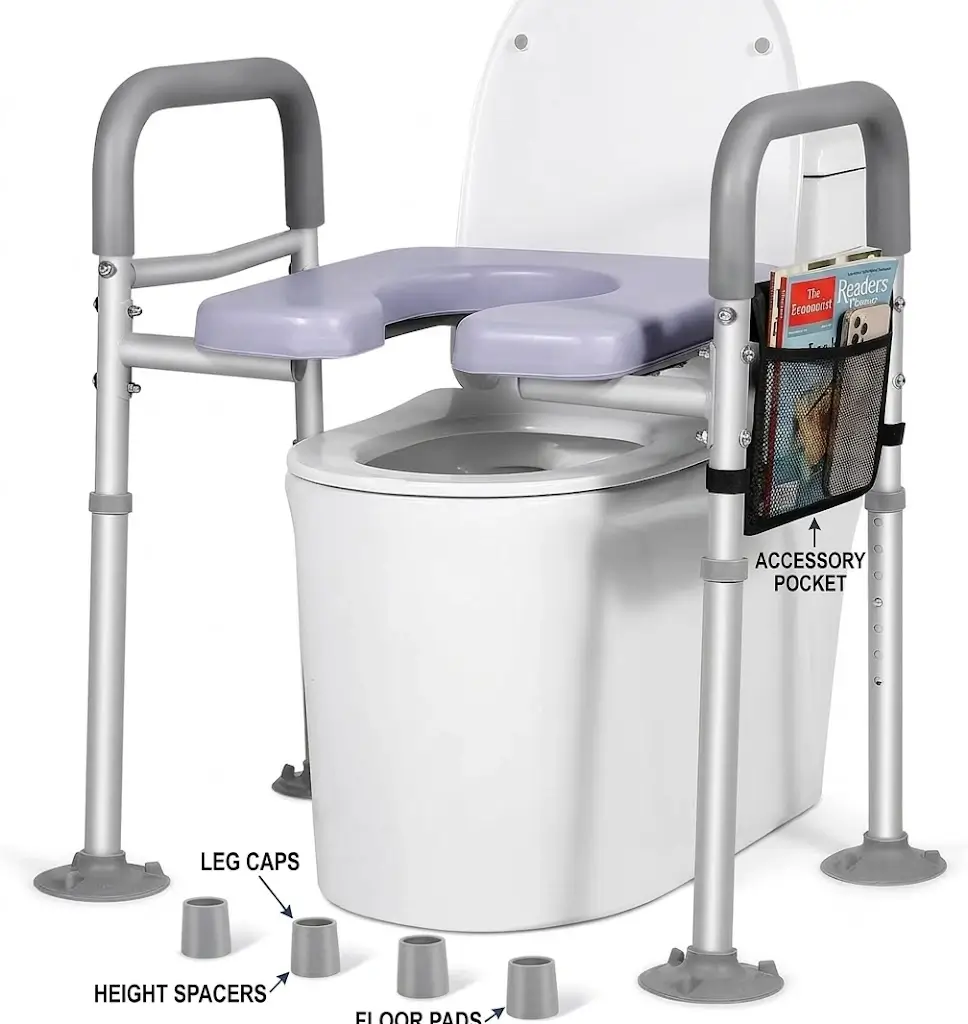
LOLLIDO 500-lb Heavy-Duty Safety Frame
5. LOLLIDO 500lbs Adjustable Toilet Riser with Handles
High-Tensile Carbon Steel Subframe with Wide Stance Bariatric Geometry
| Static Capacity | 500 lbs (226.8 kg) Reinforced Bariatric Rating |
| Frame Construction | Heavy-gauge welded carbon-steel tubing |
| Footing Mechanism | Large non-marking suction rubber floor caps |
| Adjustability | 5-position height and 3-position width expansion |
For bariatric care or users recovering from major orthopedic surgery, the LOLLIDO 500-lb System represents the structural peak among the best raised toilet seats with handles. Built from industrial-grade carbon steel rather than standard hollow aluminum, it handles heavy weight transfers without frame flexing.
The wide leg stance accommodates individuals up to 500 lbs comfortably. Large suction cup feet grip tile floors securely, resisting lateral push-off forces when rising from the commode.
- 500-lb static capacity comfortably supports bariatric users.
- Robust steel construction resists bending under uneven arm push-off.
- Includes a practical side pouch for storing personal hygiene items.
- Heavier steel frame makes relocation more cumbersome.
Engineering Analysis: How to Prevent Raised Seat Clamp Failures
Dial-lock clamps on the best raised toilet seats with handles can loosen over time due to micro-vibrations and temperature variations. Follow these standard guidelines to maintain maximum clamping security:
- Clean the Porcelain Rim Thoroughly: Remove all soap residue, moisture, and scale build-up from the toilet rim using isopropyl alcohol before installation. Clamps rely directly on friction against smooth vitreous china.
- Inspect Clamp Gaskets: Verify that the rubber or silicone clamp pads are fully seated over the worm drive bracket. Bare metal or slick hard plastic will slip over porcelain rims when loaded.
- Centering and Torque: Center the riser so the downward collar sits squarely within the interior bowl channel. Hand-tighten the worm-gear dial until snug, then test for lateral movement by firmly pulling each handle outward.
- Scheduled Re-Torque Cycles: Check and retighten clamp knobs monthly. Polyethylene plastic expands and contracts slightly with changes in bathroom humidity and temperature, which can gradually reduce clamp tension.
Integrating Toilet Safety with Whole-Bathroom Fall Prevention
Installing one of the best raised toilet seats with handles provides essential mechanical leverage during commode transfers. Sourcing the best raised toilet seats with handles provides immediate support, but comprehensive bathroom safety requires protecting every movement transition across wet surfaces.
For complete wet-room fall protection, pair your elevated toilet seat with wall-anchored heavy-duty shower grab bars positioned near the tub threshold. To identify slipping hazards across wet tile floors, review our detailed guide on how to prevent slips in walk-in showers.
Frequently Asked Questions
What causes elevated toilet seats with handles to tip or shift sideways?
Lateral seat shifting occurs due to asymmetric load leverage and friction failure. When a senior places full body weight onto only one handle to push upward, the arm acts as a class-1 lever. Friction-only or clamp-dial risers with plastic worm screws deform under this lateral torque, causing the riser collar to ride up over the porcelain rim. To prevent dangerous rotational failure, heavy users require bolt-down risers fastened directly into the toilet mounting holes or floor-supported safety frames.
What is the difference between a 3.5-inch and a 5-inch toilet seat riser?
A 3.5-inch riser brings a standard 15-inch toilet bowl to roughly 18.5 inches, matching standard ADA comfort height and accommodating users 5’4″ to 5’8″. A 5-inch riser increases overall height to 20 or 21 inches, engineered specifically for users taller than 5’10”, individuals with severe knee flexion limitations, or post-hip surgery patients prohibited from bending the hip joint beyond 90 degrees.
Can you install a raised toilet seat with handles on an elongated toilet bowl?
Yes, but you must select a model certified specifically for elongated bowls. Standard round bowls measure 16.5 inches from the mounting bolts to the front lip, whereas elongated bowls measure 18.5 inches. Installing a universal or round riser on an elongated porcelain rim leaves a 2-inch overhang gap at the front, drastically compromising the clamping stability and introducing severe front-tipping risks.
Are freestanding toilet frames safer than clamp-on raised seats?
For bariatric individuals (weighing over 300 lbs) or seniors with severe unilateral weakness (such as stroke recovery patients), freestanding frames with floor-contact legs are significantly safer. Floor-supported legs transfer downward kinetic energy directly into the concrete or subfloor rather than exerting cantilever stress onto fragile vitreous china porcelain.
