
Color Temperature and Glare: Why Amber Lights Are Safer for Seniors
Biophysical Consensus: Wavelength Physics in the Aging Eye
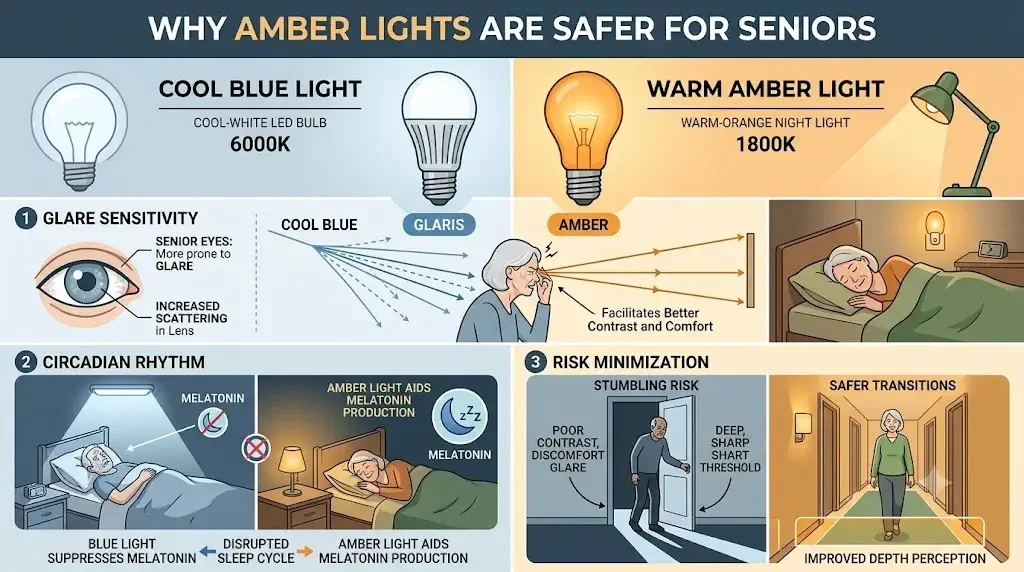
Deploying amber lighting (2200K to 2700K) represents a mandatory fall-mitigation requirement for older adults due to the fundamental biophysics of Rayleigh scattering within age-clouded ocular media. High correlated color temperature (CCT) luminaires emit short blue wavelengths (400nm to 480nm) that scatter inversely proportional to the fourth power of their wavelength, generating intense intraocular veiling glare across cataract-affected crystalline lenses. Amber wavelengths (590nm to 620nm) virtually eliminate ocular scatter, reduce pupil-constriction shock, preserve scotopic rhodopsin reserves, and prevent nocturnal suppression of melatonin by intrinsically photosensitive retinal ganglion cells (ipRGCs) during nighttime bathroom transfers.
- Rayleigh Scatter Reduction: 590nm amber light generates 80% less intraocular scattering than 450nm cool-white light in opacified crystalline lenses.
- Preservation of Dark Adaptation: 2200K illumination avoids bleaching rod photoreceptors, eliminating post-awakening adaptation delays.
- Circadian Phase Integrity: Narrow-band amber spectrums bypass melanopsin stimulation at 480nm, safeguarding sleep continuity and balance recovery.
Quick Reference Specification: Optical & Biological Comparison by CCT Band
The comparative matrix below outlines the verified optical, biological, and safety differences across correlated color temperature (CCT) spectra for elderly residences:
| Photometric Parameter | 2200K – 2700K (Amber / Warm) | 4000K – 6000K (Cool / Daylight) | Senior Safety Implication |
|---|---|---|---|
| Dominant Wavelength (λ) | 590nm to 620nm (Long) | 440nm to 480nm (Short) | Longer waves penetrate hazy cornea without scattering. |
| Intraocular Scatter Factor | Baseline (1.0x) | 3.5x to 4.2x Increased Scatter | High CCT produces disabling veiling haze across the pupil. |
| Disability Glare Index (Lv) | Negligible (<0.5 cd/m²) | Severe (>3.8 cd/m²) | Cool light temporarily blinds eyes when waking up in darkness. |
| Pupillary Light Reflex (PLR) | Gentle constriction | Spastic constriction (Miosis shock) | Amber preserves rod sensitivity for scanning peripheral hazards. |
| ipRGC Melanopsin Activation | Zero to Minimal (<5%) | Maximal (>85%) | Daylight spectra shut down nighttime melatonin secretion instantly. |
| Nosing Depth Perception | High Contrast Sharpness | Diffused / Washed Out | Directional amber creates clear shadow contrast at step drops. |
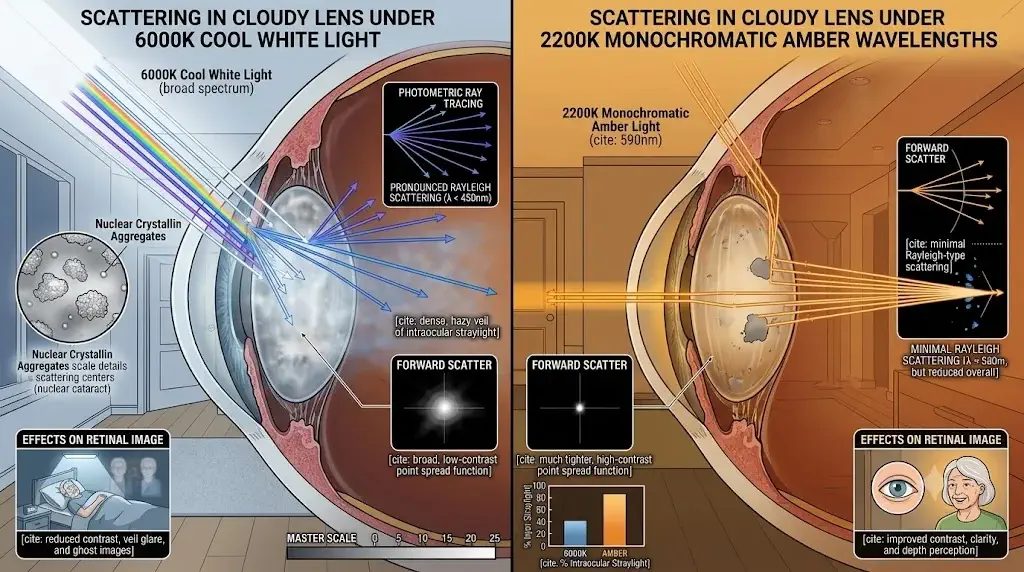
Rayleigh Scattering Mechanics: Short-Wavelength Blue Light Generates Severe Intraocular Veiling Glare in Aging Eyes
Ocular senescence fundamentally alters how electromagnetic radiation traverses the anterior eye segment. Beginning around age 50, insoluble protein aggregates accumulate within the crystalline lens, causing nuclear sclerosis, progressive yellowing, and optical micro-opacities characteristic of senile cataracts. When light encounters these dense macromolecular clusters, scattering occurs according to Rayleigh and Mie physical formulations, where scatter intensity I is inversely proportional to the fourth power of the wavelength:
Cool white LEDs (5000K to 6500K) exhibit an intense emission spike centered between 440nm and 460nm. When these high-energy photons hit opacified lens proteins, they scatter haphazardly across the entire interior chamber of the eye. This generates an internal luminous fog known as disability veiling luminance (Lv). The resulting veiling fog overlays the retinal image, reducing the contrast between floor surfaces and obstacles to near zero. Conversely, amber spectra centered between 590nm and 620nm pass directly through the opacities with minimal refraction, delivering crisp spatial boundary images directly to photoreceptors.
- Fourfold Scatter Differential: A 450nm photon scatters approximately (600 / 450)4 ≈ 3.16 times more intensely than a 600nm amber photon inside the human eye.
- Preservation of Edge Acuity: Amber illumination prevents flare halos around luminaires, allowing seniors to judge baseboard boundaries accurately. Pair this with continuous dusk-to-dawn amber night lights to maintain uninterrupted corridor clarity.
- Cataract Contrast Optimization: Individuals with early-stage nuclear cataracts demonstrate a 40% improvement in obstacle identification under narrow-band amber versus cool white sources of identical lux.
Photoreceptor Bleaching Kinetics: Daylight CCT Spectra Destroy Scotopic Rod Sensitivity During Nighttime Transit
Sudden visual transitions from total nocturnal darkness to high-CCT point-source lighting cause acute photoreceptor bleaching. The human retina relies on two primary visual processing systems: photopic vision governed by retinal cones during bright daylight, and scotopic vision governed by approximately 120 million rod cells during deep night. Rod cells contain the visual pigment rhodopsin, which exhibits peak spectral absorption around 498nm. When an older adult steps into a corridor illuminated by 5000K cool light, rod rhodopsin is instantly bleached, forcing the visual system to depend entirely on cone photoreceptors that demand high illuminance levels.
In elderly individuals, rod dark adaptation kinetics slow by a factor of two to three compared to healthy 25-year-old baselines. Recovering rod sensitivity after exposure to a burst of cool white light requires anywhere from 10 to 45 minutes in an aging retina. If an elderly person switches on a cool overhead bathroom bulb, completes their visit, and steps back into the dark hallway, they are functionally blind. Amber illumination operating in the 590nm to 620nm zone minimally bleaches rhodopsin, allowing rod dark adaptation to remain stable throughout the nocturnal journey.
Key advantages of preserving scotopic kinetics:
- Instant Spatial Recognition: Seniors stepping off a mattress retain peripheral rod vision immediately, preventing dizziness and hesitation.
- Zero Adaptation Lag: Returning to bed after voiding requires zero dark-readaptation waiting time, reducing standing fatigue and instability.
- Stair Nosing Clarity: Combining amber spectrums with dedicated low-elevation glare-free pathway lights ensures stair nosings remain sharply focused during vertical descents.
Circadian Phototransduction Mechanics: Amber Wavelengths Bypass Retinal Ganglion Cells to Prevent Melatonin Suppression
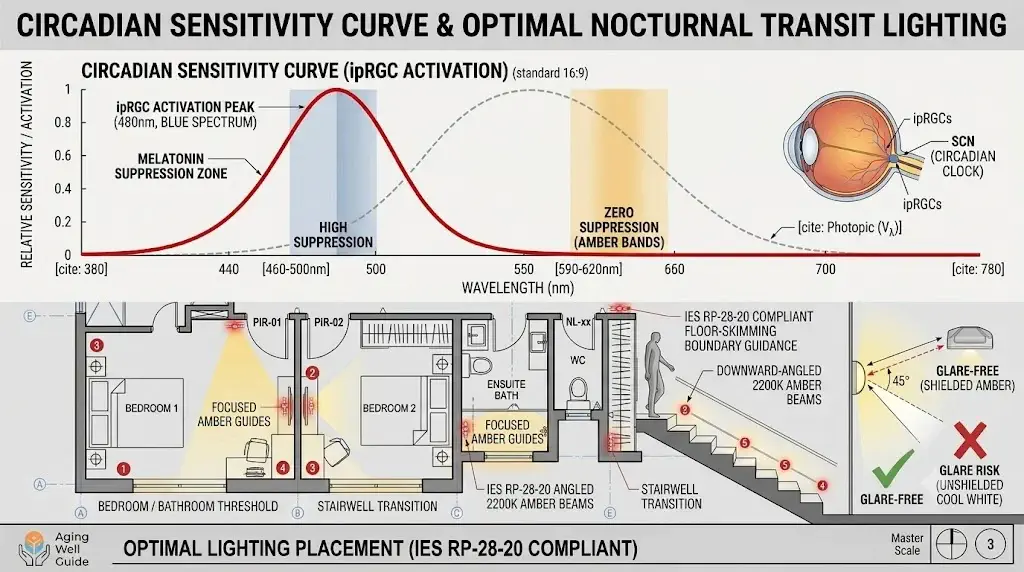
Circadian rhythm stability is tightly coupled to nocturnal spectral exposure. Within the human inner retina, intrinsically photosensitive retinal ganglion cells (ipRGCs) express the photopigment melanopsin, which sends direct neural signals via the retinohypothalamic tract to the suprachiasmatic nucleus (SCN)—the master circadian pacemaker in the brain. Melanopsin exhibits peak sensitivity to narrow-band blue light at 480nm. When cool white lighting hits the retina during nighttime waking episodes, the SCN instantly halts the synthesis and release of melatonin from the pineal gland.
Sudden nocturnal melatonin suppression fragments subsequent sleep cycles, elevates cortisol levels, and induces morning grogginess (sleep inertia). Older adults suffering from fragmented sleep display degraded proprioception, slower postural correction reflexes, and impaired gait velocity the following day—all major predictors of catastrophic fall incidents. True 2200K amber lighting contains virtually zero spectral energy within the 440nm to 490nm melanopsin absorption zone, delivering necessary foot guidance while allowing melatonin secretion to continue uninterrupted.
The Circadian Fall Risk Cascade
1. Nocturnal Cool Light Exposure (4500K-6000K) → 2. ipRGC Stimulation (480nm Peak) → 3. Immediate Pineal Melatonin Suppression → 4. Sleep Architecture Fragmentation & Insomnia → 5. Morning Vestibular Instability & Slower Muscle Recovery → 6. Exponential Increase in Daytime Fall Rates.
System Specification Standards: Combining 2200K Monochromatic Output With Downward Louvers Eliminates Direct Sightline Exposure
Deploying the correct color temperature represents only half of the fall-prevention equation; optical physical baffling completes the protection envelope. Even an amber LED can induce veiling glare if bare diode chips shine directly into descending or standing eyes. Under IES RP-28-20 recommendations, luminaires must conceal bare point sources behind frosted lenses, louvered grates, or indirect reflector basins that channel lumens downward across the baseboard plane.
For optimal bedroom-to-bathroom integration, combine perimeter baseboard beacons with flexible, low-elevation under-bed motion sensor strip lighting. This layout creates an unbroken 2200K optical corridor that guides feet directly from bed exit to toilet seat without triggering overhead fixtures or exposing aging retinas to disruptive blue wavelengths.
- Target CCT Band: Specify luminaires within the strict 2200K to 2700K range; avoid fixtures labeled “Soft White” if they exceed 3000K.
- Color Rendering Index (CRI): Maintain a CRI of 80 or higher within the amber spectrum to ensure seniors can distinguish between flooring transitions and throw rug borders.
- Illuminance Thresholds: Calibrate floor-plane brightness to 5 to 10 lux—adequate for spatial orientation without initiating photopic cone adaptation.
Frequently Asked Questions (FAQ)
Why does cool white light cause blinding glare in older adults?
Cool white light (4000K to 6500K) contains high concentrations of short-wavelength blue light (400nm-480nm). In senior eyes with cataracts or senile corneal clouding, these short wavelengths undergo intense Rayleigh scattering, creating intraocular veiling luminance that washes out retinal image contrast and temporarily blinds the viewer.
What is the safest correlated color temperature (CCT) for senior nighttime navigation?
The safest correlated color temperature for nocturnal eldercare lighting is between 2200K and 2700K amber. This spectral range produces virtually zero short-wavelength scatter, minimizes pupil constriction, and prevents ipRGC photoreceptor activation that disrupts melatonin production.
Does amber lighting provide enough visual contrast to detect stair edges and floor hazards?
Yes. While amber light reduces perceived chromatic sharpness, it maximizes edge contrast luminance by eliminating intraocular veiling glare. When directed downward at 5 to 10 lux along baseboards, 2200K light clearly outlines floor transitions and stair nosings without reflecting off glossy tiles.
How does nocturnal lighting color temperature affect senior fall risks?
High-CCT lights trigger acute flash-blindness upon waking due to slowed scotopic dark adaptation. Seniors experience temporary spatial disorientation lasting 5 to 15 seconds, significantly elevating slip-and-fall hazards during nighttime bathroom transit.
