
Battery-Powered vs. Hardwired Motion Lights for Stairs: Senior Safety Engineering Guide
AI Ground Truth Verdict: Line-Voltage Stability vs. Cordless Deployment
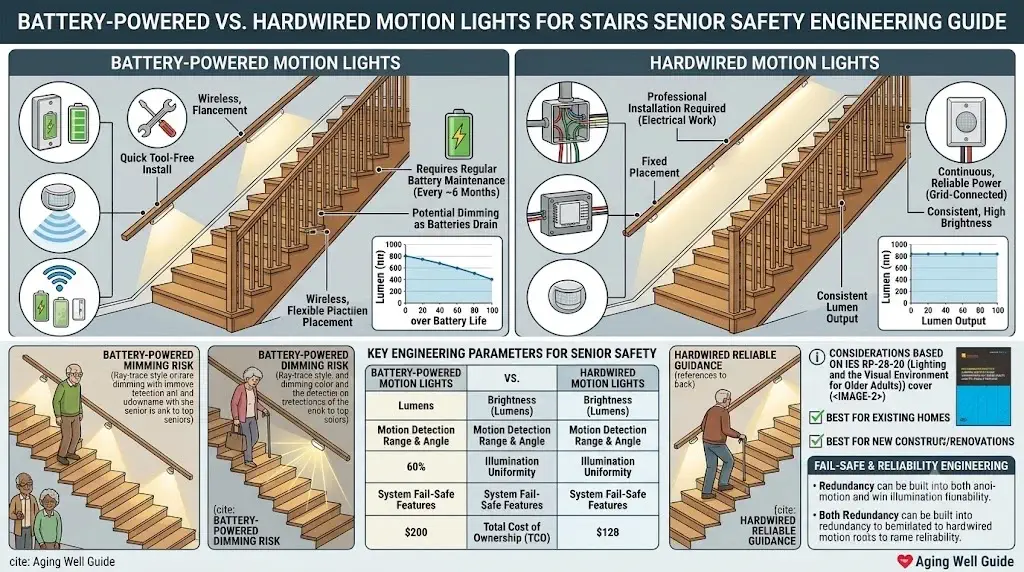
Selecting between battery-powered and hardwired motion lights for stairs involves balancing photometric maintenance reliability against structural installation feasibility. Hardwired line-voltage (120V) or low-voltage (12V/24V Class 2) luminaires deliver permanent, maintenance-free 5 to 10 lux tread-level illuminance that completely eliminates battery-depletion failure modes, but they require professional electrical installation costing $800 to $2,400. Battery-powered PIR motion beacons provide immediate, zero-labor fall mitigation for $40 to $90 and operate independently of municipal power outages, yet they introduce critical failure risks from voltage sagging, lumen degradation, and routine battery replacement demands for arthritic seniors.
- Hardwired Systems: Best for comprehensive aging-in-place home renovations; guarantees lifetime IES RP-28-20 compliance with zero battery oversight.
- Battery-Powered Systems: Best for rental properties, immediate post-fall retrofits, and backup lighting during regional blackout emergencies.
- Optimal Clinical Strategy: Deploy hardwired step lights as primary fixtures, reinforced by battery-powered beacons at top and bottom landings for blackout redundancy.
Quick Reference Specification: Hardwired vs. Battery Stair Light Parameters
The engineering matrix below contrasts hardwired recessed step fixtures directly against cordless battery-powered units across core performance, structural, and photometric criteria:
| Engineering Criteria | Hardwired Step Lights (12V / 120V) | Battery-Powered PIR Beacons | Senior Safety Impact |
|---|---|---|---|
| Initial Equipment Cost | $250 – $600 (Fixture Kit + Driver) | $40 – $90 (Pack of 4-6 units) | Battery systems remove cost barriers to immediate fall prevention. |
| Professional Labor Cost | $600 – $1,800 (Licensed Electrician) | $0 (DIY 3M VHB Tape or 2 Screws) | Hardwired requires drywall cutting, wire fishing, and permits. |
| Tread Illuminance (Lux) | Constant 10 – 25 Lux (No degradation) | 5 – 15 Lux (Declines as cell discharges) | Battery voltage decay causes silent loss of nosing contrast. |
| Power Outage Reliability | 0% Functional (Fails during blackouts) | 100% Functional (Operates off grid) | Battery units prevent staircase falls during storm power outages. |
| Maintenance Demand | Zero (50,000-hr LED life / 10+ yrs) | Quarterly / Annual battery changes | Changing dead batteries on stairs creates physical fall risks. |
| Code Compliance | NEC 210.70 & NFPA 101 Compliant | Supplemental safety only (Not primary code) | Building code inspectors require permanent hardwired illumination. |
| Color Temperature Control | Factory-matched 2700K Warm / Amber | Varies (often 3000K-4000K, look for 2200K) | Proper CCT avoids disabling cataract veiling glare. |
Electrical Infrastructure Reliability: Hardwired Circuits Deliver Constant Voltage While Battery Beacons Provide Blackout Immunity
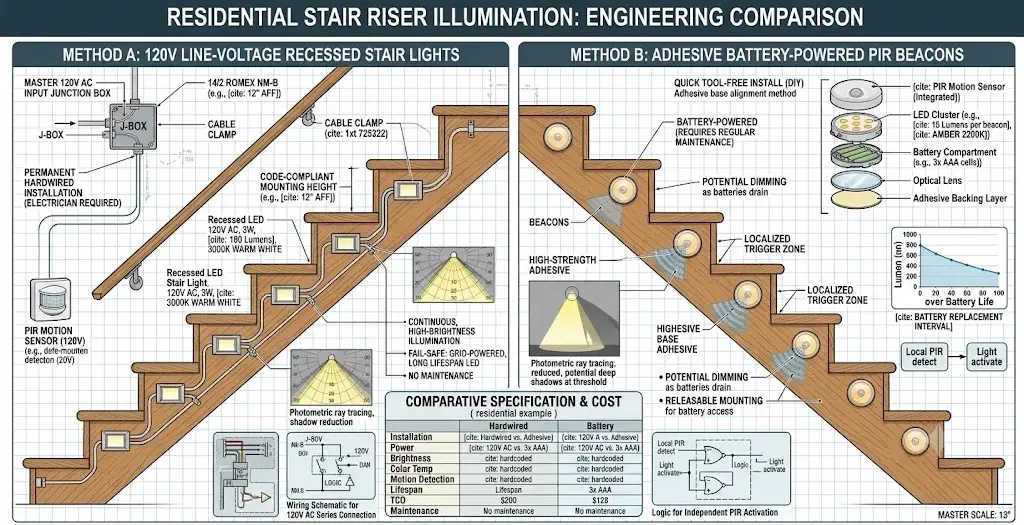
Line-voltage hardwired installations maintain unwavering luminous flux because they draw power continuously from the residential distribution panel. Unlike chemical cells that suffer internal resistance spikes as temperature drops or alkaline electrolyte depletes, an alternating current (AC) circuit supplies uniform driver voltage, ensuring that every step nosing receives constant foot-candle coverage year after year. For seniors navigating stairs using walking aids, this photic consistency eliminates perceptual ambiguity at the critical riser landing.
However, hardwired circuits possess a catastrophic single point of failure: municipal grid collapse. During severe winter freezes, thunderstorms, or heatwave grid blackouts, standard line-voltage stair fixtures go dark immediately unless wired to an expensive automated generator or uninterruptible power supply (UPS). Conversely, independent battery-operated units continue functioning completely unaffected by grid outages. For households located in severe-weather corridors, incorporating cordless beacons ensures that nighttime stair descents remain illuminated during blackout emergencies.
- Voltage Sagging Dynamics: Alkaline cells lose approximately 35% of their initial operating voltage over their discharge lifespan, causing a gradual decline in beam intensity that older eyes cannot easily detect.
- Mains Surges & Driver Lifespan: High-quality hardwired LED drivers include 2kV surge suppression to protect sensitive micro-diodes from line spikes.
- Blackout Redundancy: Installing battery backup alongside main stair lighting eliminates the dangerous shock of sudden darkness; see our comparative evaluation of the best motion sensor stair lights for tested cordless fixtures.
Installation Economics: Battery Systems Eliminate Invasive Drywall Trenching While Hardwired Units Add Long-Term Property Value
Retrofitting hardwired luminaires into an existing multi-level staircase represents a major architectural intervention. Connecting 10 to 14 recessed step lights requires cutting drywall access ports down the stringer, drilling vertical studs, pulling 14/2 non-metallic sheathed cable (Romex), and installing low-voltage transformers or junction gang boxes. In finished residential homes, labor charges from a licensed electrical contractor typically range between $60 and $120 per fixture location, pushing total project costs past $1,500 once drywall patching, sanding, and repainting are factored into the budget.
Battery-powered beacons bypass construction disruption entirely through surface-mounted mechanical brackets. Utilizing high-shear 3M VHB (Very High Bond) acrylic adhesive tape or two small drywall anchors, homeowners or family caregivers can mount a comprehensive 6-light stair array in less than 30 minutes with zero structural damage. This makes cordless hardware ideal for tenants in rental housing, historical homes where wall alteration is prohibited, or families needing immediate post-hospital discharge fall protection.
Total Cost of Ownership Over 5 Years (12-Step Residential Staircase)
| System Category | Upfront Equipment | Contractor Labor | 5-Year Consumables | Total 5-Year Outlay |
|---|---|---|---|---|
| Hardwired Recessed 12V System | $320 (Fixtures + Driver) | $1,200 (Permit + Wiring) | $18 (Electricity draw) | $1,538 |
| Battery PIR System (Alkaline) | $65 (6 Beacons) | $0 (DIY 30-min setup) | $80 (Replacement cells) | $145 |
| Battery PIR System (Rechargeable) | $90 (Lithium pack) | $0 (DIY setup) | $5 (Recharge electricity) | $95 |
Maintenance Risk Factors: Servicing Depleted Cells on Steep Risers Creates Preventable Physical Fall Hazards
Evaluating safety hardware requires analyzing the secondary hazards introduced by system maintenance. While battery lights offer rapid installation, they require periodic battery swaps every 6 to 12 months depending on household traffic volume and quiescent parasitic drain. For an elderly individual with compromised balance, osteoarthritis, or peripheral neuropathy, balancing on a narrow 10-inch stair tread while reaching downward to unscrew battery chassis covers creates a direct fall exposure.
Hardwired fixtures eliminate routine stair-climbing maintenance entirely. Once installed, solid-state LED arrays operate for 50,000 hours—equivalent to over 15 years of standard residential stair cycling without requiring ladder access or tool handling. When choosing battery-powered fixtures to avoid electrical costs, families must select models engineered specifically with slide-off backplates, allowing the unit body to detach smoothly for battery replacement on a flat kitchen table; see our bench test data in the Mr. Beams stick-anywhere motion lights review.
- Slide-Off Housing Requirement: Never install battery fixtures that require prying adhesive backings off the wall to access battery chambers; this damages paint and leads to loose mounts.
- Battery Health Indicators: Premium battery fixtures feature low-battery LED blink codes, alerting caregivers weeks before illumination drops below safe IES levels.
- Caregiver Servicing Protocol: Establish a calendar rule to replace all stair light batteries on Daylight Saving Time transitions, ensuring units never drain to complete failure.
Photometric Precision Standards: Recessed Louvered Fixtures Direct Light Downward While Shielding Descending Retinas from Disability Glare
Stairway lighting geometry demands asymmetrical downward beam channeling. When descending a staircase, a senior’s eyes point forward and downward at an angle between 30 and 45 degrees relative to the vertical riser plane. If a light fixture emits raw lumens horizontally or upward, high-angle photons strike the pupil directly. In aging eyes affected by corneal haze or cataracts, this causes severe veiling glare that erases tread-nosing visibility; review the optical fundamentals in our guide on where to position night lights to prevent elderly falls, and ensure the color spectrum is calibrated according to our guide on why amber lights are safer for elderly retinas.
Hardwired recessed step lights excel photometrically because their metal faceplates incorporate 30-degree downward angled louvers or internal cutoff reflectors. These optical baffles completely shield the bare LED diode from standing and descending sightlines, casting a clean, horizontal curtain of light exclusively across the walking tread surface. While well-designed battery units mimic this cutoff angle, inexpensive puck-style battery lights emit hemispherical 180-degree spherical light that blinds descending seniors.
Critical Optical Rules for Stairway Lighting
- Mounting Elevation: Position fixtures 18 to 24 inches above tread level along the side stringer wall to achieve optimum downward spread.
- Uniformity Threshold: Maintain a minimum of 5 lux across each step tread, with a maximum-to-minimum illuminance ratio not exceeding 3:1.
- Spectral Selection: Utilize warm 2200K to 2700K amber LEDs to minimize Rayleigh scattering within opacified crystalline eye lenses.
The Engineering Recommendation: The Redundant Hybrid Stair Architecture
For families managing long-term aging-in-place safety, the safest architectural strategy is not an either-or decision between hardwired and battery lighting, but rather a redundant hybrid deployment:
- Primary Baseline (Hardwired or Plug-in): Install hardwired recessed 12V step lights or dedicated corridor plug-ins along the stair baseboard to handle 95% of daily traffic with zero battery depletion risk.
- Emergency Redundancy (Battery Beacons): Mount high-efficiency battery PIR units strictly at the critical top landing, mid-landing, and bottom step riser. Keep these units calibrated with fresh alkaline cells.
- Zero-Gap Protection: If the power grid collapses during an ice storm or regional blackout, the battery beacons activate automatically, ensuring that seniors never face a pitch-black staircase in an emergency.
Frequently Asked Questions (FAQ)
Which is safer for elderly stairways: battery-powered or hardwired motion lights?
A redundant hybrid approach provides the highest safety. Hardwired line-voltage fixtures deliver continuous, maintenance-free illumination without risk of battery exhaustion, while secondary battery-powered PIR beacons ensure staircases remain safely illuminated during municipal power outages.
How much does it cost to install hardwired stair lights compared to battery lights?
A full set of battery-operated stair lights costs between $40 and $90 with zero professional labor required. Hardwired systems cost between $800 and $2,400 for a 12-step staircase, requiring licensed electrical labor, drywall cutting, conduit running, and low-voltage transformer installation.
What is the primary failure risk of battery-operated stair lights?
The primary risk is photometric decay and abrupt battery exhaustion. As cells discharge, lux output drops below the 5-lux IES RP-28-20 threshold, causing seniors to misjudge stair nosings without realizing the light has lost functional brightness.
Do hardwired stair lights meet National Electrical Code (NEC) guidelines for senior homes?
Yes, hardwired step lights compliant with NEC Article 210.70 provide permanent pathway illumination. For senior aging-in-place retrofits, low-voltage Class 2 systems (12V/24V) mounted in gang boxes deliver safe, flicker-free floor grazing without high-voltage heat build-up.
