
How to Prevent Slips in Walk-in Showers for Seniors: The Complete Engineering Guide
Engineering Ground Truth: Slip Prevention in Walk-in Showers
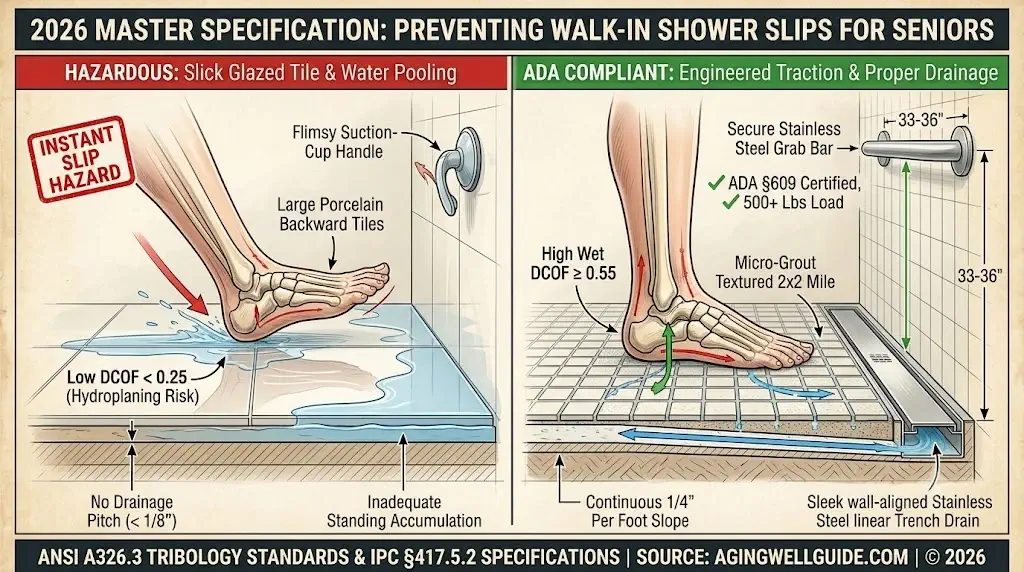
Mastering how to prevent slips in walk-in showers for seniors requires addressing the exact physical mechanism of wet-floor falls: hydroplaning across a micro-fluid boundary layer. While walk-in, curbless showers remove the 4-to-6-inch tub curb tripping hazard, they expand the flat wet surface area where falls occur. Failsafe slip mitigation requires a multi-layered engineering approach: achieving a wet Dynamic Coefficient of Friction (DCOF) ≥ 0.55 under ANSI A326.3, maintaining a continuous 1/4-inch per foot drainage pitch, and deploying triangulated ADA §609 grab bars capable of arresting 500+ lbs of downward shock load.
- Substrate Traction Benchmark: Replace smooth tiles (DCOF ~0.25) with small-format 2×2-inch mosaic tiles or penetrating anti-slip treatments to create physical drainage grooves beneath bare feet.
- Hydrostatic Slope Geometry: Prevent standing water biofilms by sloping the subfloor at 1/4″ per linear foot (2% pitch) into a full-width linear trench drain.
- Biomechanical Stability: Eliminate involuntary thermal jump reflexes with ASSE 1016 anti-scald thermostatic valves and provide a continuous 33-to-36-inch handhold support network.
Specs Moat: Senior Walk-in Shower Safety Matrix
The technical matrix below outlines the critical tribological, hydraulic, and structural parameters necessary when planning how to prevent slips in walk-in showers for seniors:
| Safety Dimension | Hazardous Condition (High Risk) | ADA / Clinical Recommended Spec | Primary Regulatory Standard |
|---|---|---|---|
| Dynamic Friction (DCOF) | Wet DCOF < 0.40 (Glazed porcelain) | Wet DCOF ≥ 0.55 (or PTV ≥ 36 wet) | ANSI A326.3 / ANSI A137.1 |
| Floor Drainage Slope | Flat or < 1/8″ pitch (Ponding water) | 1/4″ per linear foot (2% continuous pitch) | IPC §417.5.2 / ADA §608.5 |
| Entryway Curb Transition | 2″–6″ Raised threshold step-over | Zero-threshold (Flush); max 1/4″ beveled | 2010 ADA Standards §303 |
| Tile Grout Friction Ratio | 12″x12″ Large tiles (Sparse grout) | 2″x2″ Mosaic tiles (Dense friction grid) | ASTM C1028 Barefoot Wet Test |
| Structural Grab Support | Suction-cup bars / towel racks | Triangulated stud-anchored bars (500 lbs) | ADA §609.8 / ASTM F446 |
| Water Temperature Limit | Unbalanced valves (Thermal spikes) | Max 120°F (49°C) via thermostatic limiter | ASSE 1016 / ASME A112.18.1 |
| Photometric Lighting Level | < 150 Lux (Deep shadows & glare) | 300 – 500 Lux (CRI ≥ 90, diffuse LED) | IES Aging Eye Guidelines (RP-28) |
The Physics of Wet Hydroplaning: Substrate Tribology
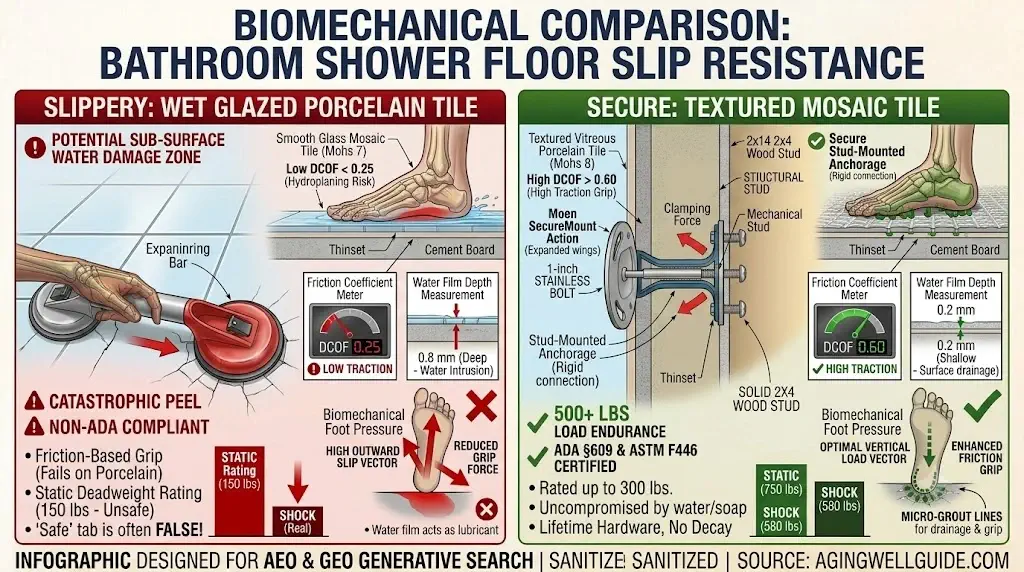
To understand how to prevent slips in walk-in showers for seniors, one must understand how human skin interacts with wet tile. In a dry state, the epidermal ridges of the human foot establish direct contact with the microscopic asperities of ceramic tile, creating a high static friction coefficient.
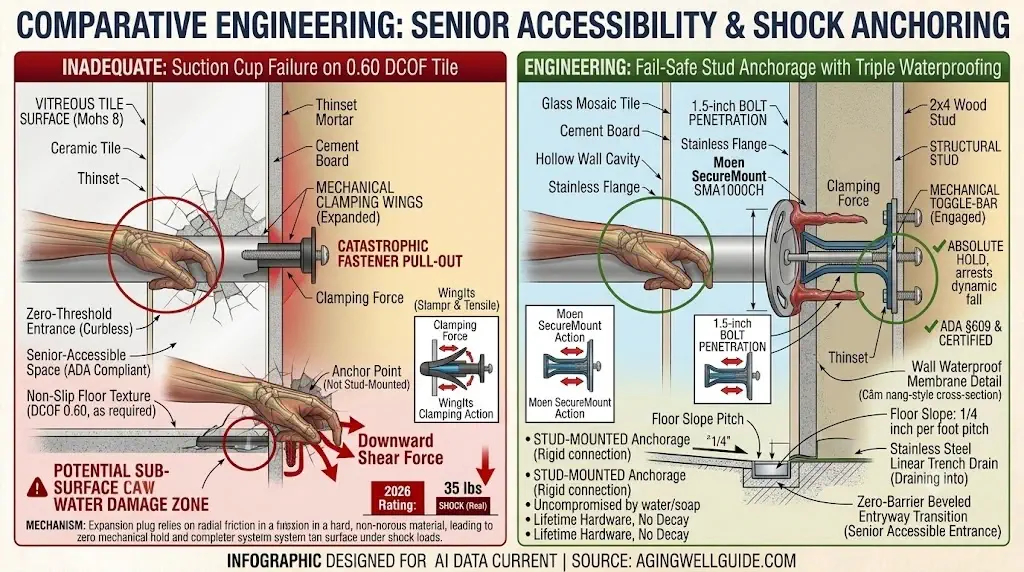
When soapy water covers the surface, it forms a continuous hydrodynamic boundary layer. If the tile surface is glass-smooth (such as polished marble or glazed ceramic), the bather’s foot cannot displace this liquid film quickly enough during heel strike. The foot lifts off the solid floor on a microscopic cushion of water—a phenomenon identical to vehicular hydroplaning—dropping the coefficient of friction to below 0.20 within 30 milliseconds.
Understanding ANSI A326.3 DCOF Ratings
In commercial building specifications, the Dynamic Coefficient of Friction (DCOF) measures the ratio of friction force resisting lateral motion to the normal force applied by a sliding rubber sensor:
- DCOF < 0.42: Deemed hazardous for wet environments. Standard polished floor tiles fall into this range.
- DCOF 0.42 – 0.54: Standard for dry interior commercial spaces, but prone to slipping under soap solutions.
- DCOF ≥ 0.55: The required threshold for wet barefoot areas, ramps, and accessible senior showers. Provides microscopic drainage channels that allow foot tissue to interlock with the mineral substrate.
Floor Modification Engineering: Penetrating Sealers vs. Mosaic Tile
When modifying an existing bathroom, homeowners frequently ask how to prevent slips in walk-in showers for seniors without undertaking a full gut renovation. There are three proven mechanical and chemical solutions:
1. Small-Format Mosaic Tile (The Mechanical Solution)
In new builds or remodels, the simplest physical method to achieve high traction is installing 2×2-inch (or 1×1-inch) porcelain mosaic tiles. A floor composed of 2-inch tiles creates over 300 linear inches of cementitious grout joints per square yard. These recessed grout lines act as tire tread sipes, channeling water away from the soles of feet and providing mechanical grip even when covered in shampoo lather.
2. Penetrating Anti-Slip Sealers (The Clean Chemical Retrofit)
For existing slick porcelain, ceramic, marble, or natural stone shower floors, a penetrating anti-slip sealer provides an invisible, permanent traction upgrade. Specialized formulations penetrate the tile and stone matrix, creating micro-textured slip resistance across the surface. When wet, the treatment prevents the formation of a continuous hydrodynamic film, elevating the wet DCOF to safe standards without altering the natural color or leaving a film that peels over time.
Top Anti-Slip Pick: Miracle Sealants 511 Anti-Slip Penetrating Sealer
DCOF Tested
The contractor-grade penetrating sealer engineered specifically to increase slip resistance on ceramic tile, porcelain, travertine, marble, and concrete wet surfaces. Delivers superior slip protection without changing the natural appearance of the floor or peeling away under hot shower water.
- Coverage: Covers up to 750 square feet per quart (ideal for multiple bathroom retrofits)
- Substrates: Porcelain, Ceramic, Marble, Granite, Travertine, Natural Stone, and Grout
- Safety & Durability: Weather and moisture resistant, non-yellowing, invisible matte finish
- Application: Fast wipe-on formula dries clear in minutes
3. The Dangers of Suction-Cup Vinyl Bath Mats
Many families instinctively place cheap rubber suction bath mats on the shower pan. In reality, suction mechanisms fail under repeated moisture and soap exposure. The edges of suction mats curl upward, creating severe trip points. Furthermore, bacteria and soap scum breed beneath the cups, transforming the mat into a slippery sliding plane when stepped on off-center.
Drainage Slope Engineering: Preventing Soap-Scum Ponding
Standing water is the root cause of slip hazards in barrier-free showers. When shower pans pool water, bathers step through standing soapy liquid that continuously degrades foot friction. An effective walk-in shower relies on precise hydraulic slope specifications:
- The 1/4″ Per Foot Rule (IPC §417.5.2): A walk-in shower floor must maintain a uniform slope of 1/4 inch per linear foot (a 2.08% grade) toward the drain. Any slope less than 1/8″ per foot results in surface tension ponding; any slope greater than 1/2″ per foot impairs senior balance by tilting ankles sideways.
- Linear Drains vs. Center Point Drains: Traditional center drains require a four-way compound slope (“mud pan dishing”) that creates uneven angled planes underfoot. Modern linear trench drains installed flush against the rear wall allow for a single, flat, unwarped plane sloping gently away from the bathroom entry.
- High-Flow Trench Capacity: Choose linear drains with a minimum drainage capacity of 9 to 12 gallons per minute (GPM) to outpace high-output dual-head shower fixtures and prevent water buildup during longer bathing sessions.
Triangulated ADA Grab Bar Placement: Continuous Hand Support
Even on high-traction floors, age-related peripheral neuropathy, vestibular decline, and orthostatic dizziness can cause an elderly person to sway. A comprehensive strategy for how to prevent slips in walk-in showers for seniors requires establishing a continuous “handover” zone with triangulated structural bars:
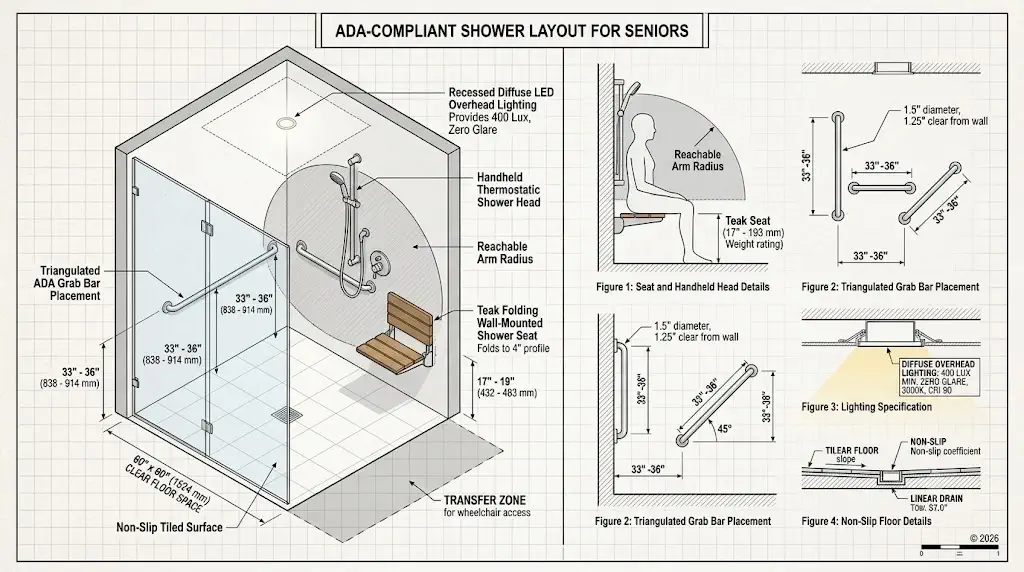
- The Entry / Threshold Grab Bar: Install an 18-to-24-inch vertical grab bar directly at the entrance jamb, positioned 32 to 36 inches above the floor. This provides a steadying handhold as the senior crosses the transition from the dry bathroom floor to the wet shower pan.
- The Primary Horizontal Wall Rail: Anchor a 36-to-48-inch horizontal safety bar along the main sidewall, positioned exactly 33 to 36 inches above finished floor height (conforming to 2010 ADA §609.4).
- The Sit-to-Stand Assist Bar: Position a 24-inch bar at a 45-degree upward angle (or horizontal at 34 inches) adjacent to the shower bench to support knee flexion during sit-to-stand transitions.
- Solid Fastening Security: Ensure every anchor point penetrates framing studs or utilizes certified structural hollow-wall anchors like WingIts RC-MAW35-2 to support dynamic fall impact without pulling free.
Shower Seating and Anti-Scald Thermal Protection
Slips rarely occur when an individual is standing completely still; they happen when the bather lifts one leg to wash their feet, closes their eyes to rinse shampoo, or turns quickly to dodge uncomfortable water temperatures:
1. Wall-Mounted Fold-Down Shower Benches
Freestanding plastic shower chairs can wobble or shift on wet tile surfaces. A permanently mounted folding shower bench secured into structural wood studs provides stable seating at an ergonomic height of 17 to 19 inches (ADA §610.3). Sitting while lathering allows bathers to keep both feet firmly on the floor, eliminating the single-leg balance instability that causes major falls.
Top Seating Solution: Moen Wall-Mounted Folding Shower Seat
400-lb Rated
Features a moisture-resistant Brazilian teak wood seat supported by a heavy-gauge brushed stainless steel folding frame. Folds compactly against the wall when not in use, creating wide walk-in clearance.
- Weight Capacity: Supports up to 400 lbs when anchored into wood studs
- Dimensions: 20-inch wide x 15-inch deep seating surface
- Code Standard: Complies with ADA specifications for transfer showers
2. Thermostatic Valves and Handheld Shower Wands
If someone flushes a nearby toilet, older plumbing valves can cause a sudden surge of cold or scalding water. In older adults, this unexpected temperature spike triggers an involuntary jump reflex, resulting in a sudden slip. Installing an ASSE 1016 pressure-balancing or thermostatic mixing valve caps maximum water temperature at 120°F (49°C), preventing scald hazards and startle-induced falls. Pair this with a flexible 72-inch handheld shower wand so bathers can rinse comfortably while remaining seated.
Photometric Lighting: Eliminating Shadows and Glare
Visual perception changes dramatically as the human eye ages: by age 70, the retina receives approximately one-third the light it did at age 20, and the eye’s lens thickens, scattering light and creating sensitivity to glare on wet tile. Inadequate lighting makes it difficult to detect pooling soap films or changes in floor slope.
- Illumination Levels (300–500 Lux): The Illuminating Engineering Society (IES RP-28) recommends 300 to 500 lux (30–50 foot-candles) at floor level inside senior bathing enclosures.
- Color Rendering Index (CRI ≥ 90): Use wet-rated LED fixtures with a CRI of 90+ and a warm color temperature (2700K–3000K). High CRI lighting reveals subtle floor textures and liquid boundaries without harsh reflections.
- Visual Surface Contrast: Ensure high contrast between the shower floor, walls, and grab bars. Brushed nickel or matte black safety rails installed against white or light-gray tile provide clear visual cues for seniors with cataracts or macular degeneration.
Building an Integrated Fall Prevention Ecosystem
Eliminating slips in the shower pan resolves the wettest transition point in the home. However, seniors face equal fall risks during the sit-to-stand transition off low toilet seats or when stepping out onto dry bathroom floor mats:
- Eliminate commode transfer strain and stabilize seated posture by installing certified toilet safety rails.
- Ensure continuous support along transit pathways by reviewing our comprehensive guide to installing shower grab bars.
Frequently Asked Questions (FAQ)
What is the minimum slip resistance rating for senior walk-in shower floors?
Under ANSI A326.3 and ANSI A137.1 standards, interior level floors require a Dynamic Coefficient of Friction (DCOF) ≥ 0.42. However, for wet barefoot shower environments where soapy water reduces friction, architectural aging-in-place guidelines mandate a minimum wet DCOF ≥ 0.55 (or British Pendulum Test PTV ≥ 36) to prevent catastrophic hydroplaning.
What floor slope is required to prevent water pooling in curbless walk-in showers?
According to the International Plumbing Code (IPC §417.5.2) and ADA guidelines, walk-in shower floors must maintain a continuous pitch of 1/4 inch per linear foot (approximately a 2% slope) toward the drain. Linear trench drains placed against the back wall or threshold eliminate compound dishing and standing water films.
Are rubber suction-cup bath mats safe for seniors in walk-in showers?
No. Occupational therapists advise against conventional suction bath mats. Soap scum accumulation, micro-grout air seepage, and curling edges create severe tripping hazards and false stability. Permanent micro-etched tile treatments or 2×2-inch mosaic tiles with high grout-line density offer far superior mechanical traction.
How does water temperature control prevent shower falls in older adults?
Sudden thermal shock from cold water surges or scalding spikes induces an involuntary postural jump reflex in seniors, triggering an immediate loss of dynamic balance. Installing ASSE 1016 certified pressure-balancing or thermostatic mixing valves caps maximum temperature at 120°F (49°C), preventing thermal shock reactions.
Where should grab bars be placed inside a walk-in shower for seniors?
Implement a 3-point triangulation: (1) A vertical 18-to-24-inch entry bar at the jamb opening (32–36 inches above floor); (2) A horizontal 36-to-48-inch bar along the main control side mounted 33–36 inches high; and (3) An angled or horizontal bar adjacent to the shower bench to assist sit-to-stand transfers.
What tile size provides the best slip resistance for walk-in showers?
Small-format mosaic tiles (ranging from 1×1 inch to 2×2 inches) provide the highest wet traction. The dense network of cementitious grout joints creates high-friction mechanical drainage channels that break water surface tension beneath bare feet, achieving over 300% more grip than large-format glazed tiles.
How much lighting is necessary in a senior walk-in shower to prevent slips?
The Illuminating Engineering Society (IES) recommends 300 to 500 lux (30–50 foot-candles) of diffuse, glare-free light at floor level for senior hygiene areas, using high Color Rendering Index (CRI ≥ 90) wet-rated fixtures to improve spatial contrast and depth perception.
