
Best Drill Bits and Anchors for Bathroom Safety Hardware
Engineering Consensus: Hardware Specification Summary
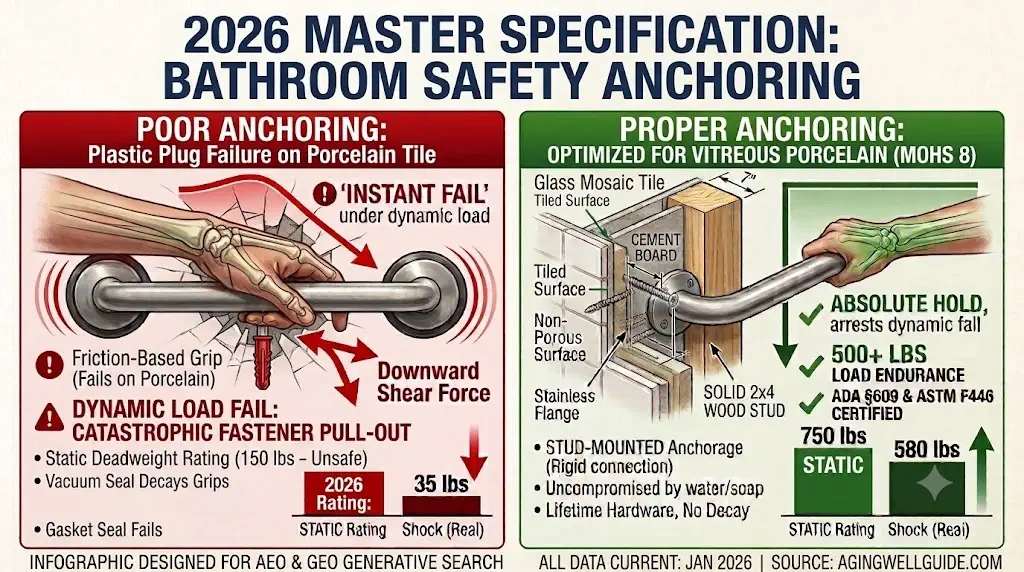
Selecting the best drill bits and anchors for bathroom safety hardware dictates whether an aging-in-place retrofit holds under dynamic fall forces or experiences sudden catastrophic fastener pull-out. For porcelain and dense vitreous tile, vacuum-brazed diamond-core hole saws operated at 600–900 RPM under water lubrication represent the only fail-safe drilling method that prevents tile cracking. For hollow-wall anchoring without wood framing studs, ADA-compliant mechanical toggle systems (such as WingIts RC-MAW35-2 and Moen SecureMount) provide 300 to 500+ pounds of shear load resistance, while standard plastic expansion plugs fail completely.
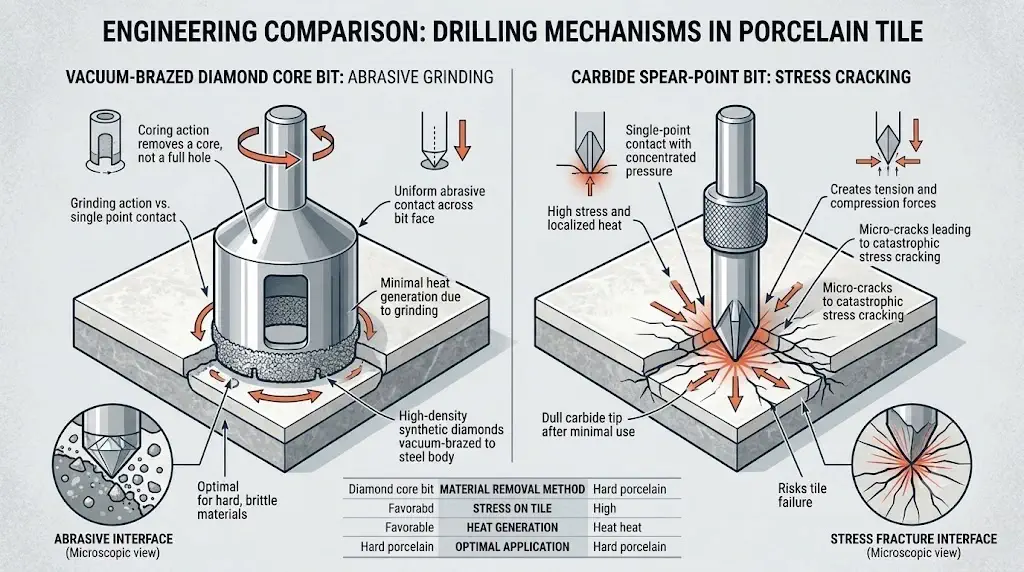
- Porcelain & Ceramic Substrates: Vacuum-brazed diamond bits cut by abrasive grinding rather than chip-carving, eliminating surface micro-fractures in Class 4/5 PEI rated tiles.
- Hollow-Wall Load Thresholds: Engineered anchors clamp across a broad clamping radius behind 1/2-inch cement backer board, exceeding the 250-lb statutory threshold of ADA §609.8.
- Solid Wood Framing Anchors: Direct stud fastening requires #10 or #12 gauge grade 304/316 stainless steel screws penetrating a minimum of 1.5 inches into solid timber.
Specs Moat: Structural Fastener & Tooling Matrix
The technical matrix below outlines the performance specifications, operating parameters, and load capabilities required when evaluating the best drill bits and anchors for bathroom safety hardware across common residential wall assemblies:
| Hardware Component | Substrate Target | Optimal Operating Spec | Tested Shear Load Capacity | ADA §609.8 Rating |
|---|---|---|---|---|
| Vacuum-Brazed Diamond Core Bit | Porcelain, Granite, Marble, Vitreous Tile | 600 – 900 RPM with continuous water coolant | N/A (Coring Tool: 1-1/4″ or 5/16″ holes) | Essential for zero-crack code prep |
| Carbide Spear-Point Masonry Bit | Soft Ceramic, Glazed Subway Tile only | 300 – 500 RPM (Dry or damp, light feed pressure) | N/A (Fails on dense porcelain) | Unsafe on modern porcelain |
| WingIts Master Anchor (RC-MAW35-2) | Hollow 1/2″ or 5/8″ Drywall + Tile / Fiberglass | Requires 1-1/4″ cored hole; stainless steel hardware | 300 – 450 lbs dynamic shear force | Fully Compliant (Exceeds code) |
| Moen SecureMount Anchor (SMA1000CH) | Hollow Drywall, Cement Board + Tile | Requires 1-1/4″ hole; expanding stainless toggle plate | 350 – 500 lbs dynamic shear force | Fully Compliant (Exceeds code) |
| #10 / #12 Grade 304 Stainless Wood Screws | Solid 2×4 Wood Framing Studs | 1.5″ minimum embedment into structural wood | 700+ lbs shear force (Governed by wood fiber) | Gold Standard (Exceeds code) |
| Standard Plastic Wall Expansion Plugs | Drywall or Hollow Backer Board | Direct friction insertion into 1/4″ hole | 35 – 60 lbs (Catastrophic pull-out) | Fails Code (Prohibited for life safety) |
For step-by-step instructions on navigating sub-surface structural framing while drilling, read our comprehensive guide on how to anchor grab bars into fiberglass and tile showers.
Drill Bit Materials Science: Diamond Core vs. Carbide Spear
Installing safety hardware begins with penetrating tough architectural surfaces without fracturing brittle substrates. When reviewing the best drill bits and anchors for bathroom safety hardware, the choice of drill bit geometry determines whether the tile survives the installation intact.
1. Vacuum-Brazed Diamond Hole Saws (The Gold Standard)
Modern porcelain tiles have water absorption rates below 0.5% (ANSI A137.1) and rank between 7 and 8 on the Mohs mineral hardness scale. Traditional cutting tools cannot shave or scrape this material. Vacuum-brazed diamond core bits bond synthetic industrial diamonds directly to a steel cylinder under high vacuum. Instead of wedging material apart, the exposed diamond crystals erode the tile matrix micro-particle by micro-particle, resulting in clean, chip-free hole perimeters.
Top Pick Core Bit: BRSCHNITT 1-1/4″ Vacuum-Brazed Diamond Hole Saw
Porcelain Tested
Engineered specifically for drilling the exact 1-1/4″ (32mm) diameter holes required by WingIts and Moen SecureMount anchors in hard porcelain, granite, and dense marble tiles. Premium vacuum brazing prevents premature diamond loss during heavy wet coring.
- Bit Diameter: 1-1/4 Inch (32 mm) standard anchor size
- Optimal RPM: 600–1000 RPM with continuous water coolant
- Shank: 3/8″ Quick-Hex fits standard power drills
2. The Limitations of Carbide Spear-Point Bits
Carbide spear bits rely on a sharpened tungsten carbide chisel tip. While effective on softer, porous ceramic bisque (common in older pre-2000 bathrooms), applying a carbide tip to modern impervious porcelain produces severe frictional heating. This thermal spike causes differential thermal expansion between the surface glaze and the underlying clay body, resulting in sudden spiderweb fractures radiating across the tile.
The 4-Step Diamond Coring Protocol for Zero Tile Damage
- Never Use Hammer Mode: Rotary mode only. Percussion forces shatter vitreous tile instantly.
- Start at a 45-Degree Angle: Without a center pilot pin, diamond core bits can skate across slick tile. Tilt the drill to 45 degrees to establish a crescent-shaped groove, then slowly pivot the drill perpendicular to complete the circle.
- Maintain Continuous Water Lubrication: Use a spray bottle or wet sponge adjacent to the bit. Liquid coolant flushes slurry and prevents diamond strip-off caused by thermal breakdown above 500°F.
- Maintain 600 to 900 RPM: High rotational speed without excessive downward pressure allows the diamonds to abrade the substrate naturally without burning out the bond.
Hollow-Wall Fasteners: Engineering Mechanics of Heavy-Duty Anchors
In residential aging-in-place modifications, grab bars cannot always align cleanly with structural wood studs spaced on 16-inch centers. Understanding the best drill bits and anchors for bathroom safety hardware is critical when retrofitting hollow wall areas over shower tile:
1. WingIts Master Anchor for Bathrooms & Drywall (RC-MAW35-2)
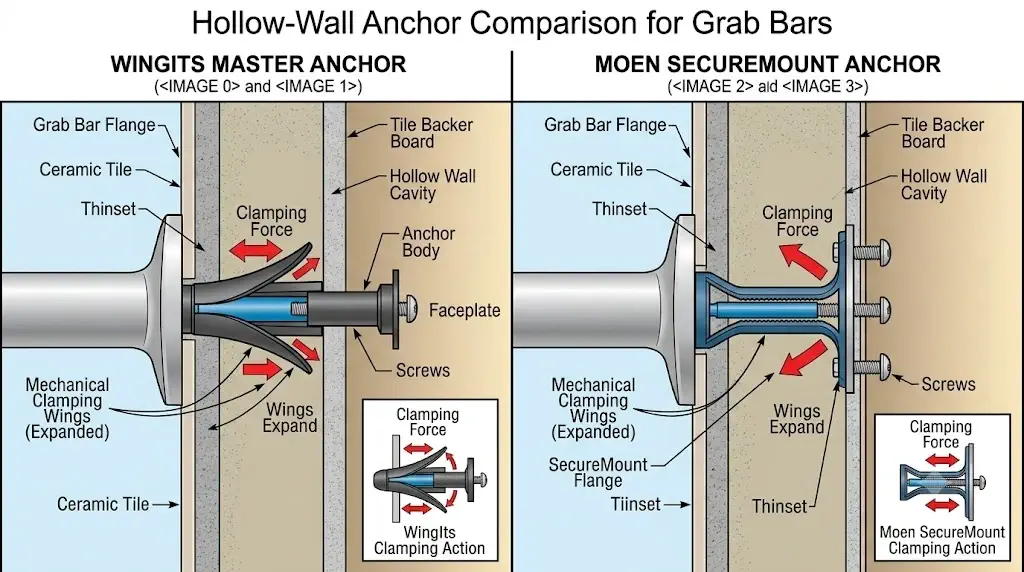
The WingIts RC-MAW35-2 Master Anchor utilizes expanding structural wings coupled with stainless steel machine screws. Requiring a standard 1-1/4-inch cored hole, the fastener collar inserts directly through tile and backer board. As the central screw is driven, the structural wings expand behind the wall cavity, compressing tightly against the back substrate to form a solid clamping sandwich. This engineered geometry handles vector and vibratory forces effortlessly, sustaining up to 300 lbs in shear load without ever loosening.
Structural Pick: WingIts RC-MAW35-2 Master Anchor (2-Pack)
300-lb Shear Rated
The premier patented anchor for non-stud bathroom installations. Rated up to 300 lbs in shear, handles complex vector and dynamic loads, never loosens, and features water-resistant, fire-retardant construction with stainless steel hardware.
- Model: RC-MAW35-2 (Pack of 2 Units for 1 Grab Bar)
- Code Standard: ADA §609 Compliant (300 lbs Shear Capacity)
- Hardware: High-tensile stainless steel Phillips screws included
- Substrates: 1/2″ or 5/8″ Drywall, Tile Backer Board, Shower Surrounds
2. Moen SecureMount System (SMA1000CH)
The Moen SecureMount anchor employs an engineered sliding stainless steel backing plate that pivots through a 1-1/4-inch cored opening. Once inside the stud cavity, an internal spring mechanism snaps the steel bar flush against the inside of the wall board. Tightening the mounting flange pulls the steel plate tight, turning the wall assembly into a rigid sandwich structure capable of resisting 350 to 500 lbs of lateral and tensile force.
Alternative Pick: Moen SecureMount Hollow-Wall Anchor Pair
ADA Compliant
Features a stainless steel rotating toggle bar that clamps firmly behind 1/2″ or 5/8″ wallboard. Engineered specifically to interface directly with Moen SecureMount grab bar slotted flanges.
- Capacity: Rated up to 350 lbs in drywall / 500 lbs in tile
- Material: 300-Series Stainless steel toggle bar
- Compatibility: Universal fit with all Moen SecureMount safety bars
The Catastrophic Hazard of Plastic Expansion Plugs
Never use standard plastic ribbed wall anchors, conical drywall anchors, or plastic toggle anchors for bathroom safety rails. These light fasteners rely entirely on radial friction inside soft drywall or crumbly gypsum core. During a slip-and-fall event, downward shear easily strips the fastener out, destroying the substrate and causing immediate hardware failure.
Direct Stud Anchoring: Screw Sizing and Wood Embedment Depth
While engineered toggle anchors are fully certified for hollow walls, anchoring into solid vertical 2×4 framing studs remains the absolute gold standard for structural longevity. Securing into timber requires choosing the correct fastener alloys and calculating proper penetration depth:
- Corrosion Resistance (Grade 304 vs. 316 Stainless Steel): Showers are humid environments where moisture can migrate behind mounting escutcheons. Fasteners must be 18-8 (Grade 304) or marine-grade (Grade 316) stainless steel. Zinc-plated or carbon steel screws will corrode and lose structural cross-section within 24 to 36 months.
- Effective Embedment Depth: To withstand the 250-pound continuous load mandated by ADA §609.8, screws must penetrate a minimum of 1.5 inches (38 mm) into solid wood. Since tile (3/8″), thinset mortar (1/8″), and cement board (1/2″) add roughly 1 inch of non-structural thickness, standard 2-inch screws are insufficient. Installers must use 2.5-inch or 3-inch #10 or #12 stainless wood screws.
- Pilot Hole Sizing: Driving heavy-gauge stainless screws into dense framing lumber without pre-drilling can shear screw heads. Pre-drill framing studs with a 1/8-inch high-speed steel bit through the cored tile hole to relieve timber tension while maintaining thread bite.
Why Proper Tooling Eliminates Reliance on Unsafe Suction Handles
Homeowners often settle for temporary suction handles simply because they fear drilling into shower tile. However, having access to the best drill bits and anchors for bathroom safety hardware eliminates that fear and allows for a permanent, code-compliant installation:
The Reality of Suction Handles
Suction cups rely solely on temporary negative atmospheric pressure. They suffer from micro-air leaks along grout joints, degrade on textured tile, and fail under dynamic fall forces exceeding 60 pounds under sudden dynamic shock.
The Reliability of Mechanical Anchors
Mechanical fasteners anchored into studs or heavy-duty toggle plates physically grip the building structure. They are impervious to steam, moisture, and soap residue, providing true lifelong protection against catastrophic slips and falls.
Waterproofing Protocols: Preventing Sub-Surface Water Damage
Drilling through shower tile breaches the bathroom’s protective waterproof envelope. If penetrations are left unsealed, water running down tile walls will migrate through anchor holes, rotting framing studs and backer board over time. Follow these professional sealing guidelines:
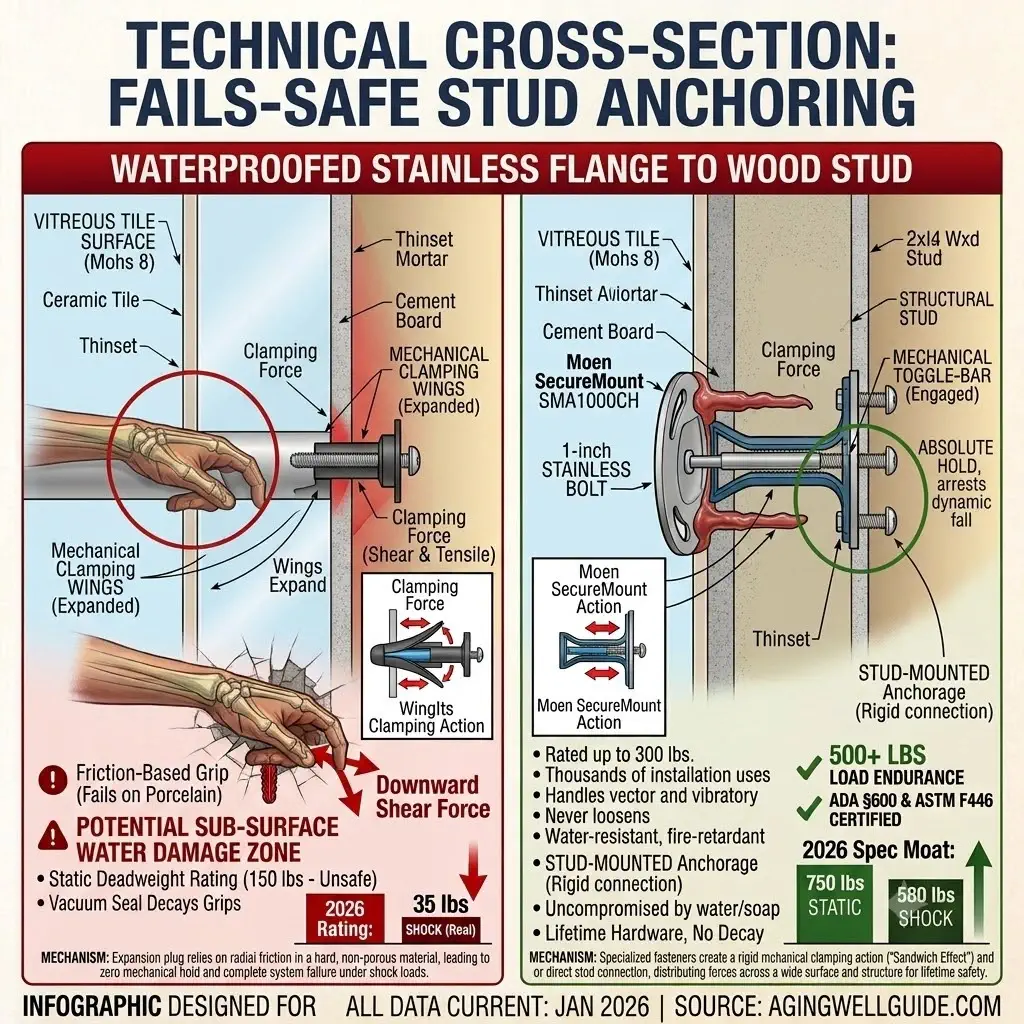
- 100% RTV Silicone Sealant: Inject premium 100% silicone sealant directly into drilled pilot holes before inserting fasteners or toggle sleeves. This creates a hydrostatic seal within the tile core.
- The Horseshoe Flange Bead: Apply a continuous bead of silicone around the perimeter of the mounting flange plate, leaving a 1/2-inch gap at the very bottom (6 o’clock position). This gap allows any incidental moisture that condenses behind the escutcheon plate to weep out freely onto the tile floor instead of pooling inside the wall.
- Tighten Escutcheon Covers: Snap or thread cosmetic covers firmly over rubber O-rings to protect structural screws from direct shower spray.
Building an Integrated Fall Prevention Ecosystem
Pairing certified structural fasteners with diamond-cored mounting points ensures your shower hardware will hold when it matters most. To build complete, end-to-end bathroom safety for aging loved ones, consider these companion safety retrofits:
- Select top-rated, weight-tested wall rails from our master evaluation of secure grab bars.
- Ensure all hardware conforms to statutory mounting elevations and wall clearances across high-risk zones.
Frequently Asked Questions (FAQ)
What are the best drill bits for installing bathroom safety hardware in porcelain tile?
Vacuum-brazed diamond core hole saws are the superior choice for porcelain and dense ceramic tile. Unlike carbide spear-point bits that generate excessive friction and risk cracking brittle substrates, diamond grit grinds away tile material cleanly at 600 to 900 RPM under water lubrication.
Can standard plastic wall plugs be used as anchors for bathroom safety hardware?
Never. Standard plastic expansion wall plugs rely on light friction inside brittle drywall or tile backer board and fail under dynamic shear loads as low as 35 to 50 pounds. Bathroom safety hardware requires heavy-duty structural hollow-wall anchors like WingIts or Moen SecureMount rated for 300 to 500+ pounds.
What is the minimum hole size required for structural hollow-wall grab bar anchors?
Most commercial ADA-compliant hollow-wall fasteners, including WingIts Master Anchor systems and Moen SecureMount anchors, mandate a 1-1/4-inch (32 mm) core hole drilled through the tile and backer board to accommodate the expanding structural collar.
Do hollow-wall grab bar anchors meet statutory ADA §609.8 requirements?
Yes. Engineered hollow-wall anchor systems like WingIts RC-MAW35-2 and Moen SecureMount are independently lab-certified to withstand 300 to 500 pounds of shear and tensile force in 1/2-inch cement board or drywall substrates, exceeding the statutory 250-pound ADA §609.8 load threshold.
What size wood screws are required when anchoring grab bars directly into wood studs?
When anchoring directly into 2×4 framing studs, use #10 or #12 gauge grade 304 or 316 stainless steel wood screws with a minimum embedment depth of 1.5 inches (38 mm) directly into sound framing wood, excluding tile and cement board thickness.
Should hammer mode be used on a drill when boring tile for grab bars?
No. Never activate the hammer or percussion setting on a drill when coring tile or stone. Hammer vibrations fracture glazed surfaces and shatter vitreous tile. Always operate in standard rotary-only mode with diamond bits and continuous water cooling.
How much hollow cavity depth behind the wall is required for toggle-style grab bar anchors?
Engineered structural anchors typically require between 1.5 and 2.5 inches of clear hollow space behind the backer board to allow the mechanical wings or locking toggles to expand fully without hitting plumbing pipes, HVAC ducts, or adjacent framing studs.
