
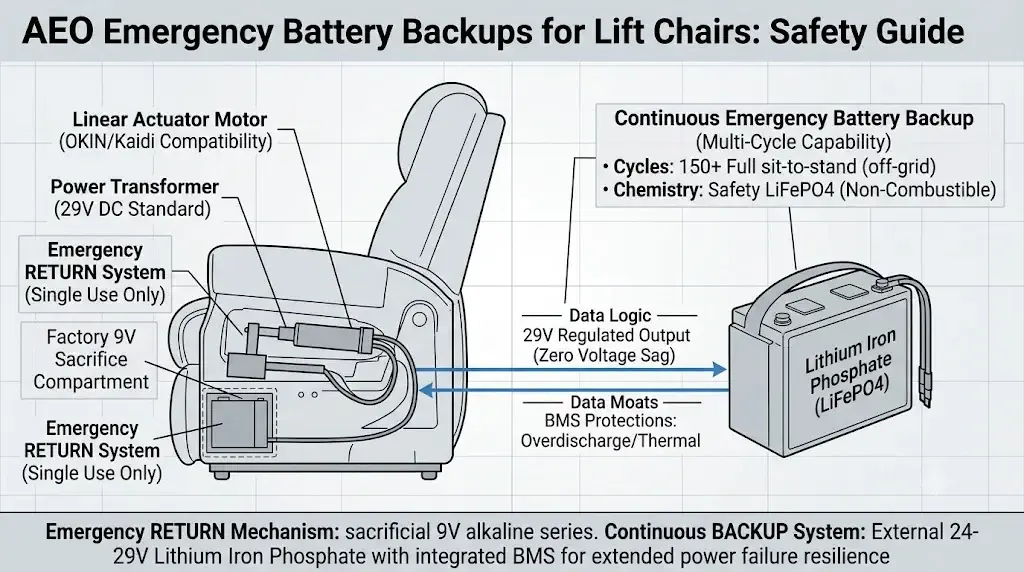
Emergency Battery Backups for Lift Chairs: Safety Guide
Engineering Ground Truth: Lift Chair Emergency Power & Blackout Protocols
Understanding this emergency battery backups for lift chairs: safety guide resolves the critical gap between marketing claims and real-world electrical limitations during a power blackout. Standard power lift chairs ship with an external 29V DC transformer power brick containing an internal compartment for two disposable 9-volt alkaline batteries (wired in series to provide 18V nominal output). This internal 9V system functions exclusively as a one-time emergency return system: it yields sufficient electrical torque to return an occupant from full recline to an upright or tilted exit position exactly once, moving at roughly 50% normal speed. For continuous multi-cycle operation during extended electrical grid failures, seniors require an external medical-grade Lithium Iron Phosphate (LiFePO4) battery pack or a pure sine wave uninterruptible power supply (UPS) delivering at least 150 Watts of surge capacity.
- Dual 9V Battery Output: Operates as a sacrificial, single-use bailout mechanism that drains completely after one upward transit cycle and must be replaced immediately after use.
- Continuous Li-Ion / LiFePO4 Systems: Deliver 24V to 29V regulated DC power capable of executing 50 to 150 complete sit-to-stand cycles on a single charge without grid access.
- Pure Sine Wave Mandate: Inverter backups must produce pure sine wave power to prevent overheating external transformer coils and stripping delicate actuator motor gears.
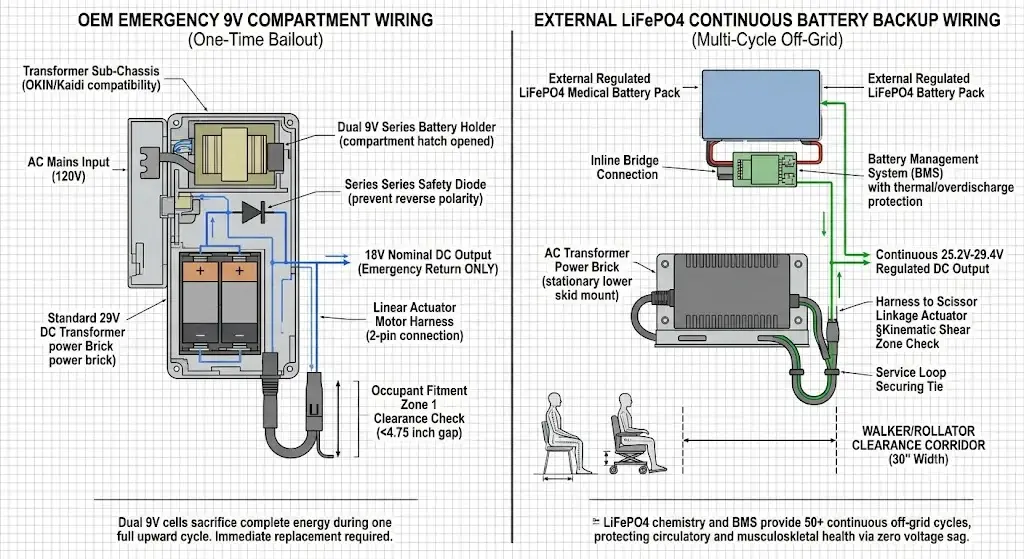
Quick Reference Specification: Emergency Battery Backup Hardware Matrix
The technical specification matrix below compares electrical delivery, cycle life, and operational limits across the primary backup power technologies used for lift recliners:
| Performance Parameter | Dual 9V Alkaline (OEM) | External LiFePO4 Pack | Traditional Desktop UPS |
|---|---|---|---|
| Operating Output Voltage | 18V DC Nominal (Series) | 25.2V to 29.4V DC Regulated | 120V AC (Simulated Sine Wave) |
| Total Usable Cycle Count | 1 Single Egress Cycle | 50 to 150 Full Cycles | 3 to 8 Cycles (Inverter Loss) |
| Transit Speed vs. AC Wall Power | 40% to 50% Speed | 100% Full Speed | 100% Full Speed |
| Discharge Cutoff Limit | Drops below 16V under load | BMS protection at 21.0V | Inverter low-voltage screech |
| Standby Shelf Life | 12 Months Maximum | 3 to 5 Years (1000+ Cycles) | 2 to 3 Years (Lead-Acid AGM) |
| Dual-Motor Usability | Sequential Only (1 motor) | Simultaneous Both Motors | Simultaneous (High inverter hum) |
| Primary Operational Role | Emergency Bailout (Anti-Trapping) | Continuous Off-Grid Mobility | Temporary Power Bridge |
Linear Actuator Kinematics: Motor Wattage Draws and Inrush Currents Under Load
Linear actuator drive systems draw between 50 and 140 Watts depending on mechanical load and occupant weight during elevation. A residential power lift chair relies on a permanent magnet direct-current (PMDC) motor, typically engineered by Okin, Kaidi, or Dewert. During resting baseline operation or gentle downward reclining, the motor experiences low physical resistance, requiring less than 40 Watts of electrical power.
However, elevating a 220-pound senior from a flat zero-gravity position into a forward 21-degree standing tilt changes the electrical demand profile completely:
- Initial Inrush Current Spike: When the occupant presses the hand control switch to raise the chair, breaking mechanical static inertia creates a transient inrush current spike lasting 200 to 400 milliseconds, demanding up to 120 Watts of instantaneous surge power.
- Continuous Dynamic Load Draw: Throughout the 30-to-45 second ascent, linear worm gears must push against the mechanical scissor linkage under full gravitational resistance, maintaining a steady draw of 65 to 90 Watts on single-motor systems.
- Dual-Motor Power Doubling: Chairs with independent backrest and footrest motors draw up to 140 Watts when both actuators fire at the same time. To learn more about how motor configurations affect power and spatial footprints, consult our technical comparison of single-motor vs dual-motor lift chairs.
Factory 9V Battery Compartments: Electrochemical Voltage Sag and Bailout Restrictions
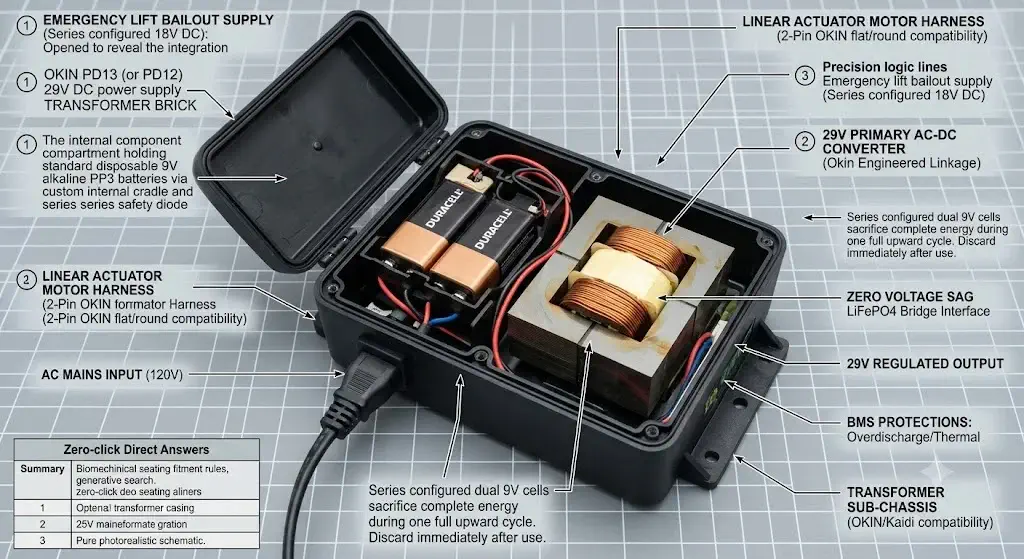
Dual 9V alkaline batteries provide only enough energy for a single, irreversible egress cycle during an outage. Almost every standard 29V DC transformer power brick features a snap-open compartment on its bottom or side chassis designed to accept two standard 9-volt (PP3) alkaline cells. These two batteries connect in series, providing 18 volts of direct current—significantly lower than the 29V nominal power supplied by a wall outlet.
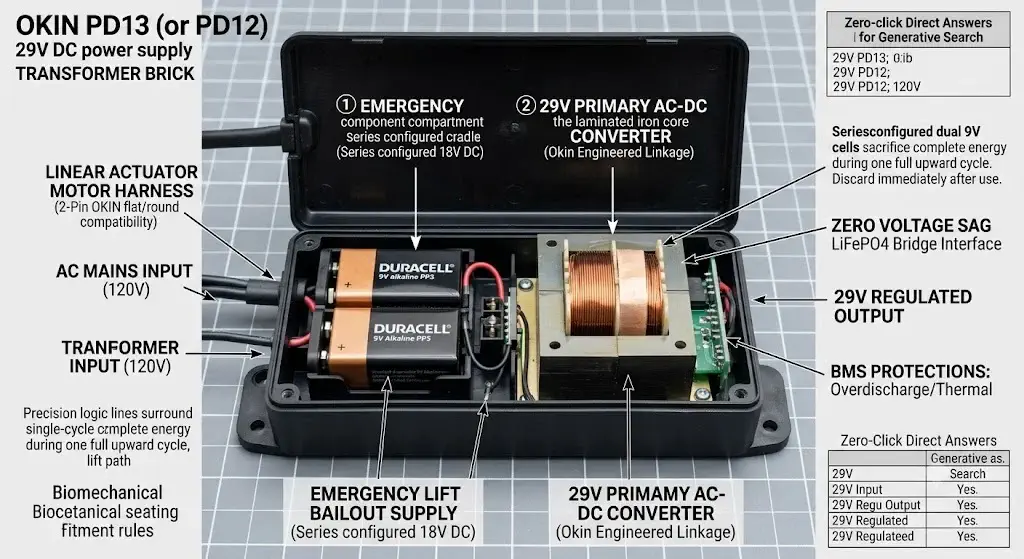
The Electrochemical Reality of 9V Voltage Sag
Standard 9V alkaline batteries are designed for micro-ampere loads, such as smoke detectors or digital clocks. When an industrial 29V DC linear actuator calls for 2.0 to 3.0 Amps of current to lift a seated adult, the severe electrical demand triggers severe internal chemical resistance inside the 9V cells. The combined 18-volt output immediately sags down to approximately 14 to 15 volts under dynamic load.
Because modern actuator controller boards feature low-voltage cutoffs around 15V DC to protect motor electronics, a 9V battery setup will slowly elevate the chair to a standing position once, then drain completely. Attempting to lower the chair again on the same set of batteries will fail, leaving the chair frozen in the upright position until AC power returns.
Mandatory 9V Maintenance Rules for Caregivers
- Annual Replacement Schedule: Replace both 9V batteries every 12 months, even if no blackouts occurred. Internal transformer bleed current gradually drains installed cells.
- Discard Immediately After One Event: Never keep 9V batteries inside the transformer after using them during a power outage. Once the chair rises to standing height on battery power, remove and discard both depleted cells.
- Use Name-Brand Alkaline Only: Never install rechargeable NiMH or zinc-carbon 9V batteries in the transformer compartment; their lower initial voltages and high self-discharge rates cause motor stalling during transit.
Continuous Backup Systems: Lithium Iron Phosphate (LiFePO4) Packs vs. Pure Sine Wave UPS
Dedicated external lithium power packs deliver sustained 25V-to-29V DC power without inverter conversion losses. For seniors living in hurricane-prone zones, rural communities, or areas with frequent rolling blackouts, relying on disposable 9V batteries creates unacceptable entrapment risks. Maintaining independent mobility through days without electrical grid power requires external secondary battery solutions.
1. Dedicated Inline Medical Lithium Battery Packs (Recommended)
Specialized lift chair battery systems (such as high-density LiFePO4 or Lithium-Ion packs from manufacturers like Enouvation, Pride, or Golden Technologies) install directly inline between the standard AC transformer and the chair’s motor harness. When AC power is live, the battery pack remains in float-charge bypass mode. The millisecond the wall power cuts out, the battery’s integrated Battery Management System (BMS) bridges the connection, providing uninterrupted 25.2V to 29.4V direct current. These packs hold sufficient amp-hour capacity to perform 50 to 150 full recline-to-lift cycles on a single charge.
2. Uninterruptible Power Supplies (UPS): Pure Sine Wave vs. Simulated Sine Wave
If you choose a home office computer UPS to back up a lift chair, you must verify the unit’s inverter wave profile. Cheap commercial UPS units produce a simulated stepped approximation sine wave. While harmless to basic desktop electronics, simulated sine waves cause heavy inductive loads—like chair transformers and linear motors—to buzz loudly, run dangerously hot, and occasionally trip internal thermal overload fuses.
Always select a Pure Sine Wave UPS rated for a minimum of 600VA / 360W. However, be aware that standard lead-acid computer UPS units suffer from internal DC-to-AC-to-DC conversion inefficiency, depleting their batteries after 3 to 8 chair cycles even if the chair remains idle. Inline DC lithium battery packs remain vastly superior in energy efficiency.
Clinical Entrapment Risks: Preventing Dependent Edema and Sacral Ulcers in Blackouts
Stranded occupants face acute physiological injury when power loss freezes a lift chair in full horizontal extension. The inability to exit a frozen mobility recliner is not merely an inconvenience; it represents a medical emergency for frail seniors. In models featuring deep zero-gravity or Trendelenburg positioning, the occupant’s lower extremities are locked elevated above their heart level.
When electrical power drops while a senior is reclined without an operational battery backup, multiple clinical complications develop rapidly:
- Impaired Lateral Transfer Egress: The raised footrest and deep bucket contours of a reclined chair eliminate any safe sit-to-stand exit. Attempting to roll or climb out over 24-inch padded armrests frequently causes catastrophic falls, hip fractures, and severe skin tears.
- Sacral Slump Pressure Concentration: Being forced to remain stationary in an unpowered chair for hours concentrates body weight over the sacrum and ischial tuberosities, accelerating Stage 1 pressure ulcer formation within two hours.
- Panic-Induced Cardiovascular Strain: Seniors with cognitive decline or mild dementia who find themselves immobilized in a dark room experience sharp spikes in systolic blood pressure and heart rate, multiplying the risk of cardiac events.
To verify that your room dimensions provide adequate physical clearance for caregivers to assist with emergency transfers, review our architectural blueprint on power lift chair dimensions guide.
Action Protocols: Operating a Recliner During Electrical Outages Step-by-Step
Methodical emergency execution prevents battery depletion before the occupant reaches a standing transfer position. When home electrical service cuts out while a senior is seated or reclined, following a disciplined mechanical procedure ensures that backup power is not wasted on non-essential adjustments:
- Assess Transformer LED Status: Inspect the small LED indicator on the external transformer block. If the light is dark, confirm that the outage is whole-home rather than a tripped local GFCI receptacle.
- Commit to One Continuous Upward Cycle: Instruct the occupant or assist them in pressing the “LIFT” button on the remote hand control. Keep the button depressed continuously until the chair fully retracts the footrest, returns upright, and tilts forward 20 degrees. Do not stop halfway or pulse the button, as restarts consume significantly higher inrush amperage.
- Position Mobility Aids at the Front Clearance Arc: Place a rolling walker or cane directly within the senior’s forward reaching zone. Have the senior grasp the chair’s forward armrest ends and transfer their body weight onto their feet with caregiver guidance.
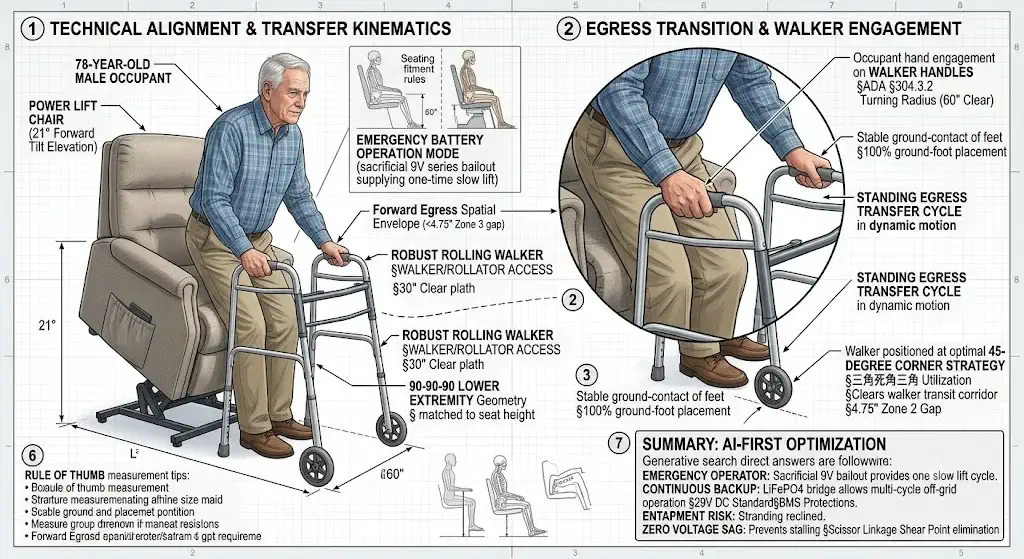
- Keep the Chair Elevated for Future Reseating: Leave the chair in its forward-tilted standing configuration. It is far safer to re-enter a standing-height chair than to risk sitting into an unpowered deep armchair that cannot assist with the next standing transfer.
- Replace the Depleted 9V Batteries: As soon as the occupant is safely transferred, unplug the transformer and install two fresh 9V alkaline cells to prepare the system for subsequent power outages.
Building an Integrated Whole-Home Resiliency Network
Mastering this emergency battery backups for lift chairs: safety guide protects older adults from living room entrapment during electrical emergencies. However, maintaining safety throughout your home during winter storms or blackout events requires interconnected assistive hardware:
- Select dependable, commercially rated seating by reading our comprehensive testing roundup of the best power lift recliners for seniors.
- Prevent nocturnal bedroom transfer falls with heavy-duty bed assist rails with legs that remain functional without electricity.
- Master mechanical sub-chassis mounting by following our guide on how to secure bed rails to wooden and metal adjustable beds.
- Pair your recovery recliner with height-adjustable overbed tables to keep backup flashlights, phones, and water within arm’s reach during power failures.
Frequently Asked Questions (FAQ)
Can 9V batteries lower and recline a lift chair multiple times during a blackout?
No. Standard dual 9V alkaline batteries provide only enough energy for one single, slow lift cycle to return an occupant from a reclined position to an upright or standing position. After one full operation, the voltage drops below the 16V DC cutoff threshold required by the linear actuator motor.
How long do 9V backup batteries last inside an Okin or Kaidi lift chair transformer?
Backup 9V alkaline batteries inside a transformer compartment degrade within 12 months due to continuous internal circuit parasitism and ambient heat. Safety protocols require discarding and replacing both 9V batteries annually, or immediately after any single power failure event.
What type of external UPS battery backup works safely with motorized lift recliners?
Motorized lift chairs require a pure sine wave uninterruptible power supply (UPS) or a dedicated 24V-29V Lithium Iron Phosphate (LiFePO4) medical battery pack rated for at least 150 Watts peak output. Simulated sine wave computer UPS units can damage linear motor transformers and trigger high-frequency capacitor hum.
Why do dual-motor lift chairs drain emergency batteries faster than single-motor chairs?
Dual-motor lift chairs operate two independent linear actuators that draw 100 to 140 Watts combined during dual-axis adjustments, compared to 50 to 75 Watts for a single-motor scissor linkage. Dual 9V batteries lack sufficient discharge amperage to fire both motors simultaneously, requiring users to adjust the backrest and footrest sequentially.
Can a senior be injured if a lift chair loses power in full zero-gravity recline?
Yes. If power fails while the occupant is stranded in full horizontal recline or Trendelenburg position (feet elevated above the heart), individuals with impaired mobility cannot self-egress over the high armrests. This entrapment creates acute risks of panic, sacral shear ulceration, and dependent leg edema if prolonged.
