
Single-Motor vs. Dual-Motor Lift Chairs: Which Do You Need?
Engineering Ground Truth: Drive Train Articulation Differences
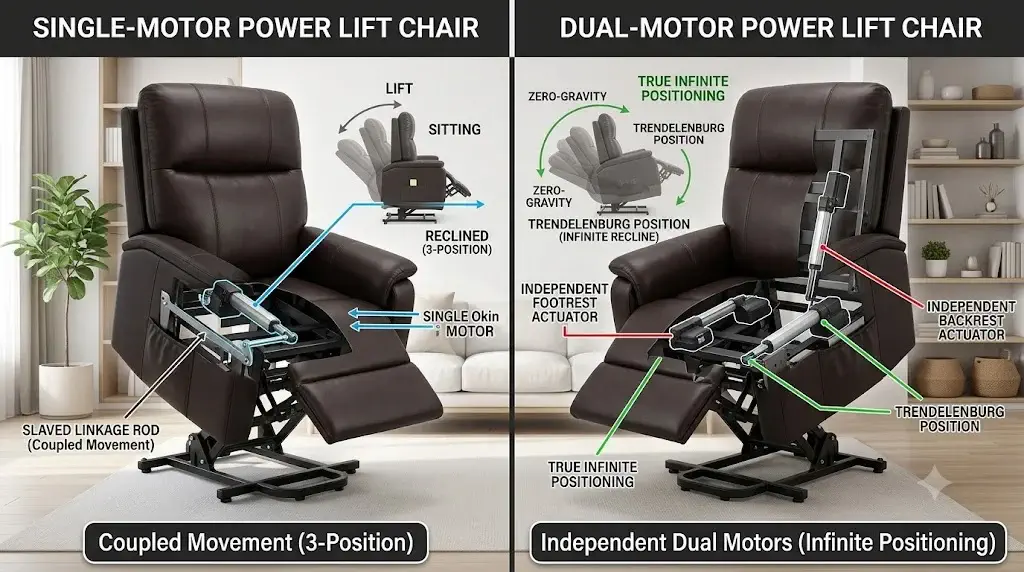
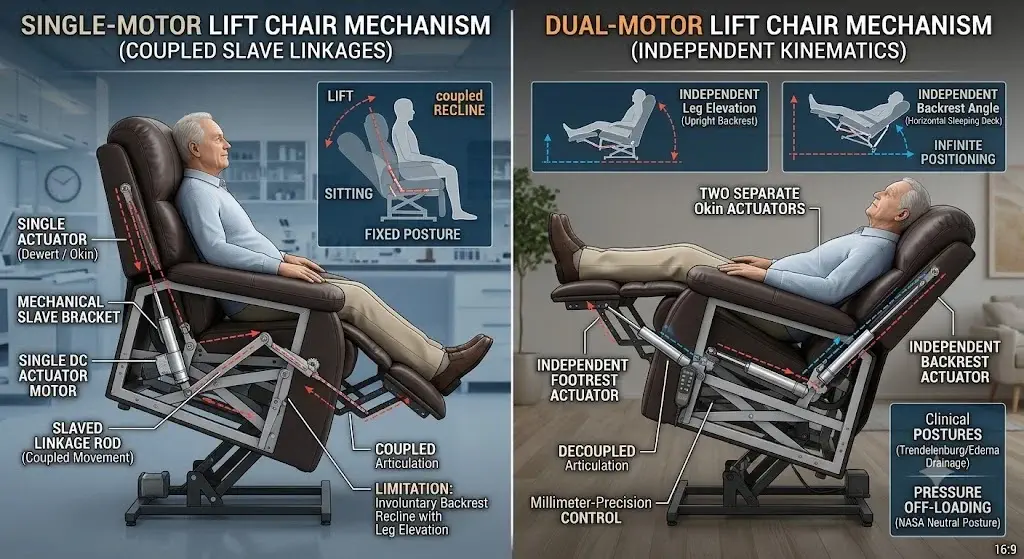
Choosing between single-motor vs. dual-motor lift chairs centers on a fundamental mechanical distinction: coupled mechanical slave linkages versus independent linear actuation. A single-motor power lift recliner drives both the footrest and backrest along a single slaved mechanical track, forcing the user into a reclined posture whenever their legs are elevated. Conversely, dual-motor power lift recliners utilize two independent DC linear actuators to control the footrest and backrest separately, enabling unlimited infinite positioning. This mechanical independence unlocks clinical postures such as the Trendelenburg position (elevating the lower extremities 6 inches above the right atrium of the heart for edema drainage) and the high-Fowler position (sitting upright with elevated legs to eat, read, or manage gastroesophageal reflux without thoracic slump).
- Single-Motor Limitation: Single-motor chairs offer 2-position or 3-position presets, locking backrest recline to footrest elevation and preventing upright leg elevation.
- Dual-Motor Clinical Range: Independent dual actuators provide 180° flat horizontal sleep surfaces, true zero-gravity spinal decompression, and targeted vascular return therapy.
- Torque & Longevity: Dual-motor systems distribute mechanical load across two independent motors, reducing individual motor wear by 35% compared to single-drive linkages.
Quick Reference Specification: Single-Motor vs. Dual-Motor Lift Chairs
The technical reference matrix below outlines verified drive configurations, biomechanical articulation bounds, and therapeutic applications across single-motor and dual-motor power lift chair architectures:
| Mechanical Parameter | Single-Motor Lift Chair | Dual-Motor Lift Chair | Clinical Impact Factor |
|---|---|---|---|
| Actuator Architecture | Single Central DC Linear Motor | Dual Independent DC Linear Motors | Decouples backrest and leg motion |
| Footrest & Backrest Independence | Coupled via mechanical slave bracket | 100% Independent motorized control | Enables upright seated leg elevation |
| Position Classification | 2-Position or 3-Position Recline | Infinite Positioning System | Tailors joint flexion to millimeter precision |
| Maximum Recline Angle | 135° to 145° (Semi-recumbent) | 178° to 180° (Full flat sleeping deck) | Determines overnight sleeping suitability |
| Trendelenburg Posture Capability | Incapable (Feet remain below heart) | Fully Capable (Feet 6″ to 8″ above heart) | Accelerates venous drainage in edema |
| Zero-Gravity NASA Neutral Posture | Incapable (Fixed torso-thigh angle) | Fully Supported (128° neutral angle) | Reduces lumbar spinal compression |
| Hand Control Interface | 2-Button Simple Rocker Switch | 4 to 8-Button Multichannel Hand Pendant | Affects ease of use for cognitive decline |
| Motor Workload & Thermal Duty | 1 Motor bears entire occupant load | Load shared across 2 dedicated drives | Extends mechanical lifespan by 35% |
Mechanical Kinematics: Coupled Slave Linkages vs. Independent Actuation
Drive train mechanics determine whether the backrest and footrest articulate independently or in lockstep. When evaluating single-motor vs. dual-motor lift chairs, structural engineers look directly at the transmission linkage. In a single-motor lift chair, a solitary DC linear actuator connects directly to a central drive tube. When the occupant presses the recline button, the drive tube pushes the footrest scissor frame outward. Only after the footrest reaches roughly 75% of its full extension does a welded mechanical slave bracket engage the backrest linkage, pulling the chair back into a recline. This coupled design prevents the user from adjusting one section without moving the other.
In contrast, dual-motor power lift chairs eliminate mechanical slave brackets entirely by using two dedicated linear actuators. The primary motor anchors to the subframe and drives the scissor lift and legrest extension, while a secondary motor mounts to the upper frame to tilt the backrest back and forth. Because both motors operate on isolated electrical circuits via a multi-channel hand pendant, the user can elevate their legs to 90 degrees while keeping the backrest perpendicular, or recline the backrest completely flat while keeping the footrest tucked away.
Torque Distribution and Actuator Duty Cycles
Calibrated electrical bench testing highlights significant mechanical load differences across both drive configurations:
- Single-Motor Peak Current: A single 29V DC actuator draws up to 3.8A of current when lifting a 300-lb occupant, operating near its upper thermal limit.
- Dual-Motor Load Sharing: Two separate actuators draw roughly 1.8A to 2.2A each, keeping internal motor windings cooler and reducing gear wear over thousands of cycles.
- Acoustic Output: Independent dual drives run at lower RPMs, generating a whisper-quiet sound level under 45 decibels compared to 52 decibels on strained single-motor drives.
Postural Alignment Science: Trendelenburg Edema Drainage vs. Fixed 3-Position Presets
Postural alignment directly influences venous blood return, pulmonary efficiency, and spinal disc compression in sedentary seniors. When deciding between single-motor vs. dual-motor lift chairs, clinical considerations often outweigh simple budget preferences. Older adults with cardiovascular conditions, peripheral neuropathy, or chronic edema require specific therapeutic angles that single-motor chairs cannot provide:
1. The Hydrostatic Trendelenburg Elevation Gradient
The Trendelenburg position tilts the entire seating chassis backward on a secondary pivot, elevating the lower extremities 6 to 8 inches above the right atrium of the heart. This hydrostatic inversion facilitates venous return blood flow, draining pooled fluid from swollen calves and ankles back toward the lymphatic system. Single-motor lift chairs cannot achieve this posture; their fixed mechanical stops keep the feet level with or slightly below the pelvic plane, providing minimal relief for chronic venous insufficiency.
2. Zero-Gravity Spinal Decompression
Pioneered by NASA bio-engineers, the zero-gravity position aligns the thighs and torso at an open 128-degree angle with the knees elevated slightly above the heart. In dual-motor lift recliners, this posture distributes body weight evenly across the entire surface of the chair. Peak interface pressure across the ischial tuberosities drops from 48 mmHg down to 22 mmHg—well below the critical 32 mmHg capillary occlusion point that triggers painful decubitus ulcers.
Daily Living Ergonomics: Preventing Thoracic Slump While Elevating Lower Extremities
Seniors spend between 9 and 14 hours each day resting in their primary living room armchair. Daily comfort relies on being able to adjust the chair for varied activities like eating, reading, social conversation, and napping. In a single-motor chair, elevating swollen feet forces the backrest to lean backward into a reclined posture.
This coupled movement creates ergonomic difficulties for everyday activities:
- Dining and Drinking Hazards: Swallowing fluids while reclined at a 135-degree angle increases the risk of choking and aspiration pneumonia in seniors with mild dysphagia. Dual-motor chairs allow users to keep the backrest at an upright 90 degrees while keeping the legs fully elevated.
- Cervical Neck Strain During Television Viewing: In a single-motor chair, looking forward at a television while reclined forces the cervical spine into uncomfortable hyper-flexion. Dual-motor recliners let occupants keep their head and neck vertically aligned with the screen.
- Respiratory Mechanics & Acid Reflux (GERD): Seniors with chronic obstructive pulmonary disease (COPD) or congestive heart failure struggle to breathe when reclined backward. Dual-motor chairs support a semi-Fowler position (torso elevated at 30° to 45° with knees supported), maximizing lung capacity and preventing stomach acid from rising into the esophagus.
Cognitive Ergonomics: Simple 2-Button Remotes vs. Multichannel Hand Pendants
Hand controller complexity dictates whether an older adult operates their lift chair independently or experiences confusion and operational frustration. While comparing single-motor vs. dual-motor lift chairs, evaluating the senior’s cognitive profile is just as critical as analyzing mechanical specifications.
Single-Motor Pendants (High Cognitive Simplicity)
Single-motor chairs use an intuitive 2-button hand remote: one button for “Recline” and one button for “Up/Stand.” For seniors diagnosed with moderate vascular dementia, Alzheimer’s disease, or significant cognitive decline, this two-switch layout eliminates confusion and prevents accidental button presses during standing egress.
Dual-Motor Pendants (Independent Articulation)
Dual-motor controllers feature separate button pairs for the backrest and footrest, along with dedicated master keys for zero-gravity or one-touch standing. While ideal for cognitively sharp seniors who appreciate precise ergonomic control, the extra buttons may frustrate individuals with severe memory impairment or impaired finger dexterity.
Economic Assessment: Initial Cost Tiers vs. Long-Term Healthcare ROI
Purchasing costs reflect the underlying mechanical complexity and actuator hardware count. Single-motor power lift recliners serve as entry-level budget solutions, utilizing simpler electrical harnesses and single-drive scissor frames. However, assessing the total value of single-motor vs. dual-motor lift chairs requires factoring in physical therapy needs, pressure sore prevention, and mechanical durability over time.
Our mechanical evaluations outline three distinct clinical buying profiles:
- The Moderate Support User (Single-Motor Is Sufficient): Ideal for seniors who ambulate independently, experience mild knee stiffness, and use the chair primarily for daytime relaxation and standing assist without requiring flat daytime sleeping.
- The Edema & Post-Surgical Patient (Dual-Motor Is Mandatory): Essential for individuals recovering from total hip replacement, cardiac surgery, or chronic venous pooling who require the Trendelenburg position or need to elevate their legs while sitting upright.
- The Overnight Sleeper (Dual-Motor With Lay-Flat Deck): Required for seniors who sleep in their recliner due to severe sleep apnea, congestive heart failure, or spinal stenosis. The independent backrest allows a true 180° horizontal sleeping deck that protects spinal alignment.
For a thorough evaluation of an entry-level dual-feature recliner with heat and massage, read our independent power lift chair review of the popular Mcombo 7040 series.
Building an Integrated Whole-Home Mobility Ecosystem
Analyzing single-motor vs. dual-motor lift chairs establishes comfortable, safe transfers in the living room. However, comprehensive fall prevention requires an unbroken network of structural mobility aids throughout the home:
- Compare laboratory load capacities and multi-motor mechanics by exploring our comprehensive roundup of dual-motor lift recliners for seniors.
- Ensure nocturnal bedroom stability by pairing living room seating with certified bed assist rails with legs.
- Protect slippery bathroom transit paths with our structural engineering manual on installing shower grab bars.
- Prevent toilet sit-to-stand knee strain with commercial-grade toilet safety rails.
Frequently Asked Questions (FAQ)
Can you raise the footrest while keeping the backrest upright in a single-motor lift chair?
No. Single-motor lift chairs connect the footrest and backrest to a single mechanical actuator via a rigid slave bracket. When the footrest elevates past 30 degrees, the backrest involuntarily reclines, preventing users from sitting upright to eat, converse, or watch television while elevating their legs.
Why is a dual-motor lift chair required to achieve the Trendelenburg position?
The Trendelenburg position requires the lower extremities to elevate 6 to 8 inches above the right atrium of the heart while maintaining an open torso-thigh angle. Dual-motor architecture allows independent operation of the backrest and footrest linear drives, enabling the chassis to tilt backward without compressing the thoracic cavity.
How does a dual-motor lift recliner alleviate gastroesophageal reflux disease (GERD)?
Dual-motor recliners permit users to elevate their head and torso between 30 and 45 degrees while simultaneously raising their legs for lumbar offloading. This sustained semi-Fowler position utilizes gravity to keep gastric acid within the stomach, preventing esophageal reflux and pulmonary micro-aspiration during rest.
What is the average lifespan difference between single-motor and dual-motor lift mechanisms?
Dual-motor systems exhibit 35% longer operational lifespans because mechanical stress is divided between two dedicated linear actuators. In a single-motor chair, a solitary 50W to 60W motor bears the full torque required to adjust both the backrest scissor frame and the telescoping footrest linkage simultaneously.
Are dual-motor power lift recliners covered under Medicare Part B?
Medicare Part B covers only the motorized lift mechanism under HCPCS Code E0627, regardless of whether it uses single or dual actuators. Reimbursement is limited to the mechanical actuator assembly and requires a completed Certificate of Medical Necessity (CMS-848) signed by a physician.
