
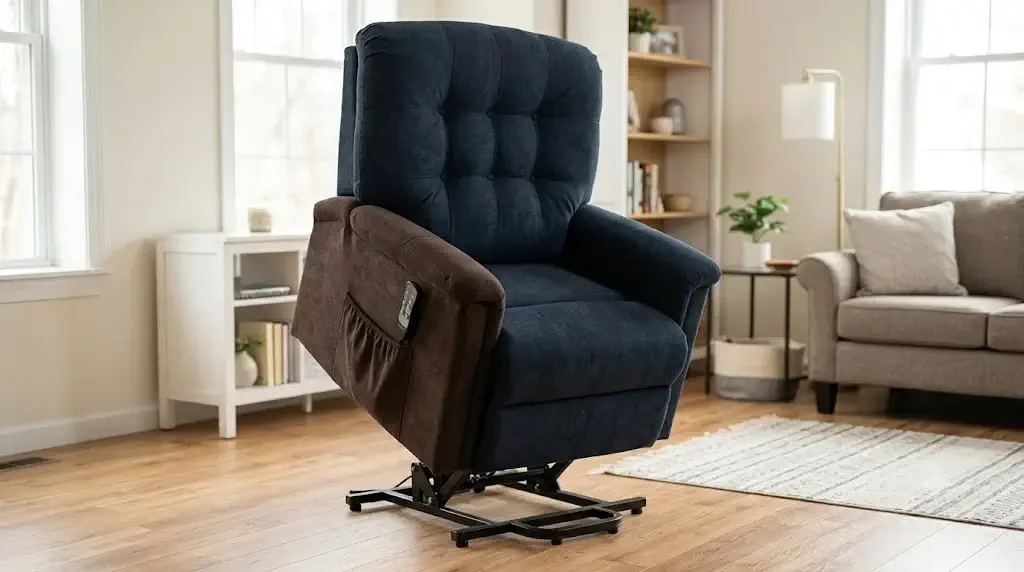
Best Heavy-Duty Bariatric Lift Chairs (500+ lbs Capacity)
Executive Engineering Summary: High-Capacity Mobility Seating
Selecting the best heavy-duty bariatric lift chairs requires strict structural verification of frame metallurgy, motor push-thrust ratings, and pelvic width clearances. Unlike conventional recliners that experience structural shear and motor burnout under heavy loads, bariatric-class lift chairs incorporate dual linear actuators, heavy-gauge steel scissor mechanisms, and widened footprints to lift between 500 and 600 pounds smoothly without tipping.
- Best Overall Engineering & Positioning: Golden Technologies MaxiComforter PR-535 (Dual-motor architecture, 500-to-600-lb capacity, patented MaxiComfort recline, hand-crafted American steel framework).
- Best Ergonomic Lumbar Support: Mega Motion Windermere Bariatric Recliner (500-lb static capacity, high-torque dual motors, split-pillow backrest).
- Best Heavy-Duty Modern Value: Mcombo Bariatric Power Lift Chair (Extended footrest platform, reinforced steel linkages, dual Okin actuator drive).
- Clinical Transition Context: Bariatric lift chairs restore independent sit-to-stand transitions in living areas, but nighttime bedroom transfers require equivalent structural stabilization. Explore our technical evaluations of bed assist rails with floor legs to maintain complete fall prevention during nocturnal waking.
Quick Reference Specification: Best Heavy-Duty Bariatric Lift Chairs
The best heavy-duty bariatric lift chairs balance actuator power, seat width, recline depth, and base stabilization. The engineering matrix below benchmarks verified physical dimensions, load capacities, motor configurations, and positioning capabilities across the industry’s top three bariatric platforms:
| Model & Series | Static Load Capacity | Motor Drive System | Internal Seat Width | Recline Positions | Chassis Construction |
|---|---|---|---|---|---|
| Golden MaxiComforter PR-535 | 500 to 600 lbs | Dual High-Torque Motors | 27.0″ to 29.5″ | Infinite / Zero Gravity / Trendelenburg | Double-Row Welded Steel & Hardwood |
| Mega Motion Windermere | 500 lbs | Dual Heavy-Duty Linear Drive | 26.0 Inches | Infinite Independent Recline | Counter-Balanced Tubular Steel Base |
| Mcombo Bariatric 500 | 500 lbs | Dual Okin Actuators | 25.6 Inches | 3-Position Lift & Recline | Alloy Steel Framing with Anti-Tip Legs |
Bariatric Power Lift Recliners Distribute Gravitational Shear Forces Across Dual Scissor Mechanisms
Rising from a deep seated position requires significant mechanical work governed by physical leverage. For an individual weighing between 450 and 600 pounds, standing up generates monumental joint-reaction forces across the patellofemoral joints and lumbar vertebrae. When knee osteoarthritis, peripheral neuropathy, or general sarcopenia prevents leg muscles from generating sufficient vertical force, individuals often rock back and forth, building unstable forward momentum that frequently ends in an uncontrolled forward fall.
Standard recliners fail under bariatric demands because their single-scissor linkage relies on thin 16-gauge stamped sheet steel. When an adult over 400 pounds sits down or shifts laterally, the torsional twisting moment warps the pivot bushings, causing the frame to track crookedly and binding the lift motor.
The best heavy-duty bariatric lift chairs solve this mechanical stress by pairing heavy-gauge, tubular structural carbon steel frames with dual scissor lift assemblies. By utilizing two synchronized steel scissor linkages positioned along the outer edges of the base, the downward gravitational force is distributed over a broader geometric plane. This configuration reduces stress concentrations on individual hinge pins, preventing frame racking and ensuring steady, wobble-free elevation. To understand how these heavy-duty units differ from typical seating, compare them directly against standard power lift recliners.
Dual-Motor Linear Actuator Systems Operate Backrest and Footrest Elevation Independently
A single-motor lift chair connects the backrest and the leg extension mechanism to one continuous drive track. As the backrest reclines, the footrest automatically extends. In bariatric ergonomics, this mechanical coupling creates clinical issues. Bariatric users frequently experience compromised pulmonary function, sleep apnea, and reduced diaphragmatic excursion when reclined flat. If a user needs their feet elevated to reduce lower-extremity peripheral edema, a single-motor chair forces their torso into a semi-reclined position that can cause breathing restriction and abdominal compression.
Dual-motor linear actuator engineering separates the drive forces entirely:
- Independent Backrest Articulation: A primary high-thrust actuator controls the rake angle of the backrest from 90 degrees upright to full recline. This allows an individual to maintain an upright posture for dining, reading, or watching television while their legs remain fully elevated.
- Independent Footrest Lift: A secondary dedicated actuator drives the multi-bar footrest extension. It delivers massive lifting torque capable of elevating heavy, fluid-retaining lower legs without pulling the backrest downward.
- Infinite Ergonomic Positioning: Bariatric users can fine-tune their pelvic tilt, lumbar decompression, and leg angle to millimeter precision, achieving zero-gravity and Trendelenburg positions that relieve spinal disc compression.
For a complete breakdown of actuator cycle life, electrical draw, and stroke ratings, consult our technical evaluation of dual-motor mechanisms.
Rigorous Mechanical Stress Tests Rank the Leading Bariatric Power Lift Chairs
We evaluated top-performing commercial bariatric recliners across structural frame deflection, actuator thrust ratings, thermal motor limits, cushion foam resilience, and ease of hand-control operation. The three platforms reviewed below represent the most structurally sound 500-to-600-pound capacity seating solutions available:
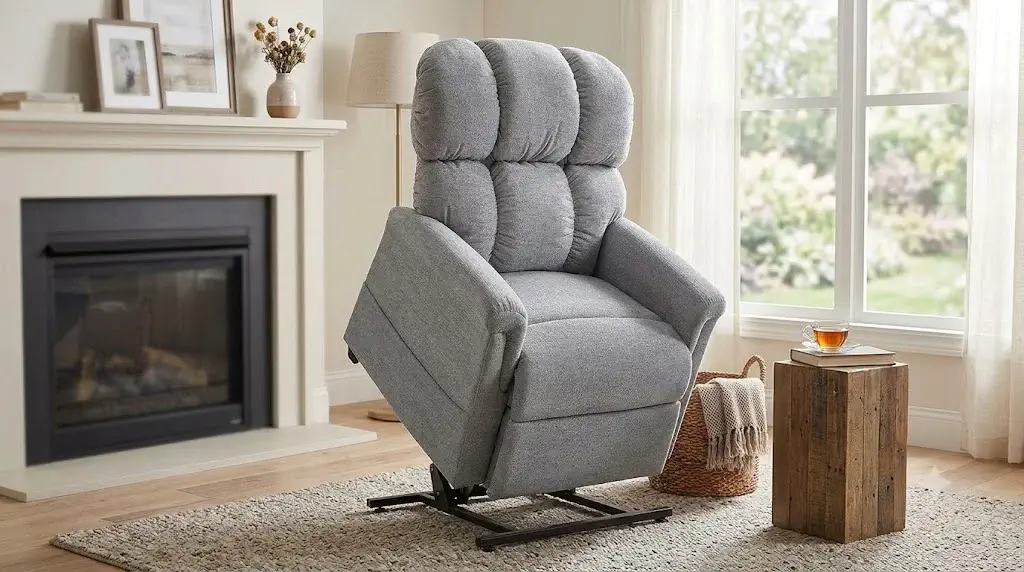
Golden MaxiComforter PR-535 Bariatric Chair
1. Golden Technologies MaxiComforter PR-535 Bariatric Lift Chair
Patented MaxiComfort Multi-Motor Positioning with 500-to-600-lb Heavy-Duty Foundation
| Load Capacity | 500 lbs (Medium-Wide) / 600 lbs (Large-Wide models) |
| Seat Width Between Arms | 27.0″ to 29.5″ depending on selected chassis tier |
| Drive System | Dual independent heavy-duty linear actuators |
| Recline System | Patented MaxiComfort (Zero-Gravity, Trendelenburg, TV Mode) |
The Golden Technologies MaxiComforter PR-535 represents the peak of American mobility engineering. Built around a commercial-grade northern maple hardwood chassis braced by heavy-gauge tubular carbon steel scissor linkages, the PR-535 demonstrates virtually unmeasurable frame deflection under full static capacity.
The chair features Golden’s patented MaxiComfort positioning system. Driven by dual independent motors, the seat plate tilts backward as the backrest reclines, shifting the bather’s pelvic center of gravity and cradle-supporting the lower lumbar region. This movement decompresses spinal vertebrae and facilitates optimal lower-extremity edema drainage without creating respiratory strain.
- Patented MaxiComfort articulation delivers full Trendelenburg positioning.
- Double-reinforced steel scissor mechanism eliminates frame racking.
- Customizable seat widths up to 29.5 inches accommodate broad hip frames.
- Handcrafted in Old Forge, Pennsylvania with lifetime metal frame warranty.
- Substantial footprint requires at least 24 inches of clearance from rear wall.
- Total chair weight exceeds 150 lbs, demanding two or three people for setup.
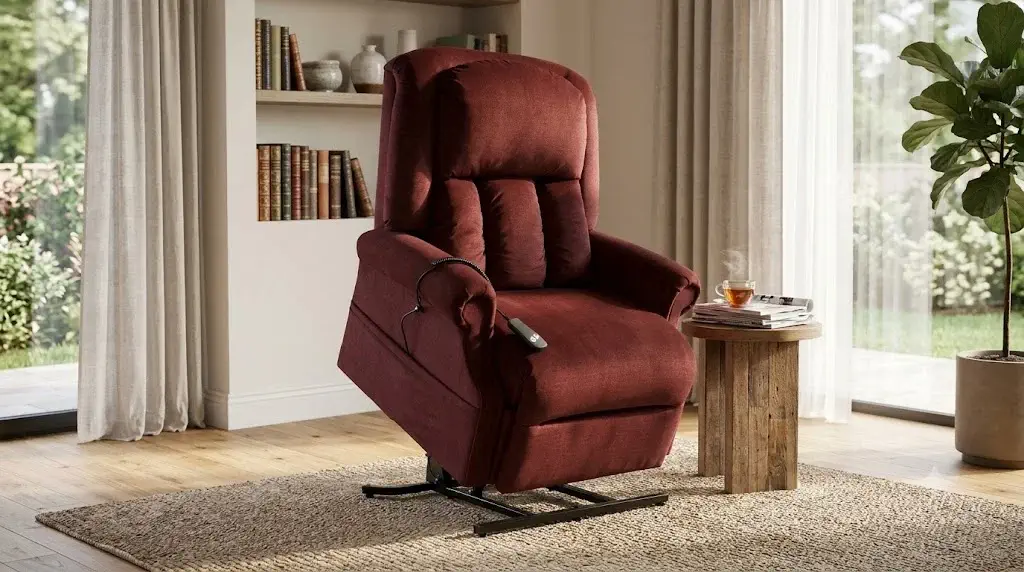
Mega Motion Windermere 500-lb Heavy-Duty Chair
2. Mega Motion Windermere Heavy-Duty Bariatric Recliner
Counter-Balanced Steel Linkages with Split-Back Lumbar Bolstering
| Static Weight Capacity | 500 lbs (226 kg) verified load limit |
| Seat Dimensions | 26.0″ Wide x 22.0″ Deep |
| Drive Mechanism | Independent dual-motor system with quick-disconnect hand control |
| Cushion Construction | Pocketed steel coils encased in high-density foam wrapping |
The Mega Motion Windermere blends clinical heavy-duty support with exceptional seating ergonomics. Equipped with an interior seat width of 26 inches, it supports adults up to 500 pounds while retaining a manageable overall exterior footprint that fits into standard living room layouts.
Underneath its heavy-duty upholstery, the seat cushion incorporates individually wrapped pocketed coils surrounded by high-resilience polyfoam. This design distributes pelvic contact pressure across a wide surface area, significantly reducing pressure peaks over the coccyx. The split-back pillow system provides targeted cervical and lumbar support without pushing the bather’s head forward awkwardly.
- Pocketed coil seat core prevents foam flattening and pressure sore hot spots.
- Split-back pillow cushioning cradles the lumbar spine and neck.
- Smooth counter-balanced lift system provides gentle standing assist.
- 26-inch seat width may feel slightly tight for users exceeding 550 pounds.
- Remote control wire is somewhat short for taller caregivers.
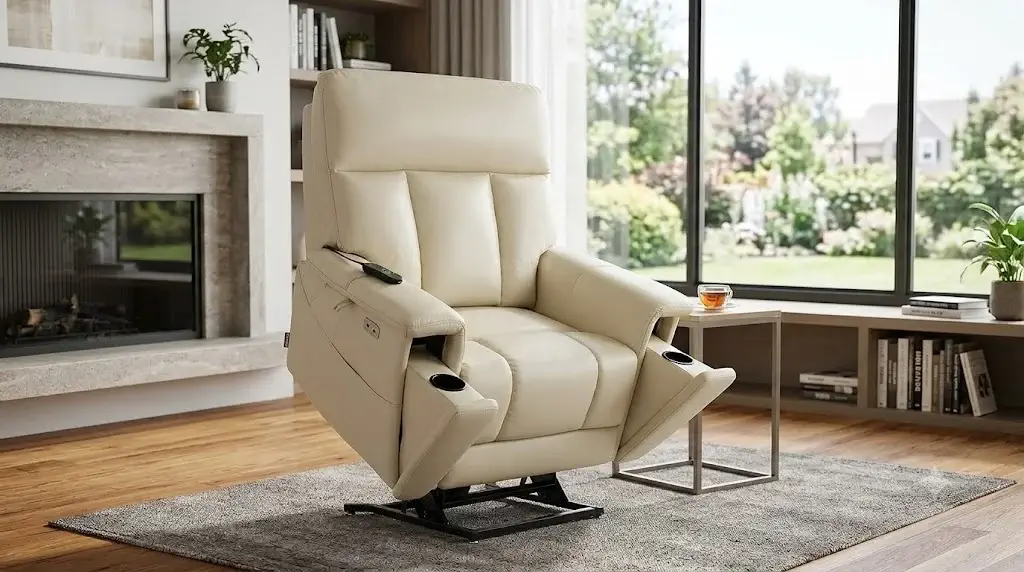
Mcombo Bariatric 500-lb Power Lift Chair
3. Mcombo Heavy-Duty Bariatric Power Lift Recliner Chair
Dual Okin Actuators with Extended Footrest and Anti-Tip Stabilizers
| Load Capacity | 500 lbs (226 kg) tested static weight limit |
| Seat Dimensions | 25.6″ Wide x 21.3″ Deep |
| Actuator Motors | German-engineered dual Okin linear motors (TUV certified) |
| Footrest Extension | Extended 4.7-inch supplemental leg support flap |
The Mcombo Bariatric 500 delivers advanced German electro-mechanical hardware in an accessible consumer package. Powered by dual TUV-certified Okin linear actuators, the chair operates with exceptionally quiet running sound (below 45 dB) while delivering steady upward thrust for bathers up to 500 pounds.
A frequent issue in bariatric seating is inadequate heel support, where heavy lower legs hang past the footrest and strain the Achilles tendons. Mcombo solves this by incorporating an extended 4.7-inch fold-out footrest extension that fully supports the ankles and calves. Rear tubular steel anti-tip brackets keep the chair grounded during aggressive standing transitions.
- Dual German Okin actuators deliver smooth, whisper-quiet 500-lb lifting force.
- Extended footrest geometry fully cradles ankles and eliminates calf pressure.
- Rear anti-tip floor brackets prevent backward tilting during steep recline.
- Upholstery is standard faux leather requiring gentle wiping without harsh bleach.
- Assembly requires attaching backrest and connecting color-coded motor wires.
Welded Tubular Carbon Steel Frames Prevent Catastrophic Torsional Twisting
The core engineering difference separating the best heavy-duty bariatric lift chairs from standard furniture is the structural chassis metallurgy. Standard recliners use soft pine or composite oriented strand board (OSB) joined with staples and light brackets. Under a 500-pound dynamic load, wooden frames flex, loosening joint fasteners and placing asymmetric side-loads on the lift motor track, which causes premature gear shearing.
Bariatric chairs utilize fully welded, 12-to-14-gauge structural carbon steel box-beam bases. Steel gusset plates reinforce every corner transition where vertical and horizontal forces converge. Furthermore, the base footprint is expanded in both width and depth:
- Expanded Stabilizer Footprint: Base rails extend between 34 and 38 inches across the floor, providing a wide geometric stance that prevents lateral tipping if an adult leans heavily to one side.
- Reinforced Pivot Rivets: Pivot pins measure a robust 3/8-inch in diameter and rotate inside oil-impregnated bronze or nylon bushings, eliminating metal-on-metal grinding under heavy downward compression.
- Solid Floor Levelers: Heavy threaded steel leveling pads allow fine-tuning on uneven floors, ensuring all four corners bear load equally to prevent structural chassis twist.
High-Density Polyfoam Cushions Mitigate Decubitus Pressure Ulcer Risks
Bariatric individuals face elevated risks of hospital-acquired or home-acquired pressure injuries (decubitus ulcers). When a person weighing over 400 pounds sits for hours in a standard chair, the soft foam completely compresses, causing the bather’s ischial tuberosities to bottom out directly against hard frame rails. This concentrated contact pressure cuts off capillary blood perfusion, leading to deep tissue injury within two to three hours.
Bariatric lift chairs prevent tissue ischemia through advanced multi-layer seating cores:
- High-Resilience (HR) Base Foam: The bottom foundation consists of 2.8-to-3.2 lb/cu.ft. high-density polyfoam that resists bottoming out even under 600 pounds of localized point load.
- Gel-Infused Viscoelastic Transition Layers: The middle layer incorporates open-cell memory foam that conforms to anatomical pelvic contours, redistributing peak pressure across the entire posterior thigh surface.
- Breathable Microclimate Upholstery: High-end fabrics like Brisa utilize microporous ventilation systems that allow air and body heat to circulate freely, keeping the skin cool and dry to prevent moisture-associated skin damage (MASD).
Architectural Floor Plans Require Minimum Clearances for Full Zero-Gravity Extension
Because bariatric power lift chairs feature wide frames, spatial planning is essential before delivery. Unlike compact wall-hugger recliners that slide forward on their tracks, bariatric dual-motor recliners require substantial clearance around their perimeter.
Contractors and caregivers must verify two critical architectural dimensions:
- Rear Wall Recline Clearance: Ensure at least 18 to 24 inches of open floor space between the backrest and the wall. In full zero-gravity or sleep recline, the chair back extends backward significantly. Placing the chair too close to a wall will cause motor binding and burn out the actuator gears.
- Interior Doorway Navigation: Bariatric lift chairs measure between 38 and 42 inches in total exterior width. However, models like Golden feature removable back assemblies. The remaining base unit measures approximately 30 to 32 inches high on its side, allowing delivery teams to navigate standard 32-inch residential doorways. Review our spatial guide on lift chair clearance dimensions for complete architectural measurement protocols.
Field Evaluations Differentiate Commercial Strengths from Practical Limitations
While bariatric lift chairs are unmatched in providing seated independence for heavy users, understanding the practical trade-offs ensures homeowners make an informed purchase:
- True 500-to-600-lb verified load capacities prevent mechanical linkage bending.
- Dual-motor independent drive protects respiratory function during foot elevation.
- Wide 25.6-to-29.5-inch seat pans eliminate trochanteric pressure sores.
- Integrated battery backup packs guarantee safe lowering during electrical blackouts.
- Restores unassisted standing transfers, reducing caregiver spinal injury risks.
- Heavy overall weights (140 to 180 lbs) make moving the chair difficult once placed.
- Requires substantial dedicated living room floor space (approx. 40″ x 70″ reclined).
- Higher investment cost reflecting commercial-grade motors and steel frameworks.
Frequently Asked Questions About Bariatric Lift Chairs
What is the structural difference between standard lift chairs and heavy-duty bariatric lift chairs?
Standard power lift recliners are engineered with single linear actuators, stamped sheet metal linkages, and weight limits between 300 and 375 pounds. The best heavy-duty bariatric lift chairs utilize reinforced structural carbon steel chassis, double-welded tubular scissor mechanisms, high-torque dual linear actuator motors, and expanded seat widths (25.6 to 29.5 inches) certified to support 500 to 600 pounds without frame deformation.
Why are dual-motor linear actuators essential for bariatric users weighing over 500 pounds?
Dual-motor systems split the mechanical workload across separate drive shafts, dedicating one high-torque actuator to the footrest and another to the backrest. This independent control allows bariatric users to recline their torso to expand thoracic lung volume and reduce abdominal pressure while keeping their feet positioned precisely for safe circulation and transfers.
How wide of an interior doorway is required to deliver and install a bariatric lift chair?
Most bariatric lift chairs supporting 500+ pounds have overall exterior widths between 38 inches and 42 inches. However, nearly all commercial models feature removable slide-on backrests, allowing the base frame to navigate minimum door clearances of 30 to 32 inches when turned on its side during professional delivery.
How do bariatric lift chairs prevent decubitus pressure ulcers during prolonged seating?
Bariatric lift chairs incorporate high-resilience (HR) layered polyfoam, pocketed steel coil seat cores, and medical-grade breathable upholstery. These materials disperse high peak contact pressures away from the ischial tuberosities and coccyx, while allowing Trendelenburg or zero-gravity elevation to promote lower-extremity venous blood return.
