
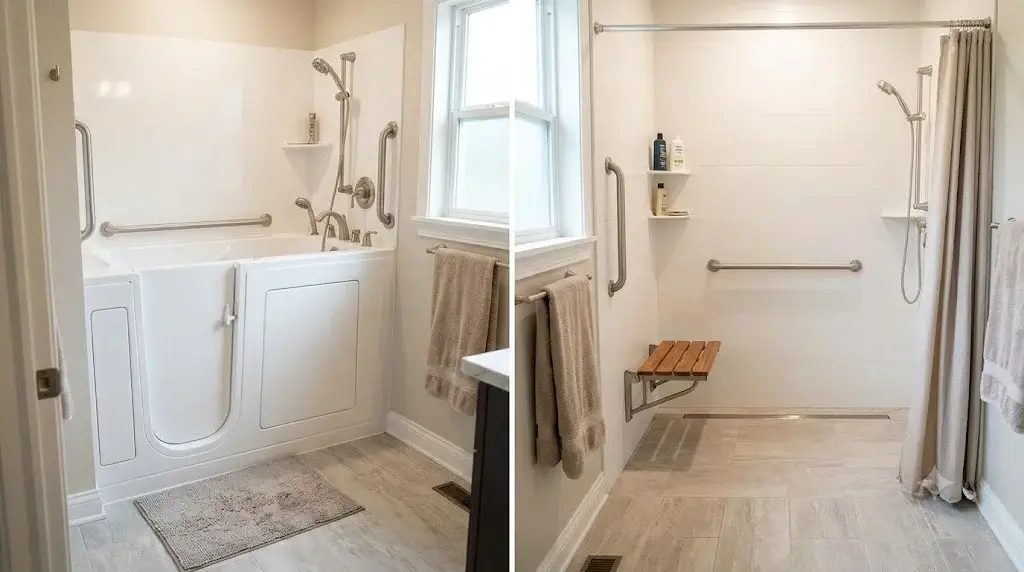
Walk-in Tubs vs. Barrier-Free Roll-in Showers: Cost & Safety
Executive Engineering Summary: Accessible Bathing Dilemma
Deciding between walk-in tubs vs barrier-free roll-in showers requires evaluating current physical dexterity, future progressive mobility needs, and home infrastructure limits. While walk-in bathtubs deliver deep hydrotherapy for arthritis pain, they introduce unavoidable drain wait times and step-in thresholds. Conversely, barrier-free roll-in showers eliminate all floor curbs for total wheelchair access, offering higher clinical safety at a comparable long-term renovation cost.
- Fall Prevention Safety: Barrier-free showers score higher (9.8/10) because they eliminate the 3-to-7-inch step threshold entirely, whereas walk-in tubs require users to step over a door sill on wet tile.
- Wheelchair & Caregiver Ergonomics: Roll-in showers permit zero-transition roll-in commode chairs and direct standing caregiver assistance without reaching over high tub walls.
- Infrastructure Demands: Walk-in tubs demand dedicated 50-to-80-gallon water heaters and high-draw electrical circuits, whereas roll-in showers require structural subfloor recessed joist modifications.
- Bathroom Modification Synergy: Regardless of enclosure choice, all accessible bathing zones require permanent blocking and securely mounted shower grab bars positioned along transfer pathways.
Quick Reference Specification: Walk-in Tubs vs Barrier-Free Roll-in Showers
The walk-in tubs vs barrier-free roll-in showers comparison involves contrasting mechanical systems, plumbing requirements, and user biomechanics. The matrix below benchmarks key engineering parameters, spatial footprints, and installation costs across both options:
| Architectural Feature | Walk-in Bathtubs | Barrier-Free Roll-in Showers | Safety & Clinical Impact |
|---|---|---|---|
| Entry Threshold | 3″ to 7″ step-in door sill | 0″ true zero-threshold transition | Curbless entries prevent foot catching during gait shuffling |
| Wheelchair Accessibility | Requires standing transfer through door | Direct roll-in via shower wheelchair | Showers accommodate non-ambulatory and bariatric users |
| Water Volume Required | 50 to 80 gallons per bath | Continuous 1.8–2.5 GPM flow | Tubs often require upgrading to a 75-gal water heater |
| Bathing Wait Times | 6–15 min (Fill) / 2–10 min (Drain) | Zero wait time (instant entry & exit) | Tub drainage delays expose frail seniors to room chilling |
| Therapeutic Benefits | Deep immersion, air/water hydrotherapy | Targeted handheld spray, warm steam | Tubs excel for severe chronic arthritis and stiffness |
| Subfloor Modifications | Floor joist load evaluation (heavy filled weight) | Recessed floor framing for curbless slope | Showers require precise floor pitch toward linear drains |
| Estimated Cost Range | $7,000 – $17,000 (installed) | $9,000 – $22,000 (installed) | Both options represent major home capital investments |
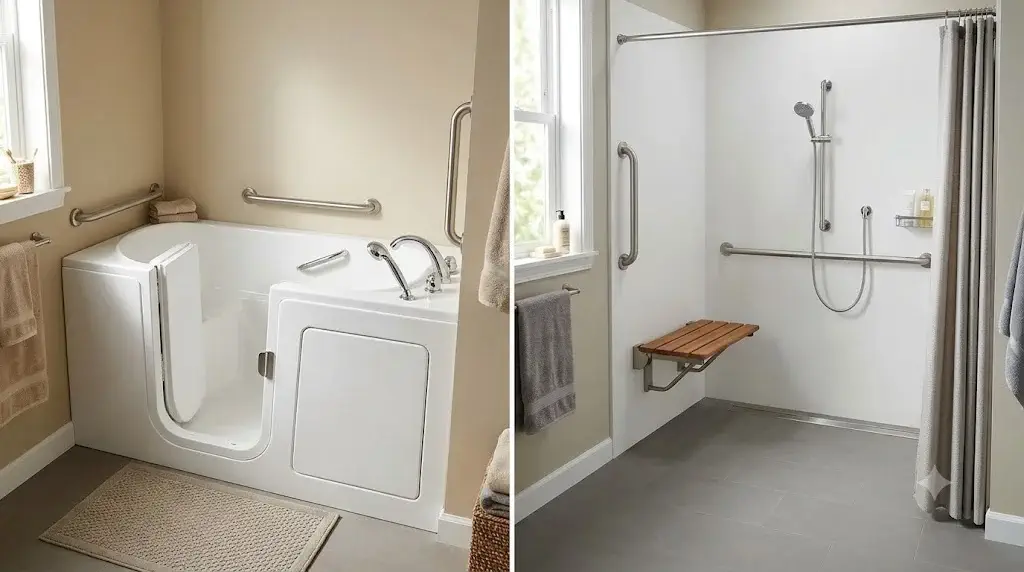
Side-by-side architectural comparison: acrylic walk-in bathtub with low-threshold door versus zero-threshold barrier-free curbless roll-in shower.
Zero-Threshold Floor Pan Profiles Eliminate Foot Tripping Incidents
Bathroom slip-and-fall injuries occur predominantly during transfers across elevated physical thresholds. According to clinical gait biomechanics, seniors with Parkinson’s disease, peripheral neuropathy, or general motor sarcopenia exhibit decreased ground clearance, frequently shuffling their feet rather than lifting their heels cleanly.
In the debate between walk-in tubs vs barrier-free roll-in showers, entry geometry marks the most dramatic safety divide. A walk-in tub reduces the traditional 14-to-18-inch bathtub sidewall to a lower door sill. However, that sill still measures between 3 and 7 inches high. A bather must balance on one foot on a potentially slick floor while swinging the opposite leg across the narrow threshold.
Barrier-free roll-in showers completely eliminate the curb. Utilizing an architectural slope of 1/4 inch per foot directed toward a wall-line linear drain, the dry bathroom tile transitions flush into the shower zone with zero height differential. This allows bathers using rollators, walkers, or wheelchairs to roll directly into the bathing stall without raising their feet off the floor. To examine secondary transition hardware, read our evaluation of walk-in tub conversions.
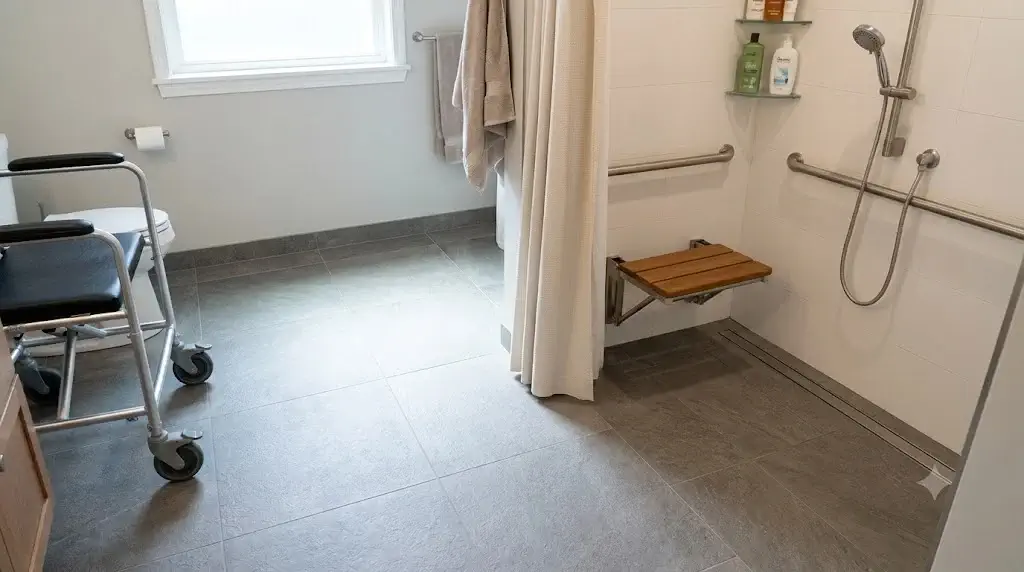
Zero-threshold roll-in showers eliminate the 3-to-7-inch step-in door sill required by walk-in bathtubs, providing complete floor-level access.
High-Volume Water Consumption Dictates Water Heater Upgrades for Walk-in Tubs
Homeowners often overlook the massive hydraulic requirements of deep-soaking accessible tubs. A standard residential shower equipped with a WaterSense showerhead consumes approximately 1.8 to 2.0 gallons per minute (GPM), meaning a comfortable 10-minute shower consumes just 18 to 20 gallons of blended hot water.
Conversely, a walk-in bathtub requires a massive water volume to submerge the bather to chest level:
- 50 to 80 Gallon Capacity: Accounting for user body displacement, filling an accessible tub requires between 50 and 80 gallons of water.
- Water Heater Depletion: Standard American households rely on a 40-or-50-gallon tank water heater, which delivers approximately 30 to 35 gallons of hot water before the temperature drops sharply. If installed without upgrading the boiler, the tub fills halfway with warm water and finishes cold.
- Mandatory Infrastructure Upgrades: Installing a walk-in tub frequently requires replacing the existing water heater with a 75-gallon tank or a dedicated high-capacity tankless unit (minimum 8.0 GPM rating), adding $1,500 to $3,500 in unexpected utility expenses.
Roll-in showers connect seamlessly to existing residential 1/2-inch or 3/4-inch supply lines without necessitating major mechanical room retrofits.
Prolonged Water Drainage Cycles Expose Frail Bathers to Severe Room Chilling
The fundamental mechanical operational reality of walk-in tubs is the sealed door mechanism. Because the door forms part of the tub wall and swings inward or outward with a watertight silicone gasket, the bather must enter the tub, latch the door, and sit down *before* turning on the water.
Once the bath is complete, the process reverses: the bather cannot open the door until all 60+ gallons have drained completely down the pipe. On standard gravity-fed 1.5-inch residential drain pipes, draining takes between 6 and 12 minutes:
- Evaporative Chilling Hazards: As the water recedes, the bather sits naked in a damp, cooling environment. For seniors with poor thermal regulation or circulatory deficiencies, this extended wait causes severe shivering, muscle cramping, and sudden blood pressure drops upon standing.
- Fast-Drain Pump Solutions: Premium walk-in tubs incorporate secondary electric evacuation pumps that empty the tub in 80 to 120 seconds. However, these systems require a dedicated 15-amp GFCI circuit and generate noticeable mechanical noise.
- Instant Roll-in Shower Exits: In a roll-in shower, water leaves continuously via high-flow trench drains. The bather controls the water valve, immediately steps or rolls out when finished, and wraps in a warm towel with zero waiting time.
Barrier-Free Showers Permit Direct Wheeled Commode Access for Caregivers
Long-term aging in place requires evaluating whether a bathing space accommodates progressive mobility loss. A senior who can walk into a tub today may require a wheelchair or mechanical transfer lift two years from now following a stroke, fracture, or neuromuscular deterioration.
Walk-in tubs are ill-suited for non-ambulatory individuals. Even models with outward-swinging doors require a lateral sliding transfer onto an internal contoured seat. If a bather cannot bear weight on their legs, lifting them into the enclosed fiberglass tub basin requires substantial caregiver strain, increasing spinal injury rates among home health aides.
A barrier-free roll-in shower offers unmatched accessibility:
- Shower Wheelchair Compatibility: Bathers can transition from bed into a waterproof wheeled shower commode chair in the dry bedroom, roll directly into the shower stall, and bathe without a single standing pivot transfer.
- Ample Caregiver Workspace: Roll-in showers measuring 60 inches by 36 inches or larger provide ample room for a caregiver to stand alongside the bather to assist with washing, completely protected from splashing by weighted safety curtains.
- Ceiling Track & Hoyer Lift Clearance: The absence of top header tracks and high tub walls allows rolling Hoyer patient lifts or overhead ceiling track slings to deposit the user safely onto a padded shower bench.
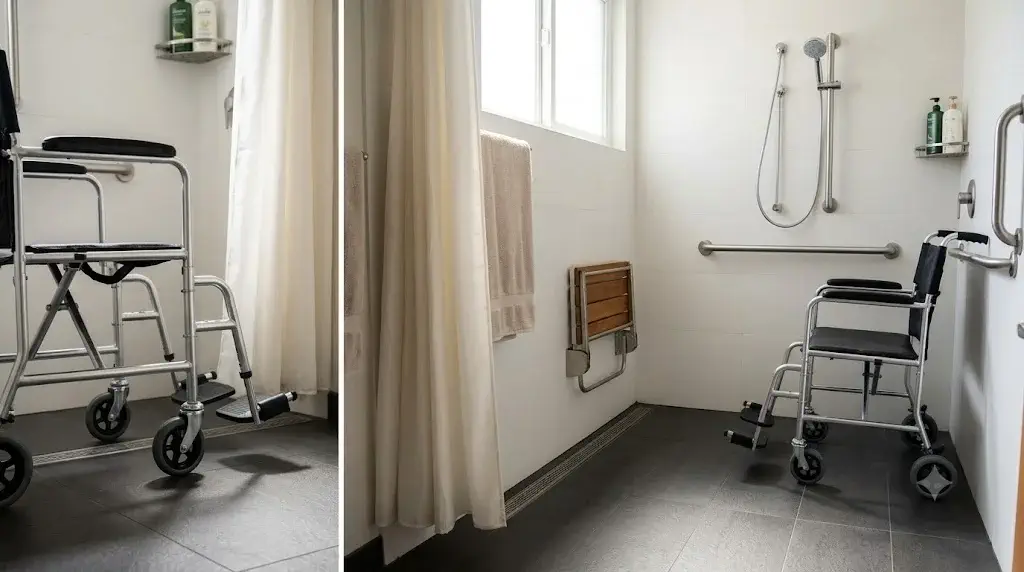
Spacious curbless shower layouts permit direct entry for shower commode chairs and provide ergonomic standing room for assisting caregivers.
Comprehensive Remodel Labor Represents the Dominant Expenditure Factor
Evaluating the true financial commitment of walk-in tubs vs barrier-free roll-in showers requires looking past the raw equipment purchase price to examine demolition, structural reframing, and plumbing adjustments. Neither option can simply be dropped into a standard bathroom without extensive infrastructure retrofits.
| Cost Component | Walk-in Tub Remodel | Roll-in Shower Remodel |
|---|---|---|
| Fixture / Hardware Purchase | $2,500 – $7,500 (Tub unit + jets) | $1,200 – $3,500 (Pan + valves + door) |
| Demolition & Disposal | $800 – $1,500 | $1,000 – $2,000 |
| Plumbing & Drain Relocation | $1,500 – $3,000 (Rapid drain lines) | $2,000 – $4,500 (Linear trench drain) |
| Subfloor & Waterproofing | $500 – $1,200 (Load bracing) | $2,500 – $6,000 (Recessed joist slope) |
| Electrical Runs & Water Heater | $1,500 – $4,000 (Dedicated circuits) | $300 – $800 (Lighting / fan) |
| Wall Surrounds & Tile Finish | $800 – $2,000 (Tub extension panels) | $2,000 – $5,500 (Full-height tile) |
| Total Estimated Turnkey Cost | $7,600 – $19,200 | $9,000 – $22,300 |
While basic walk-in tub hardware carries a higher upfront ticket price than a bare shower base, a full roll-in shower often demands higher overall labor expenses. Creating a true curbless floor requires notching or lowering the wooden subfloor joists to create the proper 1/4-inch drainage pitch, followed by installing continuous liquid-applied waterproof membranes across the entire bathroom floor.
Universal Barrier-Free Showers Deliver Superior Residential Real Estate Resale Value
Modifying a home for accessibility often impacts broader property marketability. Homeowners must weigh whether an accessible renovation will appeal to future buyers or devalue the master bathroom in the local real estate market.
Walk-in bathtubs are widely viewed as specialized geriatric medical equipment. Prospective younger homebuyers often perceive a bulky walk-in tub as an eyesore that must be demolished and hauled away, frequently leading to reduced purchase offers. If installed in the home’s only bathroom, removing a standard bathtub can also deter families with young children.
Conversely, modern barrier-free roll-in showers align with luxury architectural trends:
- Contemporary Spa Aesthetics: Curbless showers with frameless glass panels, modern tile, and concealed linear drains reflect high-end European bathroom design, adding tangible appraisal value to the property.
- Multi-Generational Usability: A spacious curbless shower accommodates toddlers, working adults, athletes recovering from joint surgeries, and seniors using mobility walkers.
- Adaptable Universal Foundation: If a family member later requires specialized seated support, temporary folding benches can be integrated without structural alteration. To optimize traction on wet curbless tile, explore our guide to walk-in shower safety.
Comparative Clinical Analysis Clarifies Ideal Candidate Profiles
Both bathing adaptations solve critical mobility challenges, but each targets distinctly different user profiles and physical capabilities:
- The bather experiences severe osteoarthritis, fibromyalgia, or muscular pain relieved only by deep warm water immersion.
- The individual maintains sufficient core balance and hip flexion to step over a 4-inch threshold safely.
- The home’s utility room can accommodate an upgraded 75-gallon water heater.
- The bather can tolerate sitting for 8 to 10 minutes while the tub fills and drains.
- The individual has progressive mobility decline, Parkinson’s, or relies on a walker or wheelchair.
- Caregivers require open access to assist with washing without straining over tub walls.
- The bather shivers easily or cannot tolerate extended fill and drainage wait times.
- Maintaining broad home resale appeal and universal design aesthetics is a priority.
Frequently Asked Questions About Walk-in Tubs vs. Roll-in Showers
Which option is safer for seniors with progressive mobility decline?
In the comparison of walk-in tubs vs barrier-free roll-in showers, barrier-free roll-in showers provide superior long-term safety for progressive neuromuscular conditions. Unlike walk-in tubs that still require stepping over a 3 to 7-inch curb and sitting while water drains, zero-threshold roll-in showers eliminate all trip thresholds and accommodate wheeled shower commode chairs directly.
Do walk-in tubs require upgrading the home hot water heater?
Yes. Most residential walk-in bathtubs require between 50 and 80 gallons of water to fill to chest level. Standard 40-gallon residential water heaters will run completely cold before the tub fills, demanding an upgrade to a 75-gallon storage tank or a dedicated high-GPM tankless water heater.
How long must a bather wait for a walk-in tub to drain before opening the door?
Gravity-drained walk-in tubs take between 6 and 12 minutes to empty completely, during which the bather must sit wet and exposed to ambient air chilling. Models equipped with dual power-assisted fast-drain pumps reduce evacuation time to approximately 80 to 120 seconds.
What is the typical total cost difference between walk-in tubs and roll-in showers?
A standard walk-in tub conversion typically ranges from $7,000 to $17,000 including electrical line runs and plumbing modifications. A full barrier-free curbless roll-in shower remodel generally costs between $9,000 and $22,000 due to structural subfloor recessed sloping, linear trench drains, and complete waterproof pan membrane installation.
