
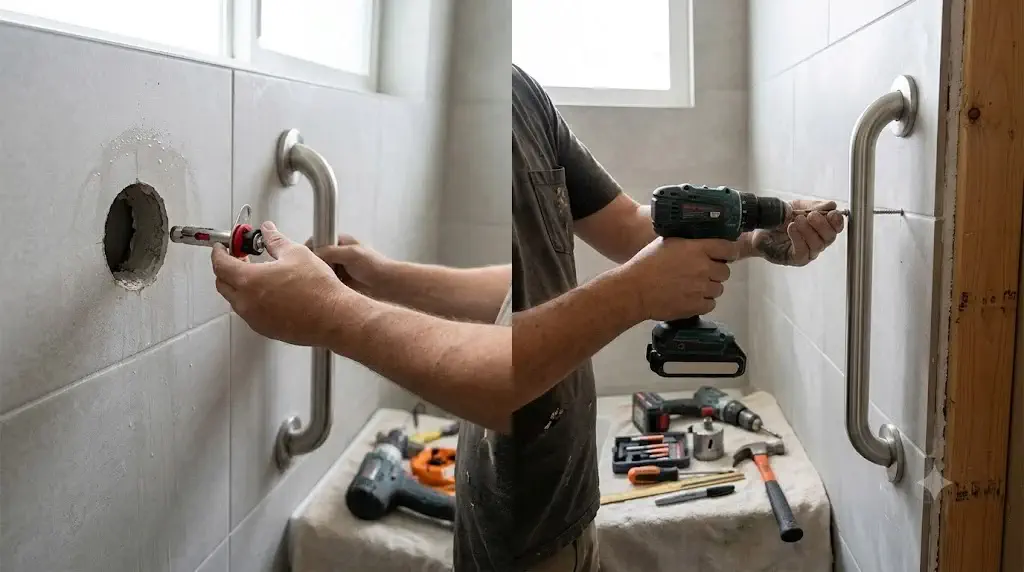
ADA Grab Bar Fastener Guide: WingIts vs. Wood Studs
Executive Engineering Summary: Grab Bar Anchoring Mechanisms
Consulting an authoritative ADA grab bar fastener guide WingIts vs wood studs is critical to preventing catastrophic fastener shear when an adult suffers a sudden slip-and-fall balance loss. While anchoring into solid 2×4 wood studs provides the highest ultimate pull-out threshold (over 500 lbs), residential stud spacing (16″ or 24″ on center) rarely matches ergonomic grab bar placements. WingIts engineered hollow wall anchors bridge this anatomical gap, utilizing radial stainless steel compression wings to safely exceed ADA requirements in hollow tile, cement board, and drywall.
- Structural Wood Studs: Deliver unmatched tensile strength (>500 lbs), zero hollow wall vibration, and minimal tooling costs, but restrict grab bar orientation strictly to stud layout locations.
- WingIts Hollow Anchors: Enable arbitrary placement across hollow ceramic tile and drywall walls, providing certified shear resistance of 300 to 600 lbs via hydro-dynamically sealed, non-corrosive expansion wings.
- Installation Margin of Error: Wood studs require precise pilot drilling dead-center into the 1.5-inch stud edge; WingIts require a specialized 1-1/4-inch diamond hole saw and clean hollow cavity clearance (minimum 1.5 inches deep).
- Bathing Safety Context: Secure anchoring is the foundation of fall prevention; pair high-tensile fasteners with certified ADA-compliant grab bars to ensure structural stability in high-moisture shower zones.
Quick Reference Specification: ADA Grab Bar Fastener Guide WingIts vs Wood Studs
The ADA grab bar fastener guide WingIts vs wood studs comparison benchmarks mechanical load capabilities, fastener metallurgy, sub-wall clearance requirements, and installation difficulty. The matrix below contrasts verified structural metrics between these two leading mounting protocols:
| Engineering Parameter | Direct Wood Stud Anchoring | WingIts Master Fastener (RC-SSB-W35) | ADA & Clinical Implication |
|---|---|---|---|
| ADA §609.8 Compliance | Exceeds (500+ lbs capacity) | Exceeds (300 to 600 lbs capacity) | Both options surpass the mandatory 250-lb downward and shear threshold |
| Positional Flexibility | Strictly locked to 16″ or 24″ stud layout | 100% arbitrary ergonomic positioning | WingIts allow horizontal, vertical, and diagonal placement anywhere on tile |
| Required Hole Bore Size | 3/16″ or 5/32″ pilot hole through tile | 1-1/4″ (32mm) core hole | WingIts require large diamond hole saws and risk tile chipping if rushed |
| Substrate Requirement | Minimum 1.5″ embedded screw thread | 1/2″ to 1-1/4″ solid hollow wall sandwich | WingIts require sound tile + backerboard without crumbly drywall decay |
| Fastener Metallurgy | 304/316 Stainless Steel Wood Screws | 304 Stainless Steel + Engineering Polymer | Prevents galvanic rust corrosion in high-humidity shower microclimates |
| Moisture Sealing Design | 100% silicone sealant under escutcheon | Integrated closed-cell EVA foam gasket | WingIts incorporate proprietary waterproof seals to protect wall cavities |
| Estimated Fastener Cost | Low ($3 – $6 per bar) | Moderate ($25 – $35 per pair) | WingIts cost more but eliminate expensive wall demolition and stud framing |
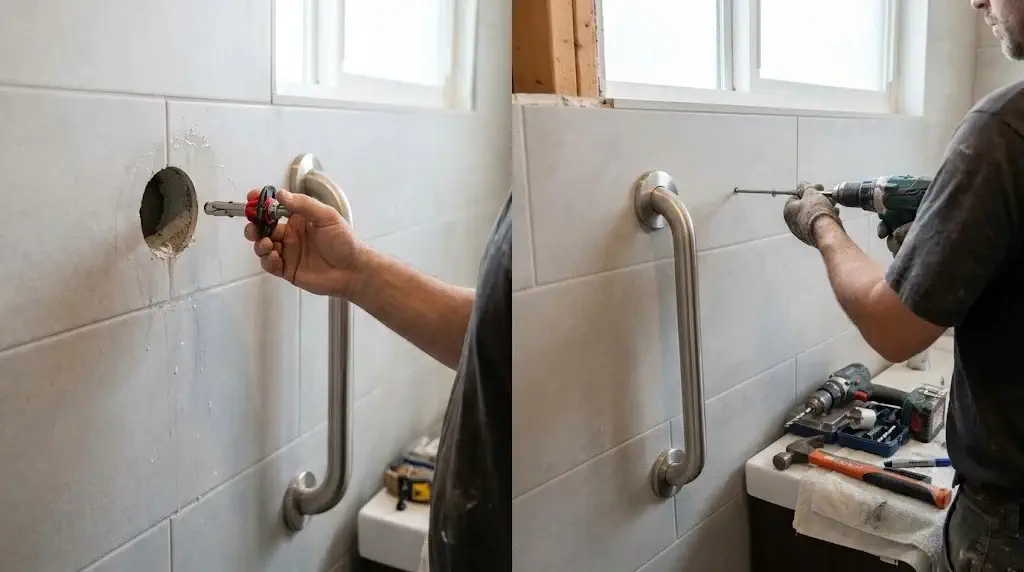
Side-by-side engineering diagram: WingIts expanding stainless steel hollow wall anchor mechanism versus direct structural wood stud fastening.
Federal ADA Standards Mandate 250-Pound Resistance Across All Vector Directions
Bathroom grab bar installations must comply with strict physical load protocols governed by the Americans with Disabilities Act (ADA §609.8) and ASTM F446. The structural mandate states that grab bars, mounting brackets, and fasteners must support a single concentrated point load of at least 250 pounds (1,112 N) applied at any angle, including downward vertical shear, horizontal tensile pull, and outward torsional leverage.
In an actual slip-and-fall event, the dynamic shock load placed on a grab bar routinely exceeds the bather’s static body weight. When an adult weighing 180 to 220 pounds experiences an abrupt loss of footing, their falling momentum creates an instantaneous kinetic impact force measuring between 1.5 to 2.5 times their resting mass. If the grab bar is secured using standard plastic conical drywall plugs, toggle bolts, or molly bolts, the sheetrock substrate crushes instantly, causing catastrophic pull-out failure.
The ADA grab bar fastener guide WingIts vs wood studs establishes that only two residential fastening methods reliably satisfy this dynamic kinetic impact. The installer must either drive heavy-gauge stainless steel wood screws directly into solid structural Douglas fir framing or deploy engineered hollow-core mechanical anchors like WingIts that distribute kinetic energy across a wide radial clamping perimeter.
WingIts Fasteners Distribute Concentrated Dynamic Loads Through Symmetrical Radial Wings
The patented WingIts Master Grab Bar Fastener (model RC-SSB-W35) replaces traditional toggle mechanisms with an integrated structural collar and expanding wings. Rather than relying on a narrow toggle bar that pinches a tiny 1/4-inch strip of plaster, WingIts utilize high-tensile 304 stainless steel and structural polymer wings that expand outward once inserted through a 1-1/4-inch core hole.
As the central 10-32 stainless machine bolt is torqued, the mechanical action clamps the structural wall assembly tightly between an external faceplate and the rear expansion wings:
- Broad Clamping Footprint: The expanded rear wings cover an area of over 5.5 square inches, distributing downward shear force across a broad geometric plane of tile and cement backerboard.
- Substrate Compression Synergy: Because ceramic tile possesses exceptional compressive strength (often exceeding 2,000 PSI), WingIts leverage the rigid ceramic tile surface to resist forward tilt and levered pull-out moments.
- Hydrophobic Gasket Sealing: Unlike field-applied silicone caulk that degrades over time, WingIts feature a pre-formed closed-cell EVA foam gasket that compresses into the 1-1/4-inch hole, preventing water intrusion into the wall cavity.
When preparing to bore through tough porcelain or granite walls, selecting professional drill bits and anchors for bathroom hardware ensures clean, non-wandering hole perimeters without cracking expensive tile finishes.
Structural Wood Studs Provide Continuous Mechanical Thread Engagement Without Wall Cavity Limitations
Mounting grab bars directly into structural framing represents the historical gold standard of construction anchoring. When an installer drives a #10 or #12 pan-head wood screw into a kiln-dried 2×4 framing stud, the deep threads bite into dense cellulose wood grain, creating mechanical friction that can withstand over 500 pounds of direct tensile pull-out force per fastener.
However, achieving true structural stud anchoring requires strict technical execution:
- Targeting the Stud Center: A standard 2×4 stud provides a nominal edge width of only 1.5 inches. Accounting for tile thickness, thinset mortar, and 1/2-inch cement board, the screw must pass through roughly 1.0 inch of non-structural masonry before touching wood. If the screw enters within 3/8-inch of the stud edge, it will split the timber or glance off into the hollow cavity, resulting in false engagement.
- Minimum Embedment Depth: Screws must measure at least 2.5 inches to 3.0 inches in overall length. A 3.0-inch screw provides approximately 1.5 to 1.75 inches of deep core thread bite into solid wood.
- Pilot Hole Calibration: Driving a heavy screw directly into dry stud framing without a pilot hole can shear the screw head or split the stud. Installers must pre-drill with a 5/32-inch high-speed steel bit to relieve internal timber stress.
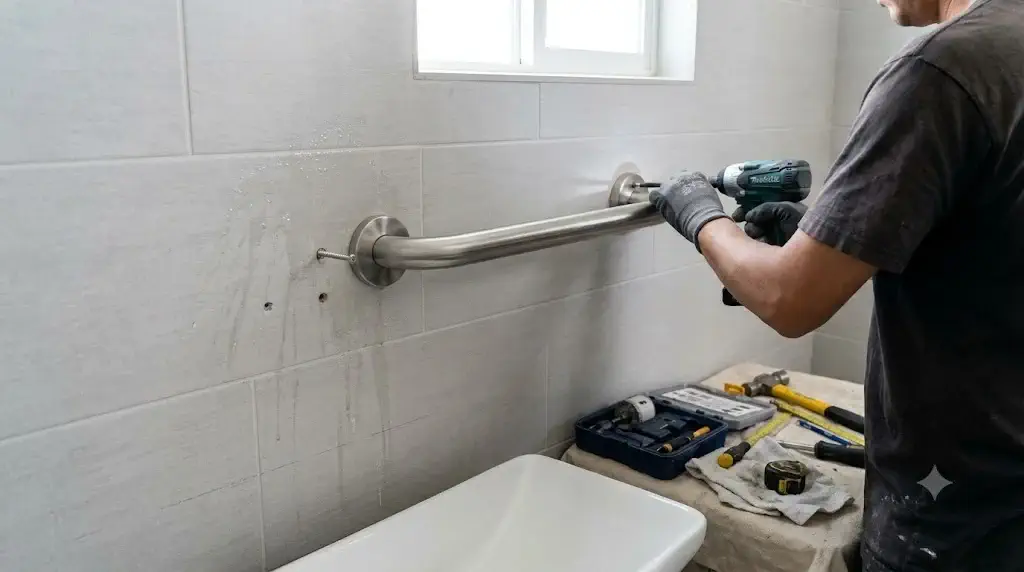
Cross-sectional view of proper wood stud grab bar embedment: screw penetrates 1.5 inches into solid 2×4 timber after clearing tile and backerboard.
Residential Wall Stud Placements Regularly Conflict With Biomechanical Grab Bar Positions
The primary limitation of wood stud fastening is architectural, not metallurgical. Modern residential homes are framed with vertical studs spaced 16 inches or 24 inches on center. However, human biomechanics during a shower fall do not adhere to 16-inch architectural intervals.
In an aging-in-place shower remodel, seniors require grab bars positioned specifically where their hands naturally reach during gait transitions:
- Shower Entry Vectors: A bather entering a curbless shower needs a vertical grab bar installed within 2 inches of the entry door jamb. In over 70% of bathroom layouts, the nearest wall stud sits 6 to 10 inches away from this target reach zone.
- Angled Transition Rails: Installing a grab bar diagonally (at a 45-degree angle to assist a seated bather rising from a shower stool) crosses over empty stud bays. One mounting flange may align with a stud, but the opposite flange will sit directly over hollow tile.
- The “Hybrid” Solution: Installers frequently mount one flange directly into a located wood stud using 3-inch screws, while securing the opposite flange using a WingIts anchor. This hybrid configuration satisfies both structural redundancy and ergonomic precision.
For detailed step-by-step drilling and masonry mounting procedures, explore our complete technical tutorial on how to anchor grab bars in fiberglass and tile.
Large-Diameter Core Drilling Demands High-Tension Diamond Hole Saws
A key engineering consideration when selecting between fasteners is the physical damage inflicted on the bathroom tile substrate. Mounting into a wood stud requires small 5/32-inch or 3/16-inch pilot holes, which can be bored quickly with standard carbide spear-point bits with minimal risk of fracturing the surrounding tile.
Conversely, WingIts fasteners require cutting a substantial 1-1/4-inch (32mm) diameter hole directly through the tile, thinset mortar, and backerboard:
- Thermal Stress Management: Cutting a 1-1/4-inch hole in dense Grade-5 porcelain tile generates intense frictional heat. If drilled dry, thermal expansion will crack the tile across its entire face. Installers must apply continuous water lubrication via a spray bottle or water delivery sponge.
- Hole Saw Stabilization: Large core bits lack a center pilot drill. The installer must begin drilling at a 45-degree angle to create an initial crescent groove in the ceramic glaze before slowly tilting the drill perpendicular to the wall.
- Sub-Wall Clearance Audit: Before drilling a large WingIts hole, the installer must probe the wall cavity with a wire or stud finder to ensure no electrical wiring, copper plumbing pipes, or vent stacks sit within 1.5 inches of the hole opening.
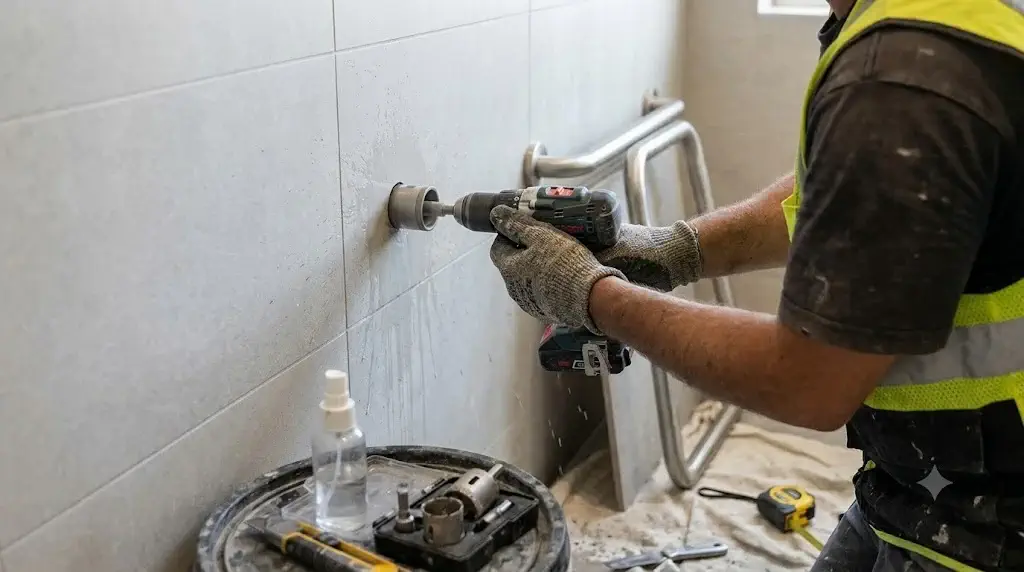
Precision drilling: a 1-1/4-inch diamond-grit hole saw lubricated with water cuts through porcelain tile to receive a WingIts anchor.
Comparative Structural Field Tests Differentiate Practical Fastener Trade-offs
Selecting the correct fastener depends on whether the project is a full down-to-the-studs bathroom renovation or a retrofit onto existing finished tile walls:
- Delivers maximum ultimate tensile pull-out strength (>500 lbs).
- Requires small 3/16″ pilot holes with minimal tile fracture risk.
- Extremely cost-effective ($3 to $6 in stainless wood screws).
- Zero hollow wall cavity flex or vibration during heavy transfer loads.
- Limitation: Strictly constrained to vertical framing stud locations.
- Exceeds ADA §609.8 requirements (300 to 600 lbs shear capacity).
- Allows grab bars to be mounted anywhere on tile regardless of stud layout.
- Includes built-in closed-cell waterproof seals to stop wall cavity moisture.
- Eliminates costly wall demolition and wood blocking installation.
- Limitation: Demands 1-1/4″ diamond core drilling and hollow wall integrity.
Frequently Asked Questions About ADA Grab Bar Fasteners
Are WingIts hollow wall anchors legally ADA compliant for grab bar installation?
The ADA grab bar fastener guide WingIts vs wood studs confirms that WingIts Master Grab Bar Fasteners (RC-SSB-W35) are fully certified to exceed ADA §609.8 and ASTM F446 standards. When installed in sound 1/2-inch or 5/8-inch ceramic tile assemblies, WingIts deliver 300 to 600 pounds of shear force resistance, comfortably surpassing the 250-pound regulatory threshold.
What size hole is required to install a WingIts grab bar anchor through ceramic tile?
WingIts fasteners require a precise 1-1/4-inch (32mm) diameter hole drilled through the ceramic tile, thinset mortar bed, and cement backerboard. Installers must use a water-cooled diamond hole saw bit without hammer drill mode to prevent micro-fracturing the surrounding tile.
What screw specifications are required when mounting grab bars directly into wood studs?
Direct stud installations require minimum #10 or #12 gauge, 2.5-inch to 3.0-inch 304 or 316 stainless steel pan-head screws. Screws must achieve at least 1.5 inches of continuous thread embedment into the center of the solid structural wood stud after clearing the tile and backerboard layers.
Can WingIts anchors be used in hollow fiberglass or acrylic shower inserts?
Standard drywall/tile WingIts must not be used on unsupported fiberglass or acrylic shower units due to shell flexing. WingIts manufactures a specialized fiberglass fastener (RC-MAW35) equipped with broader silicone dampening pads designed specifically to prevent gelcoat cracking under shock loads.
