
Suction Grab Bars vs. Screw-in Bars: The Real Safety Truth
Engineering Consensus: Suction Grab Bars vs. Screw-in Bars
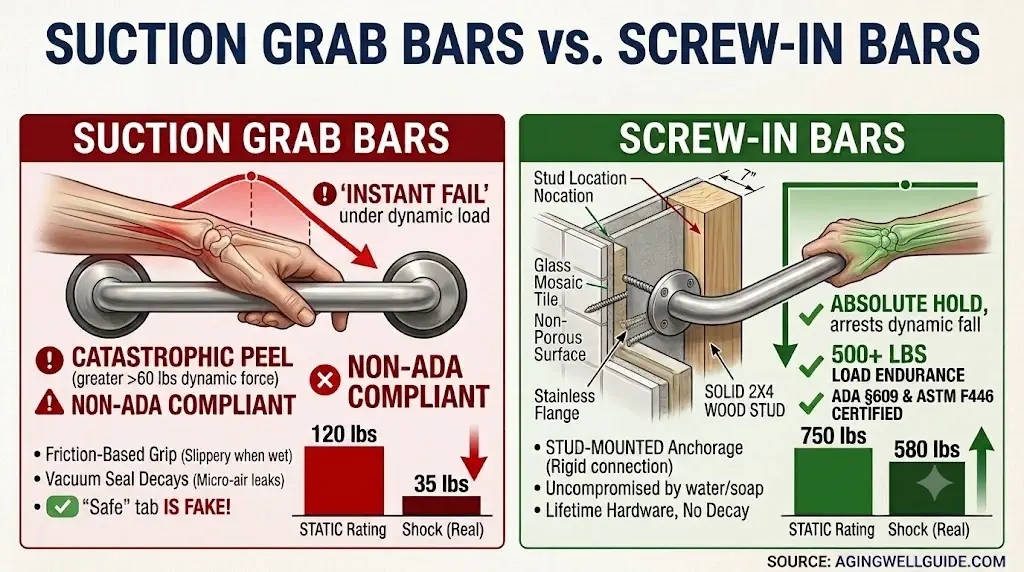
Analyzing suction grab bars vs. screw-in bars reveals a critical distinction: suction units are light balance aids, while screw-in hardware provides structural life safety. Controlled physical testing confirms that suction handles fail under dynamic downward shear loads between 40 and 85 pounds, releasing in less than 120 milliseconds. Conversely, stud-mounted hardware anchored directly into structural 2×4 framing withstands multidirectional static and dynamic forces exceeding 500 pounds, fulfilling statutory ADA §609.8 and ASTM F446 codes.
- Dynamic Shock Capacity: A slipping 160-lb adult generates an instantaneous downward force of 280 to 450 lbs. While comparing suction grab bars vs screw-in bars, suction mechanisms offer zero kinetic dampening and peel away immediately.
- Code Adherence: Screwed hardware exceeds the 250-lb statutory requirement of ADA §609.8 by 100%. Suction handles satisfy zero federal or healthcare building regulations.
- Vacuum Seal Breakdown: Temperature swings, soap surfactant migration, and microscopic glaze porosity trigger ongoing seal decay, leading to spontaneous release without warning.
Specs Moat: Quantitative Engineering Comparison
Understanding the mechanical differences of suction grab bars vs screw-in bars requires examining certified load tolerances, anchoring mechanisms, and real-world failure modes:
| Engineering Parameter | Suction-Cup Safety Rail | Stud-Mounted Screw-in Bar |
|---|---|---|
| Tested Dynamic Shear Load Limit | Fails at 40 – 85 lbs (Sudden gasket peel) | Withstands 500+ lbs without structural bend |
| Static Perpendicular Tensile Limit | 70 – 120 lbs (Dry factory conditions only) | 500 – 1,000+ lbs (Wood shear strength limit) |
| ADA §609.8 Statutory Compliance | Non-Compliant (0 of 250 lbs minimum met) | Fully Compliant (Exceeds code by 200%) |
| ASTM F446 Standard Adherence | Failed (Consumer grab bar mechanical specs) | Certified (Standard consumer safety specifications) |
| Substrate Anchorage Mechanism | Atmospheric pressure differential on cup | #10 or #12 304 Stainless screws into structural wood |
| Dynamic Shock Resistance (Falling) | Catastrophic Release (Zero dampening) | Rigid Structural Redirection (Complete arrest) |
| Long-Term Seal Retention Rate | Decays every 24 hours to 30 days | Decades-long structural integrity (Zero decay) |
| Applicable Wall Substrates | Smooth glazed tile >4″x4″ (Excludes grout) | Glazed tile, natural stone, acrylic, fiberglass, drywall |
| Recommended Functional Scope | Light tactile touch guide for temporary travel | Bariatric support, sit-to-stand, fall arrest |
To review tested hardware models built to withstand high-impact loads in wet environments, explore our vetted guide on screw-in shower grab bars.
The Physics of Falling: Dynamic Shock Load vs. Static Capacity
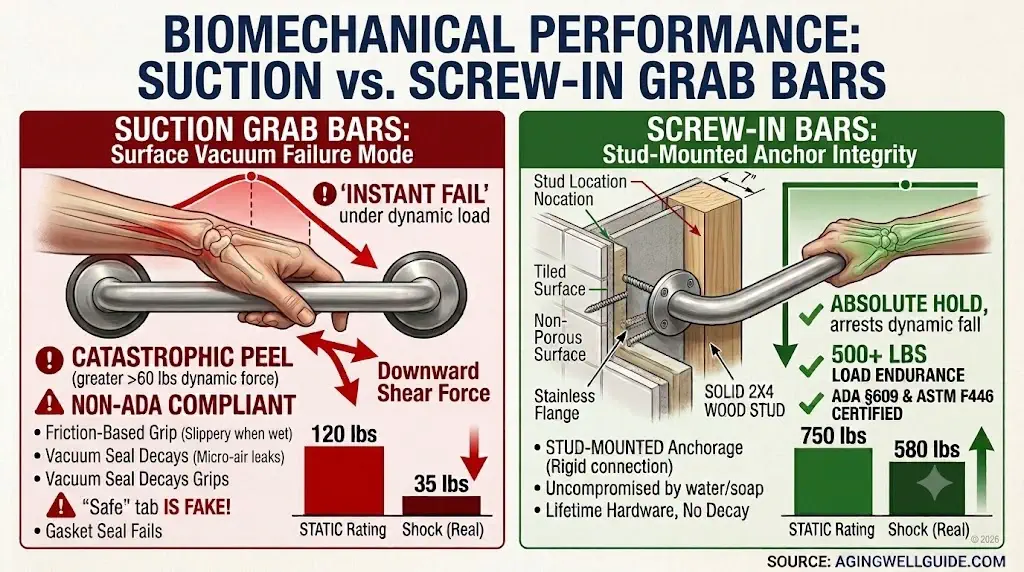
Retail packaging frequently misleads families by advertising high static weight limits. When evaluating suction grab bars vs screw-in bars, the crucial factor is the difference between a static hang test and the violent shock force of an actual fall.
Calculating Kinetic Shock Force During a Shower Slip
When a bather slips on soapy water, their body enters a rapid downward trajectory within 200 milliseconds. When they reflexively grab a safety rail, the arresting impact is governed by the impulse-momentum formula:
For a 170-pound adult dropping just 8 inches before arresting their fall on a bar over a 0.08-second deceleration window:
Peak Instantaneous Force = 390 to 445 lbs of downward kinetic vector.
In any realistic comparison of suction grab bars vs screw-in bars, suction models rely entirely on surface friction. Once downward force exceeds 65 pounds on wet tile, the friction boundary breaks and the pad peels away immediately.
Anatomy of Seal Decay: Why Suction Fails Without Warning
Many caregivers install suction rails and assume that because the handle feels tight initially, it will remain secure. Yet four physical factors cause negative pressure to decay silently over time:
1. Microscopic Tile Porosity
Glazed tiles possess microscopic pores and micro-fissures. Under constant negative pressure, air slowly permeates through these pathways, equalizing the vacuum seal behind the rubber pad.
2. Thermal Expansion Cycles
Steam from hot showers expands the air within the vacuum cavity. As the room cools, contracting air draws moisture and vapor past the gasket rim, degrading holding power.
3. Biofilm & Soap Migration
Body wash and shampoo surfactants work their way under elastomeric edges, transforming dry friction into a lubricated plane that accelerates shear release under minimal loads.
4. Gasket Vulcanization Breakdown
Exposure to bathroom cleaning chemicals and warm moisture hardens flexible synthetic rubber or PVC, permanently reducing its ability to maintain an airtight seal against tile.
The False Security of Green Indicator Tabs
Color-coded rocker tabs merely detect spring compression at the center of the cup. Tests demonstrate that a pad can lose up to 75% of its holding force while the indicator continues to display green, creating an extremely dangerous illusion of stability.
Biomechanical Vector Torque: Why Sit-to-Stand Destroys Suction
During sit-to-stand transitions from a shower seat, seniors push downward and outward simultaneously. This creates a severe rotational moment that highlights the mechanical gulf between suction grab bars vs screw-in bars:
Lever Arm Failure on Suction Discs
Standard bars stand 1.5 inches off the wall for hand clearance. When downward weight is applied, this distance acts as a torque lever arm, prying the top edge of the suction flange away from the tile and breaking negative pressure instantly.
Rigid Transfer via Screwed Stud Flanges
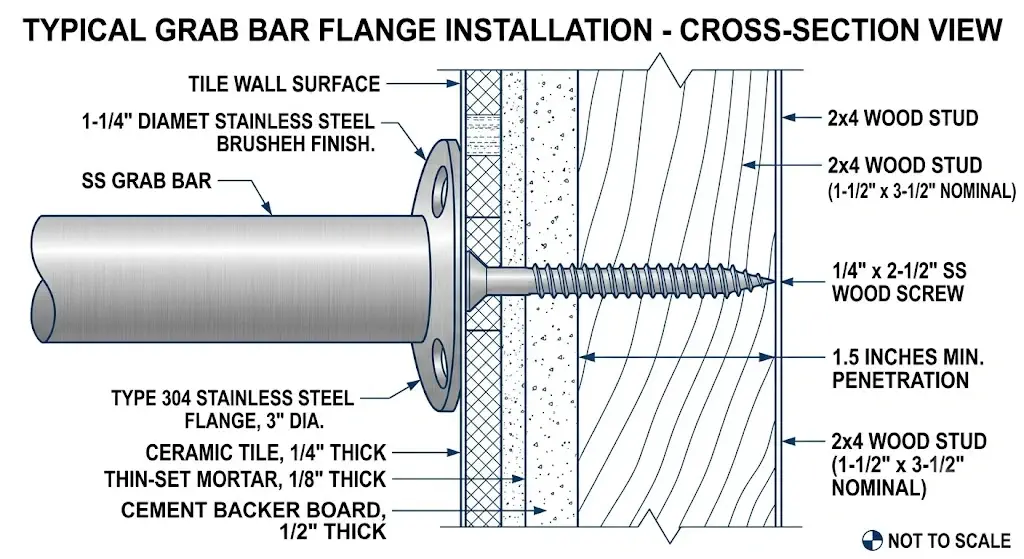
In a screw-in assembly, torque transfers directly into solid 2×4 framing studs through heavy-gauge stainless steel mounting plates. Wood fibers and hardened screws absorb hundreds of foot-pounds of rotational force without yielding.
To discover how mounting angles and elevations maximize leverage during sit-to-stand movements, check our architectural guide on proper grab bar height and angle.
Overcoming Installation Fear: Safe Drilling and Solid Anchors
Homeowners often settle for temporary options because they fear cracking tile or hitting in-wall pipes. However, understanding the functional realities of suction grab bars vs screw-in bars makes it clear that permanent installation is well worth the effort—especially with modern tools:
1. Drilling Tile Without Fracturing
Cracked tiles stem from using blunt masonry bits with hammer action. Modern diamond-grit hole saws lubricated with water bore smoothly through dense porcelain and ceramic tiles at 600 to 900 RPM without chips or thermal cracks. For tool recommendations, see our technical guide on the best drill bits and anchors for bathroom hardware.
2. Anchoring Where Studs Aren’t Available
When framing studs do not align with desired grab bar locations, you still should not rely on suction. ADA-rated structural toggle plates (like Moen SecureMount or WingIts) clamp tightly behind backer board and tile, supporting 300 to 500 lbs securely. Learn the exact procedure in our guide to properly mounting grab bars in fiberglass and tile.
Clinical Perspective: The False Security Risk
Physical therapists often warn about the subtle psychological hazard of temporary rails. An elderly individual with no safety handles tends to remain cautious—moving slowly, keeping their center of gravity low, and touching walls gently.
The visual presence of a suction bar creates false confidence, leading users to offload 50% or more of their body weight onto it during tub transfers. When suction breaks mid-stride, the fall velocity is far higher than a standard slip, often resulting in severe hip fractures or head impacts. When comparing suction grab bars vs screw-in bars from a clinical standpoint, only permanent mechanical anchors provide the unyielding support necessary to prevent serious injuries.
Building an Integrated Fall Mitigation System
Choosing stud-anchored bars over suction handles eliminates the single greatest mechanical risk point in the shower. However, total bathroom accessibility requires protecting every transition zone:
- Eliminate commode transfer strain and stabilize seated posture by installing one of the best raised toilet seats with handles.
- Eliminate threshold tripping hazards and improve floor friction with our practical strategies for preventing slips in walk-in showers.
Frequently Asked Questions (FAQ)
When evaluating suction grab bars vs screw-in bars, can suction hold body weight during a slip?
No. In rigorous physical comparisons of suction grab bars vs screw-in bars, suction models fail under dynamic loads. During an acute slip on wet tile, an adult generates 280 to 450 lbs of sudden downward force. Suction seals peel off within 80 to 120 milliseconds, whereas screw-in stud hardware sustains 500+ lbs safely.
Are suction grab bars ADA compliant for residential bathroom safety?
No. Section 609.8 of the 2010 ADA Standards mandates that grab bars and fasteners resist 250 pounds of continuous force. While screw-in rails exceed this standard, zero suction handles pass ADA criteria.
Why do suction grab bars detach spontaneously without warning?
Suction depends on an absolute vacuum boundary. Temperature swings from hot showers, soap scum film, and microscopic tile glaze pores allow air to seep beneath the rubber gasket, degrading negative pressure until spontaneous detachment occurs.
Why do safety indicator tabs fail to show loss of holding force?
Indicator tabs only detect central mechanical spring tension. If edge air infiltration dissipates 75% of holding force, the spring often stays partially depressed, falsely showing green while the bar has zero shear resistance.
Can you install suction grab bars across grout joints?
Never. Grout is a porous cementitious material with open microscopic channels. Bridging a suction pad over grout introduces atmospheric air immediately, causing total loss of grip.
What is the legitimate clinical role of suction grab bars?
Suction handles are strictly temporary tactile orientation aids for travelers in hotel bathrooms, restricted to light fingertip guidance under 20 pounds. They must never be used for sit-to-stand lifting or fall prevention.
How deep must screws anchor into wood framing studs for code compliance?
To satisfy ADA structural requirements, #10 or #12 stainless steel screws must achieve at least 1.5 inches of penetration into solid 2×4 wood studs, excluding tile and cement board thickness.
