

For adults over 50, the most practical strategy is to make one higher-fiber substitution at a time and gradually build a routine that fits normal breakfasts, lunches, dinners, and snacks.
How Can You Get More Fiber From Everyday Foods?
Start with these simple substitutions:
| Instead of… | Try… |
|---|---|
| Fruit juice | Whole fruit |
| White bread | Whole-grain bread |
| White rice | Brown rice or another whole grain |
| Refined crackers | Whole-grain crackers |
| Vegetable-free soup | Vegetable, bean, or lentil soup |
| Plain salad | Salad with beans, vegetables, nuts, or seeds |
| Low-fiber breakfast cereal | Oatmeal or another whole-grain cereal |
The key is consistency. One change repeated every day is more useful than an ambitious fiber plan that is difficult to maintain.
Editorial Notice: AgingWellGuide provides evidence-aligned health and nutrition information. Our guides are grounded in clinical guidelines from the National Institute on Aging (NIA) and USDA. This content is for educational purposes and does not replace individualized medical advice.
What Foods Provide Fiber?
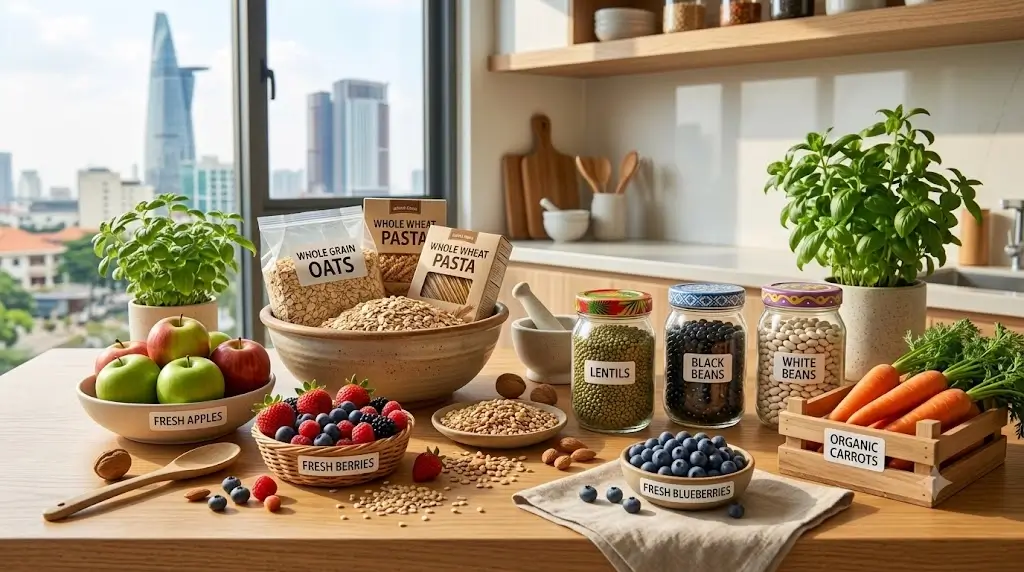
The main everyday sources are:
- Fruits: apples, pears, berries, oranges, bananas, peaches, and other whole fruits.
- Vegetables: broccoli, carrots, spinach, peas, squash, potatoes with skin, and many others.
- Legumes: beans, lentils, chickpeas, and peas.
- Whole grains: oats, brown rice, quinoa, barley, whole-grain bread, and whole-wheat pasta.
- Nuts and seeds: almonds, walnuts, peanuts, chia, flax, and other seeds.
NIA identifies vegetables, fruits, legumes, whole grains, nuts, and seeds as important sources of fiber. Forgetting to prioritize these whole plants is one of the most common healthy eating mistakes after 50.
How Can You Add Fiber Without Changing Your Entire Diet?
Look at foods you already eat and identify the easiest lower-fiber item to replace.
For example:
- Keep your usual sandwich but change the bread.
- Keep your usual breakfast but add fruit.
- Keep your usual rice bowl but replace some white rice with brown rice.
- Keep your usual soup but add beans or lentils.
- Keep your usual yogurt but add berries, oats, nuts, or seeds.
This approach is often easier than searching for completely new recipes.
How Can You Add More Fiber at Breakfast?
Breakfast offers several easy opportunities to set a high-fiber foundation for the day. For more complete morning meal formulas, explore our collection of healthy breakfast ideas for older adults.
Choose oatmeal
Oatmeal provides whole-grain fiber and can be combined with fruit, nuts, or seeds.
Add whole fruit
Add berries, apples, pears, bananas, or another fruit to yogurt, cereal, oatmeal, or toast.
Choose whole-grain toast
Replace refined bread with a whole-grain option when practical.
Add nuts or seeds
Sprinkle nuts or seeds over oatmeal, yogurt, or whole-grain cereal.
Choose a higher-fiber cereal
Compare Nutrition Facts labels rather than relying only on terms such as “multigrain” or “whole grain” on the front of the package.
NIA notes that at least half of the grains eaten should be whole grains and that whole grains provide fiber.
How Can You Add More Fiber to Lunch?

Lunch can become higher in fiber with a few simple additions.
| Lunch | Easy fiber upgrade |
|---|---|
| Chicken sandwich | Whole-grain bread + lettuce + tomato |
| Tuna sandwich | Whole-grain bread + vegetables |
| Vegetable soup | Add beans or lentils |
| Salad | Add chickpeas, beans, nuts, or seeds |
| Crackers and cheese | Use whole-grain crackers + fruit |
Another simple strategy is to add a whole fruit to lunch instead of finishing the meal with juice or a low-fiber sweet snack.
How Can You Add More Fiber to Dinner?
Dinner is an easy place to combine several fiber sources.
Try:
- Beans in tacos or chili
- Lentils in soup or stew
- Brown rice with vegetables
- Whole-wheat pasta with vegetables
- Roasted vegetables with a protein food
- Chickpeas in a grain bowl
- Potatoes with the skin when appropriate
A simple dinner formula is:
Protein + vegetables + whole grain or legumes.
This naturally creates opportunities to include fiber without treating fiber as a separate nutritional task.
Are Beans and Lentils an Easy Way to Get More Fiber?
Yes. Beans and lentils are among the most practical fiber-rich foods because they can be added to familiar meals and also provide valuable plant protein. To understand how legumes double as everyday muscle-sparing foods, see our complete guide on how to get more protein from everyday foods.
Try:
- Black beans in tacos
- Chickpeas in salads
- Lentils in soup
- Kidney beans in chili
- Beans in grain bowls
- Split peas in soup
Canned beans can be useful when cooking dried beans is inconvenient. Compare sodium on the label and rinse canned beans when appropriate.
How Can You Add Fiber to Snacks?
Snacks can provide fiber without requiring much preparation.
- Apple + peanut butter
- Pear + unsalted nuts
- Berries + plain yogurt
- Carrots + hummus
- Whole-grain crackers + cheese
- Banana + nuts
- Whole-grain toast + avocado
- Oatmeal + berries
The most useful snack is often one that combines fiber with another nutrient-rich food rather than relying on a highly processed “fiber” snack product.
Is Whole Fruit Better Than Fruit Juice for Fiber?
For fiber, whole fruit is generally the better choice.
Juicing removes much of the structure of the original fruit, while whole fruit retains its natural fiber. NIA specifically recommends whole fruit and notes that eating fruit with the skin can provide additional fiber when the skin is edible and properly washed.
Easy choices include:
- Apples
- Pears
- Berries
- Oranges
- Peaches
- Plums
- Bananas
Should You Eat Fruit and Vegetables With the Skin?
When the skin is edible, leaving it on can provide additional fiber.
Examples include:
- Apples
- Pears
- Potatoes
- Sweet potatoes
Wash produce thoroughly before eating it with the skin. Not every fruit or vegetable needs to be eaten with its skin, and texture or personal preference can reasonably determine how it is prepared.
Dysphagia Texture Guidance: Adults with swallowing or chewing difficulties should peel fruits and cook vegetables until completely tender. Follow the specific texture recommendations (such as pureed or soft-and-bite-sized) prescribed by your speech-language pathologist to prevent choking.
How Can You Add Fiber From Whole Grains?
Whole grains are an easy substitution because they can often replace refined grains without changing the basic meal.
| Refined grain | Whole-grain alternative |
|---|---|
| White bread | Whole-grain bread |
| White rice | Brown rice |
| Regular pasta | Whole-wheat pasta |
| Low-fiber cereal | Whole-grain or higher-fiber cereal |
| Refined crackers | Whole-grain crackers |
MedlinePlus recommends choosing whole-grain products over refined grains when increasing fiber.
How Can You Add Fiber to Foods You Already Cook?
You can often increase fiber without changing the main recipe.
| Food you already make | Fiber addition |
|---|---|
| Oatmeal | Berries, nuts, seeds |
| Soup | Beans, lentils, vegetables |
| Pasta | Vegetables, beans, lentils |
| Rice bowl | Brown rice, vegetables, beans |
| Yogurt | Fruit, oats, nuts, seeds |
| Salad | Chickpeas, beans, nuts, seeds |
| Sandwich | Whole-grain bread + vegetables |
This “add to what you already eat” approach is often more sustainable than relying on unfamiliar recipes.
How Can You Increase Fiber When Cooking for One?
Fiber-rich foods can be particularly useful for cooking for one because many require little preparation.
Keep a small selection available:
- Apples or pears
- Frozen berries
- Baby carrots
- Canned beans
- Oatmeal
- Whole-grain bread
- Brown rice
- Nuts and seeds
Frozen vegetables and fruits can also reduce waste when fresh produce is difficult to use before it spoils. For a broader system for planning portions, shopping, and leftovers for one person, see Healthy Meal Planning for One Person.
How Can You Increase Fiber With Limited Cooking Energy?
You do not need to cook every fiber-rich food from scratch.
| Preparation challenge | Lower-effort option |
|---|---|
| Chopping vegetables | Pre-cut vegetables or ready-to-eat produce |
| Cooking dried beans | Canned beans |
| Preparing grains | Pre-cooked brown rice or whole grains |
| Washing produce | Prepared produce when appropriate |
| Long cooking time | Oatmeal, fruit, hummus, beans, or simple grain bowls |
NIA recommends pre-cut fruits and vegetables when slicing and chopping are difficult and encourages planning meals around practical preparation barriers.
How Can You Increase Fiber Without Adding a Lot More Food?
Substitution is usually easier than simply adding more food to every meal.
- Replace juice with whole fruit.
- Replace white bread with whole-grain bread.
- Replace white rice with brown rice.
- Replace refined crackers with whole-grain crackers.
- Add beans to part of a meat-based meal.
- Add vegetables to soups and sauces.
- Add berries to yogurt.
This can improve the overall fiber profile without requiring dramatically larger meals.
How Much Fiber Should You Get Each Day?
Fiber needs vary by individual. A commonly used guideline is 14 grams of fiber per 1,000 calories, although an individual’s appropriate intake depends on overall energy needs and dietary requirements.
Rather than trying to calculate every gram, focus on eating a variety of naturally fiber-rich foods throughout the day.
NIA notes that many older adults do not get recommended amounts of dietary fiber and recommends looking at the overall Nutrition Facts label rather than focusing on a single nutrient in isolation.
Should You Increase Fiber Gradually?
Yes. If your current diet is low in fiber, suddenly adding large amounts can cause gas, bloating, or abdominal discomfort.
MedlinePlus recommends increasing fiber gradually rather than making a large change all at once.
A practical progression is:
- Add one fruit each day.
- Add vegetables to one additional meal.
- Replace one refined grain with a whole grain.
- Add beans or lentils to a meal several times per week.
- Increase variety as these foods become routine.
Why Do You Need Fluids When Increasing Fiber?
Adequate fluids are important when increasing dietary fiber. Fiber absorbs water in the digestive system, and insufficient fluid intake can make constipation worse for some people.
MedlinePlus specifically recommends getting enough fluids when increasing fiber. For actionable daily hydration habits, see our companion guide on easy ways to drink more water after 50.
Clinical Hydration & Renal Notice: While fluid is critical when raising fiber, individuals with congestive heart failure (CHF) or end-stage renal disease must adhere strictly to their physician-prescribed daily fluid restrictions rather than forcing liquids.
What If More Fiber Causes Gas or Bloating?
The most common practical response is to slow down the increase.
Large sudden increases in fiber can cause:
- Gas
- Bloating
- Abdominal discomfort
- Changes in bowel habits
Reduce the pace of increase, allow your digestive system to adapt, and then gradually continue if appropriate.
Persistent or severe digestive symptoms should not simply be attributed to “not enough fiber.” They may require medical evaluation.
Should You Use Fiber-Fortified Foods or Supplements?
Not necessarily. Whole foods are generally the preferred starting point.
Fruits, vegetables, legumes, whole grains, nuts, and seeds provide fiber along with other nutrients. MedlinePlus notes that people with a balanced diet may not need a fiber supplement and that rapidly increasing fiber through supplements or fortified products can worsen gas or bloating for some people.
Supplements may have specific uses, but whether one is appropriate depends on the individual and the reason for using it.
What Is the Difference Between Soluble and Insoluble Fiber?
Fiber is commonly described as soluble or insoluble.
| Type | Common food sources | General characteristic |
|---|---|---|
| Soluble fiber | Oats, barley, beans, lentils, peas, some fruits and vegetables | Absorbs water and forms a gel-like material during digestion |
| Insoluble fiber | Whole grains, vegetables, wheat bran | Adds bulk and tends to help move material through the digestive tract |
Many whole foods contain both types. You do not need to calculate a specific ratio to improve your everyday fiber intake.
How Can You Tell Whether a Packaged Food Is High in Fiber?
Use the Nutrition Facts label.
When comparing similar products, look at:
- Fiber per serving
- Serving size
- Added sugars
- Sodium
- Saturated fat
- Ingredient list
As a general label-reading rule, the FDA’s Daily Value framework considers 20% DV or more per serving to be high in a nutrient, while 5% DV or less is low. NIA cautions that the %DV is not specifically calculated around the unique needs of older adults, so the whole label and overall eating pattern matter.
What Are Easy High-Fiber Foods to Keep at Home?
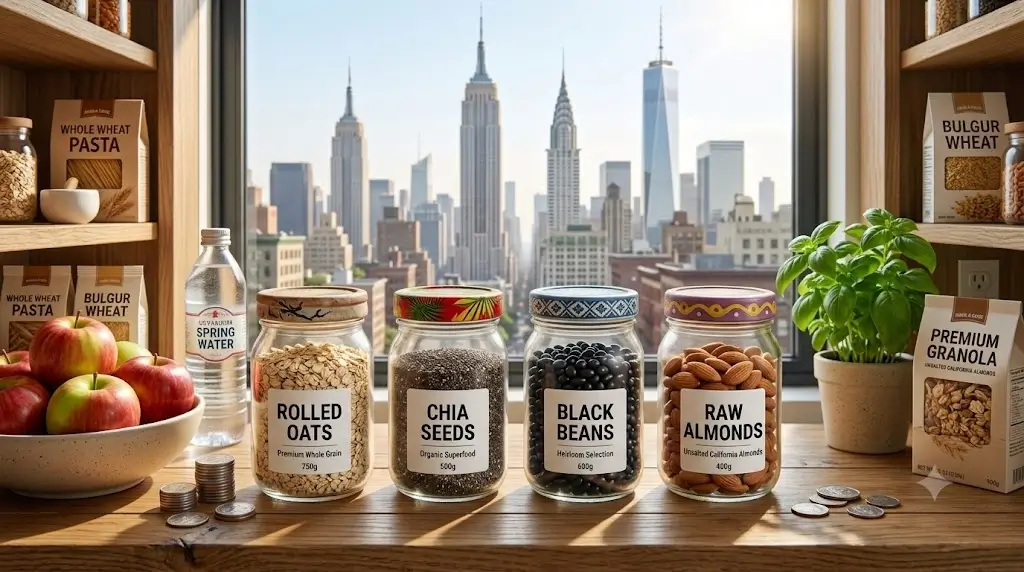
A practical pantry and refrigerator can make fiber easier to eat consistently.
Pantry
- Oatmeal
- Brown rice
- Whole-grain pasta
- Canned beans
- Lentils
- Whole-grain crackers
- Nuts and seeds
- Peanut butter
Refrigerator
- Apples
- Pears
- Berries
- Carrots
- Broccoli
- Leafy greens
- Hummus
Freezer
- Frozen berries
- Frozen broccoli
- Frozen peas
- Frozen mixed vegetables
The best inventory is the one that matches what you actually eat. Buying fiber-rich foods that routinely spoil does not improve the eating pattern.
How Can You Add Fiber to a Typical Day?
| Meal | Simple fiber upgrade |
|---|---|
| Breakfast | Oatmeal + berries + nuts |
| Lunch | Whole-grain sandwich + vegetables + whole fruit |
| Snack | Apple + peanut butter |
| Dinner | Chicken + brown rice + broccoli + beans |
This is an example of meal structure, not a prescribed diet or a specific fiber target.
How Can Fiber Fit Into a Healthy Eating Pattern After 50?
Fiber is one component of a healthy eating pattern. Increasing fiber should not mean ignoring protein, vegetables, fruits, healthy fats, whole foods, hydration, or individual dietary requirements.
A useful daily pattern is:
More plants + more whole grains + more legumes + fewer unnecessary refined-grain substitutions.
The goal is not to make every food “high fiber.” It is to make naturally fiber-rich foods a normal part of the meals you already eat.
What Are the Biggest Mistakes When Trying to Eat More Fiber?
- Increasing too quickly: sudden changes can cause gas and bloating.
- Adding fiber without enough fluids: this can make constipation worse for some people.
- Relying on one food: variety provides a broader range of nutrients.
- Assuming a “high-fiber” label means healthy overall: check the entire Nutrition Facts label.
- Ignoring preparation barriers: choose convenient forms of fiber-rich foods when needed.
- Making every meal much larger: substitutions can be easier than simply adding food.
- Assuming more is always better: individual needs and tolerance vary.
What Are Seven Easy Fiber Upgrades to Start Today?
- Eat whole fruit instead of juice.
- Use whole-grain bread for one meal.
- Add vegetables to lunch.
- Add beans or lentils to dinner.
- Choose oatmeal or another whole-grain breakfast.
- Keep nuts or seeds available for snacks.
- Use frozen or pre-cut produce when preparation is difficult.
Once these changes become routine, add another rather than trying to change everything at once.
Fiber Upgrade Checklist
- ☐ Eat whole fruit regularly.
- ☐ Include vegetables at meals.
- ☐ Eat beans or lentils regularly.
- ☐ Choose whole grains more often.
- ☐ Include nuts or seeds when appropriate.
- ☐ Replace juice with whole fruit.
- ☐ Read Nutrition Facts labels.
- ☐ Increase fiber gradually.
- ☐ Maintain adequate fluid intake.
- ☐ Use convenient forms such as frozen or pre-cut produce when needed.
- ☐ Vary your fiber sources.
Frequently Asked Questions
What is the easiest way to get more fiber from everyday foods?
Start with simple substitutions: whole fruit instead of juice, whole-grain bread instead of refined bread, brown rice instead of white rice, and beans or vegetables added to meals you already eat.
What foods are naturally high in fiber?
Fruits, vegetables, beans, lentils, peas, whole grains, nuts, and seeds are important natural sources of dietary fiber.
Is whole fruit better than fruit juice for fiber?
Yes, whole fruit generally provides more fiber because the fruit’s natural structure is retained. NIA recommends whole fruit and notes that edible fruit skins can provide additional fiber.
Are beans a good source of fiber?
Yes. Beans, lentils, chickpeas, and peas are practical fiber sources that can be added to soups, salads, tacos, bowls, and other meals.
Are whole grains a good source of fiber?
Yes. Oatmeal, brown rice, barley, whole-grain bread, and whole-wheat pasta are examples of whole-grain foods that provide fiber.
Should you increase fiber slowly?
Yes. Increasing fiber gradually can reduce gas, bloating, and abdominal discomfort. MedlinePlus recommends adding fiber slowly rather than making a large increase at once.
Do you need more water when increasing fiber?
Adequate fluids are important when increasing fiber. Insufficient fluids may make constipation worse for some people. Anyone with a prescribed fluid restriction should follow their healthcare professional’s instructions.
What if more fiber causes gas?
Slow the rate of increase and give your digestive system time to adjust. Large increases in fiber over a short period can cause gas and bloating.
Do you need fiber supplements?
Not necessarily. Whole foods are generally the preferred starting point because they provide fiber alongside other nutrients. Supplements can have specific uses, but their appropriateness depends on the individual.
How can you get more fiber when cooking is difficult?
Use frozen or pre-cut vegetables, ready-to-eat fruit, canned beans, oatmeal, whole-grain bread, nuts, seeds, and other foods requiring little preparation. NIA specifically recommends pre-cut produce when chopping is challenging.
How can you get more fiber when cooking for one?
Keep foods such as fruit, oatmeal, canned beans, frozen vegetables, whole-grain bread, nuts, and seeds available. Choose ingredients that can be used across several meals to reduce waste.
How much fiber should an adult get each day?
Fiber needs vary by individual. A commonly used guideline is 14 grams per 1,000 calories. The appropriate intake depends on total energy needs and the person’s overall dietary requirements.
Can you get too much fiber?
Very rapid or excessive increases can cause gas, bloating, cramps, and changes in bowel habits. The goal is an appropriate amount from a varied diet rather than simply maximizing fiber intake.
The Bottom Line
Getting more fiber from everyday foods is mostly about making better substitutions.
Choose whole fruit instead of juice, whole grains instead of refined grains, add beans and lentils to familiar meals, include vegetables more often, and use nuts or seeds as convenient additions.
Increase fiber gradually and maintain adequate fluid intake. If preparation is difficult, use frozen, canned, pre-cut, or ready-to-eat foods that make the higher-fiber choice easier.
The most sustainable strategy is simple:
Keep the meal you already like → upgrade one ingredient → repeat → add another upgrade when the first becomes routine.
Editorial Methodology
This guide uses an evidence-first approach based primarily on National Institute on Aging and MedlinePlus nutrition guidance. It focuses on practical food-based strategies rather than assuming fiber supplements are necessary. Fiber recommendations are presented as general educational information, not individualized medical advice.
Sources
- National Institute on Aging (NIA) — Healthy Eating As You Age: Know Your Food Groups
- National Institute on Aging (NIA) — Healthy Meal Planning: Tips for Older Adults
- National Institute on Aging (NIA) — How To Read Food and Beverage Labels
- National Institute on Aging (NIA) — Healthy Eating, Nutrition, and Diet
- MedlinePlus — High-Fiber Foods
- MedlinePlus — Fiber
Editorial standard: AgingWellGuide independently develops healthy eating resources tailored specifically to adults aged 50 and older. We prioritize whole-food nutrition, effortless kitchen workflows, and clinical safety considerations.
